If we’re a dog owner, we’ve been there. we hear that unmistakable sound from the other room—the retching, the heaving—and your heart sinks. You rush
Table of Contents
If we’re a dog owner, we’ve been there. we hear that unmistakable sound from the other room—the retching, the heaving—and your heart sinks. You rush over, clean up the mess, and then spend the next hour worrying.
Is this serious? Should I call the vet? What caused it?
You’re not alone in wondering. Vomiting and diarrhea are two of the leading reasons why people take their dogs to the vet. But here’s the thing most guides won’t tell you: a single episode of vomiting is often nothing to worry about. In fact, 89% of cases resolve within two days. But that other 11%? That’s where knowing what to look for can literally save your dog’s life.
Let me walk you through everything you need to know—including some recent research discoveries that most pet websites haven’t covered yet.
Part 1: First, Understand What Vomiting Actually Is
Before we dive into colors and causes, let’s get one thing straight.
Vomiting is an active process. Your dog will heave, retch, and show signs of nausea beforehand—drooling, lip-licking, pacing, or whining. The stomach actively contracts to expel its contents.
Regurgitation is passive. Food comes back up shortly after eating, usually without any effort or nausea. It often looks like undigested food in a tube shape. This can be a sign of esophageal problems, not stomach issues.
The distinction matters because the causes and treatments are completely different.
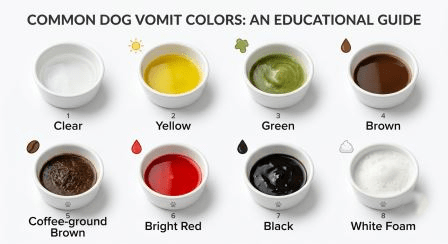
Part 2: The Visual Guide—What Different Vomit Colors Mean
Here’s a quick reference guide to help you decode what your dog’s vomit is telling you.
Color
What It Likely Means
What to Do
Clear / Liquid
Excess saliva, drank water too fast, or empty stomach
Usually not serious. Monitor for other symptoms.
Yellow or Green
Bile from an empty stomach (most common in the morning)
Try giving a small meal. If it happens more than twice or they seem unwell, call your vet.
Green with Grass
Ate grass or plant matter
Some plants are toxic—note what they ate. Monitor closely.
Brown (chunky)
Partially digested food
Usually normal. Watch for other symptoms.
Brown (like coffee grounds)
Partially digested blood—possible stomach ulcer, internal trauma, or intestinal blockage
Call your vet immediately.
Bright Red / Bloody
Fresh blood—could be poison, swallowed a foreign object, gastrointestinal disease, or stomach inflammation
Emergency. Contact your vet immediately. If possible, save a sample in a ziplock bag to show them.
Black / Dark Red
Digested blood higher up in the digestive tract
Emergency. Call your vet immediately.
Foamy / White
Mild stomach upset, acid reflux, indigestion, or potentially pancreatitis, bloat, or kidney problems
If it happens once, monitor. If repeated or with other symptoms, call your vet.
Mucous / Slimy
Irritation or inflammation in the stomach lining
Call your vet if it persists.
Important caveat: There isn’t a standard dog vomit color chart that works perfectly for every situation. Colors can overlap, and the same color can mean different things depending on context. But this guide gives you a solid starting point.
Part 3: The Causes—Why Do Dogs Vomit?
The Complete Guide to Dog Health Symptoms: What Your Dog Is Trying to Tell You Have you ever watched your dog do something strange and wondered, “What are you trying to tell me?”
Dogs can’t use words, but they are constantly communicating with us. Every change in behavior, every new habit, every odd movement—it’s all a message. The hard part is learning how to read it.
Most of us are pretty good at spotting the obvious stuff. Vomiting? We notice. Limping? We see it. But what about the quiet signs? The subtle shifts that happen slowly, over weeks or months? Those are the ones that often get missed. And those are exactly the ones this guide is here to help you catch.
Because here’s the truth: your dog is trying to tell you something long before they show you a “textbook” symptom. You just need to know what to look for.
Chapter 1: The “Bad Dog” That’s Actually a Sick Dog Let’s start with something a lot of people don’t think about.
Your dog has been perfectly house-trained for years. Suddenly, they’re having accidents in the living room. Your first reaction might be frustration. Maybe you think they’re being stubborn, or upset about something, or just being “bad.”
But here’s what’s really going on: potty accidents can be a sign of medical issues.
Kidney disease, tumors, infections, and spinal cord injuries can all cause incontinence. In senior dogs, hormonal changes can increase thirst, which creates more urine and triggers accidents. Even certain medications can cause bladder control problems.
What to watch for:
Straining to urinate
Changes in urine volume (suddenly peeing a lot more or a lot less)
Blood in the urine (can be a sign of UTI, bladder stones, or even cancer)
The same goes for behavioral changes like sudden aggression, increased clinginess, hiding, or restlessness. These aren’t personality flaws—they’re symptoms. A dog that’s normally friendly but suddenly snaps when touched could be in pain. A dog that hides under the bed all day could be feeling sick or anxious.
Before you label your dog “naughty,” stop and think: What are they trying to tell me?
Chapter 2: The Three “Big” Symptoms Everyone Knows (But Often Misinterpret) You already know these. But let’s dig a little deeper into what they actually mean.
Vomiting vs. Regurgitation These are not the same thing, and treating them like they are can lead you down the wrong path.
Regurgitation is passive. Food comes back up shortly after eating, usually without any heaving or nausea. It often looks like undigested food in a tube shape. This can be a sign of esophageal problems.
Vomiting is active. Your dog will heave, retch, and usually show signs of nausea beforehand (drooling, lip-licking, pacing). The contents are usually partially digested and mixed with bile.
One episode of vomiting isn’t usually an emergency, especially if your dog is acting normal afterward. But repeated vomiting, especially with other symptoms like weakness, lethargy, or loss of appetite, needs a vet visit.
Diarrhea A 2025 study found that about 44% of dogs with diarrhea had vomiting, 28% had a reduced appetite, and 24% were lethargic. About 29% of cases were classified as hemorrhagic (bloody).
Here’s the good news: most dogs recover in a few days with proper care. But if the diarrhea is bloody, persistent, or accompanied by other symptoms, don’t wait it out.
Changes in Appetite A dog that suddenly stops eating is clearly telling you something’s wrong. But what about a dog that starts eating more?
An increased appetite, especially if your dog is losing weight at the same time, can be a red flag for diabetes, Cushing’s disease, or hyperthyroidism.
The key is knowing your dog’s “normal.” If your food-obsessed Lab skips a meal, that’s a big deal. If your picky eater skips a meal, it might be less concerning.
Chapter 3: Pain—The Hidden Epidemic This is where most owners fail. Not because they don’t care, but because dogs are masters at hiding pain.
Think about it. In the wild, showing weakness makes you a target for predators. That instinct is still hardwired into your dog’s brain. They might be in significant pain and still wag their tail when you walk in the room.
A 2025 study found that dog owners often miss pain signals because they’re looking for the wrong things. When asked to identify pain signs, owners scored “change in personality”, “fluctuating mood”, and “reduced play” as higher indicators of pain than obvious physical signs.
The Subtle Pain Signals Most People Miss Pain Signal What It Looks Like Panting without reason Panting long after exercise stops, when it’s not hot Restlessness Constantly changing positions while lying down Avoiding touch Flinching, moving away when you reach to pet them Changes in sleep patterns Sleeping more—or sleeping poorly and waking up restless Vocalization Whining when getting up or lying down, grunting on stairs Licking or biting a specific area Focusing on one spot obsessively Hunched posture Standing with a rounded back, avoiding stretching out Why Tooth Pain Is So Often Missed Here’s something that blew my mind when I learned it: up to 80% of dogs have periodontal disease by age three. That’s not a typo. Eighty percent.
And yet, most owners never notice until it’s advanced. Why? Because dental pain doesn’t always present as whining or crying. Instead, your dog might:
Eat less or chew on one side of their mouth
Seem “flat” or less social
Drool more than usual
Develop bad breath that gets worse over time
Veterinarians see this all the time. A dog that’s “slowing down with age” might actually be in significant dental pain. The pain isn’t just in their mouth, either. Untreated dental disease can lead to infections that spread to the heart, liver, and kidneys.
Chapter 4: What Science Just Discovered (That Most Sites Won’t Tell You) This is where we get into the really new stuff—research from 2025 and 2026 that most pet websites haven’t covered yet.
Discovery #1: GI Disease Shows Up in Biomarkers Before Symptoms Appear Researchers at Texas A&M University discovered that certain biomarkers start to show up in dogs before they develop any symptoms of gastrointestinal disease.
This is huge. GI disease causes more than 10% of all new vet visits, and certain breeds like Soft-Coated Wheaten Terriers, German Shepherds, Yorkshire Terriers, and Staffordshire Bull Terriers are especially prone.
The signs they found:
Inflammation in the gut
“Leaky gut” (increased intestinal permeability)
Changes in gut microbial composition
What this means for you: If your dog has subtle digestive issues—occasional soft stool, gas, bloating, or unexplained lethargy—don’t brush it off. These could be early warning signs of developing GI disease. A new study is now looking at whether dietary interventions can prevent the disease from developing in at-risk dogs.
Discovery #2: Shorter Strides Could Mean Dementia This is fascinating. A 2026 study found that shorter strides in a dog’s front legs can be an early warning sign of canine cognitive dysfunction (dementia).
Researchers followed 88 senior dogs and found that as their cognitive performance worsened, the stride length of their front legs decreased. On average, a 10-point increase in a dementia scale translated into a 1.2% reduction in front leg stride length.
The really interesting part: This change happens even when you account for age and pain. It’s not just “getting old” or “arthritis”—it’s specifically linked to cognitive decline.
What this means for you: If your senior dog’s walk is getting shorter, choppier, or more shuffling, don’t just chalk it up to old age. Talk to your vet. It could be an early sign of dementia, and early intervention matters.
Other signs of canine dementia to watch for:
Disorientation (getting stuck in corners, staring into space)
Changes in sleep-wake cycles (restless at night, sleeping more during the day)
House-soiling accidents
Decreased interaction with family members
Anxiety
Discovery #3: Brachycephalic Breeds—It’s Not Just Pugs and Bulldogs We all know flat-faced breeds like Pugs, French Bulldogs, and Bulldogs struggle to breathe. But a 2026 study of 898 dogs across 14 breeds found that the problem is much wider than we thought.
The most shocking finding: Only 11% of Pekingese and 17.4% of Japanese Chins in the study were free of breathing symptoms.
Other breeds with significant breathing problems:
King Charles Spaniels (25-50% affected)
Shih Tzus (25-50% affected)
Boston Terriers (25-50% affected)
The three main factors linked to breathing problems:
Being overweight
Narrowing of the nostrils
Extreme facial flatness
What this means for you: If you have any flat-faced breed, don’t assume “noisy breathing” is normal. Wheezing, difficulty exercising, inability to cool off, and sleep apnea are all signs of Brachycephalic Obstructive Airway Syndrome (BOAS), which can be treated surgically in severe cases.
Discovery #4: The Gut-Brain Connection—Anxiety and Gut Health Are Linked Multiple 2025 studies confirmed what many vets have suspected for years: your dog’s gut health affects their behavior.
Researchers found links between gut microbiome composition and aggression and anxiety in dogs. Another study found that fearful dogs had different microbiome profiles than confident dogs.
What this means for you: If your dog has sudden behavioral changes (anxiety, aggression, fearfulness) along with digestive issues, the two could be connected. A diet that supports gut health might help both problems.
Chapter 5: The Science of What’s Normal—and What’s Not One of the hardest things about monitoring your dog’s health is knowing what’s “normal” for them.
Every dog is different. Some are energetic. Some are couch potatoes. Some eat like they’ve never seen food before. Some are picky. Some sleep 14 hours a day. Some sleep 10.
The key is knowing your individual dog’s baseline.
Veterinarians often say that the most important thing you can tell them is “what’s different from normal.” Not what’s “wrong” in a textbook sense—just what’s changed.
Things to track:
Energy level (how much activity is normal? When do they slow down?)
Eating habits (how much, how fast, any new pickiness?)
Drinking habits (how often do they drink? Are they drinking more?)
Sleeping patterns (how much sleep is normal? Are they restless?)
Stool quality (firm? soft? any blood or mucus?)
Urination (how often? any straining? any accidents?)
Behavior around family (affectionate? withdrawn? irritable?)
Changes in any of these areas—even subtle ones—are worth paying attention to.
Chapter 6: When to Call the Vet—A Practical Guide Not every symptom needs an emergency vet visit. But some absolutely do.
Go to the ER Immediately If: Difficulty breathing (fast breathing, wheezing, blue/gray gums)
Collapse or inability to stand
Bloated abdomen (hard, swollen belly—could be bloat, which is life-threatening)
Repeated vomiting (especially with weakness or lethargy)
Seizures
Blood in vomit or stool
Ingestion of toxins (grapes, raisins, chocolate, xylitol, etc.)
Call Your Vet Within 24 Hours If: Loss of appetite lasting more than a day
Vomiting or diarrhea lasting more than 24 hours
Noticeable weight loss or gain without diet change
Changes in drinking or urination patterns
Persistent coughing or sneezing
Limping lasting more than a day
Any lump or bump that’s growing, changing, or bothering your dog
Monitor Closely (But Don’t Panic) If: One episode of vomiting with normal behavior afterward
Soft stool without other symptoms
Mild lethargy that resolves within a day
Minor limping that improves with rest
Chapter 7: How Technology Is Changing the Game We live in an age where we can track our own steps, heart rate, and sleep quality. The same technology is now available for our dogs.
Smart dog trackers can monitor your dog’s daily activity levels, sleep patterns, and even vital signs. A sudden drop in activity could be an early sign of pain or illness. Changes in sleep quality could signal something wrong.
Some devices are even exploring ways to monitor breathing rate and heart rate, giving you data you’d otherwise never have.
The key: Use the data as a tool, not a diagnosis. If your tracker shows changes, don’t panic—but do pay attention and talk to your vet.
Chapter 8: The Bottom Line—Trust Your Gut You know your dog better than anyone.
If something feels off, even if you can’t put your finger on it, trust that feeling.
You might not be able to explain why you’re worried. You might not have a “textbook” symptom to point to. But if you’ve had your dog for years and something just feels different—listen to that.
Veterinarians will tell you that some of the most important diagnoses come from owners who said, “I just knew something wasn’t right.”
What your dog is trying to tell you:
“I’m not being bad—I’m sick.”
“I’m not getting old—I’m in pain.”
“I’m not stubborn—I’m scared.”
“I’m not lazy—I’m exhausted.”
“I’m not aggressive—I hurt.”
Learn to listen. The signs are there. You just have to see them.
Disclaimer This article is for educational and informational purposes only.
Vomiting in dogs can be caused by a wide range of issues. According to veterinary sources, these can be classified into eight categories:
The majority of cases fall into the first two categories—gastrointestinal problems are the most common cause.
Part 4: What Most Sites Don’t Tell You—New 2025-2026 Research Discoveries
This is where things get interesting. Here are some recent findings that most pet websites haven’t covered yet.
Discovery 1: Cyclic Vomiting Syndrome in Dogs (First-Ever Report)
In 2025, veterinarians published the first-ever case report of Cyclic Vomiting Syndrome (CVS) in a dog.
CVS is a chronic disorder in humans characterized by recurrent episodes of severe vomiting triggered by stress and circadian rhythms. It affects about 1.9% of children but had never been documented in dogs until now.
The case: A 16-year-old Maltese was evaluated for persistent daily vomiting that didn’t respond to standard antiemetic medications. After extensive testing that ruled out gastrointestinal, metabolic, and neurological causes, veterinarians identified a pattern:
Stress-related prodromal behavior before episodes
Clusters of vomiting
Symptom-free intervals between episodes
Early-morning onset
The treatment: The dog was treated with phenobarbital, which led to rapid resolution of vomiting. At 462 days follow-up, the dog remained clinically normal without recurrence.
What this means for you: If your dog has episodic vomiting that doesn’t respond to standard treatments and follows a predictable pattern (especially triggered by stress or in the morning), this might be something to discuss with your vet. It’s a newly recognized condition in veterinary medicine.
A 2025 study identified Functional Dyspepsia (FD) as a clinically emerging disorder in dogs. This is a condition where dogs show chronic gastrointestinal symptoms but all test results come back normal.
Key findings from the study of 29 dogs:
Finding
Percentage
Vomiting
97%
Abdominal pain
58%
Intermittent diarrhea
52%
Pica (eating non-food items)
52%
Compulsive chewing
48%
Belching or excessive yawning
41%
Who gets it most?
Females (66%)
Toy and small breeds
Middle-aged dogs
Median age of onset: 1.5 years
Treatment success: Of the 21 dogs with follow-up data, 76% showed clinical improvement.
The gut-brain connection: Interestingly, owner anxiety was commonly reported, suggesting FD may reflect a gut-brain axis disturbance. This means your dog’s chronic vomiting might be linked to emotional or stress-related factors—both theirs and yours.
What this means for you: If your dog has chronic vomiting but all vet tests come back “normal,” don’t give up. Functional dyspepsia is a real condition, and treatments like dietary changes, antacids, and prokinetic agents can help.
Discovery 3: Breed Matters—Not All Dogs Are Created Equal
A 2026 longitudinal study of 585 dogs across four large breeds (Newfoundland, Labrador Retriever, Leonberger, and Irish Wolfhound) found that the incidence of vomiting and diarrhea was significantly different between breeds.
Other fascinating findings from this study:
Vomiting and diarrhea are most common during the first months of life
After three months of age, the odds of diarrhea drop significantly
Males had higher odds of diarrhea than females
Urban dogs had higher odds of diarrhea than rural dogs
Seasonal variation: higher incidence during summer months
If a dog had diarrhea, they had 5.4x higher odds of also vomiting (and vice versa)
What this means for you: If you have a puppy, be extra vigilant about vomiting and diarrhea in their first few months. If you live in a city, your dog may be at higher risk for digestive issues. And if your dog has one digestive symptom, watch closely for the other.
Discovery 4: The Numbers Don’t Lie—Vomiting Is Incredibly Common in Sick Dogs
A clinical study comparing two groups of sick dogs found just how common vomiting is:
Group
Dogs with Vomiting
One group
81% (21 out of 26)
Another group
92% (44 out of 48)
Of those vomiting, about 18-19% had blood in their vomit.
What this means for you: Vomiting is one of the most common signs of illness in dogs. If your dog is vomiting, they’re not alone—but that doesn’t mean you should ignore it.
Discovery 5: What Doesn’t Work—New Insights on Nausea Biomarkers
A 2025 study investigated whether certain biomarkers could reliably indicate nausea in dogs. The findings? Arginine vasopressin, ghrelin, 5-hydroxyindoleacetic acid, and substance P do NOT appear to be reliable biomarkers of nausea in dogs.
However, ACTH and cortisol concentrations appeared to be associated with signs of nausea.
What this means for you: This is more relevant to veterinarians than pet owners, but it highlights that diagnosing nausea and vomiting in dogs is still an evolving science. If your vet runs tests and everything comes back “normal,” it doesn’t mean nothing is wrong—it just means we haven’t found the right test yet.
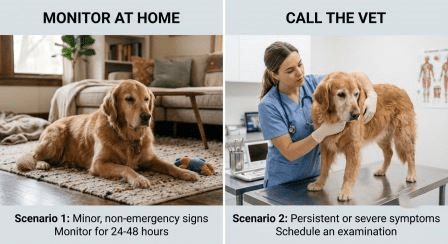
Part 5: When to Call the Vet—A Practical Guide
Go to the Emergency Vet Immediately If:
Blood in vomit (bright red or coffee-ground appearance)
Vomiting more than 8 times in a day
Vomiting with lethargy (too weak to stand)
Vomiting with diarrhea (especially bloody)
Bloated, hard abdomen (possible bloat—life-threatening)
Signs of poisoning (you know they ate something toxic)
Vomiting after head injury
Call Your Vet Within 24 Hours If:
Persistent vomiting lasting more than 24 hours
Vomiting with decreased appetite or weight loss
Vomiting more than twice in under 24 hours (especially for seniors or dogs with health issues)
Vomiting with diarrhea
Lethargy alongside vomiting
Monitor at Home If:
One episode of vomiting and your dog is acting normally
Vomiting that resolves quickly and doesn’t recur
No other symptoms (no diarrhea, lethargy, or appetite loss)
Important: If your dog is eating well and acting totally normal but vomits once, I’m usually less concerned. But if you’re worried at any point, call your vet—that’s what they’re there for.
Part 6: What Vets Will Do
If you take your dog to the vet for vomiting, here’s what to expect:
History and physical exam (focusing especially on the mouth and abdomen)
Blood work to rule out metabolic, electrolyte, and acid-base problems
Abdominal X-rays to check for obstructions, gas patterns, or foreign bodies
Abdominal ultrasound to identify tumors, foreign bodies, or thickening of the intestinal wall
Don’t give any medications to your dog without consulting a vet first.
Part 7: When It’s Not Just a Stomach Bug—Other Conditions to Know About
Parvovirus (Especially in Puppies)
Canine parvovirus causes a highly contagious acute enteritis and is most common in unvaccinated dogs younger than six months.
Key signs:
Sudden lethargy and depression
Loss of appetite
Vomiting and diarrhea (often bloody and projectile)
Prostration and isolating themselves
Survival rates are very low in untreated dogs. But with timely and intensive intervention—including antibiotics, IV fluids, and antiemetic therapy—complete recovery is possible.
Prevention: Regular vaccination, deworming, reducing stress, and routine cleaning with disinfection of bedding.
Gastrointestinal Motility Disorders
Sometimes vomiting isn’t about what’s in the stomach—it’s about how the stomach is moving.
Mechanical causes: Obstructions from intussusceptions, stenosis, tumors, or foreign bodies.
Functional causes: Severe inflammation of the intestinal wall, esophagitis, reflux esophagitis.
Secondary causes: Endocrine disorders like hyperadrenocorticism or hypothyroidism, metabolic diseases, neuromuscular disorders.
Part 8: The Bottom Line
Vomiting is one of the most common health issues in dogs—and most of the time, it’s not an emergency. But when it is, knowing what to look for can save your dog’s life.
Your quick checklist:
Check the color—blood means emergency
Count the episodes—more than 8 times a day is emergency territory
Look at your dog—lethargy, weakness, or pain means call the vet
Check for other symptoms—diarrhea, appetite loss, or weight loss
Trust your gut—if something feels wrong, call your vet
And remember: there are new conditions being recognized in veterinary medicine all the time. Cyclic Vomiting Syndrome and Functional Dyspepsia were only identified in dogs in 2025-2026. If your dog has chronic vomiting that doesn’t respond to standard treatments, it might be something new—and there might be new treatments available.
Your dog is trying to tell you something. Learning to read the signs is the best thing you can do for them.
Disclaimer This article is for educational and informational purposes only.


Pingback: Heatwave Pet Health: How To Spot, Treat, And Prevent Heatstroke | Paws & Antlers