How to Have a Cat and Dog Live Together
Dog chasing your cat? Learn the exact scent-swapping protocol, the 5-second safety rule, and breed-specific tips to help your cat and dog live together safely.

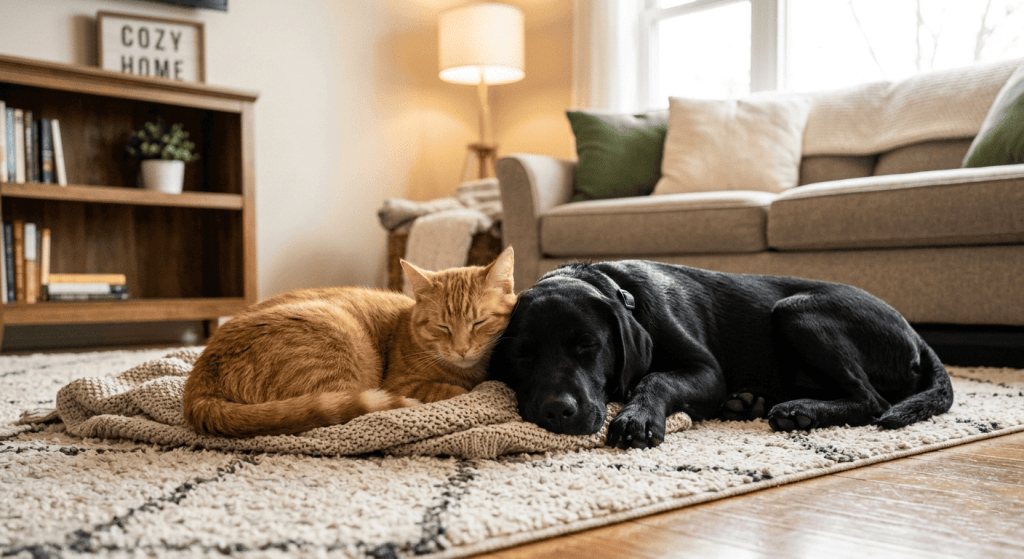
I believe that cats and dogs living together can be a truly beautiful experience if approached with patience and the right strategy. MY dog just cornered MY cat again. Or maybe the cat screamed, puffed up like a balloon, and scratched ME when I tried to break it up.Cat and Dog Live Togetherabout luck or personality. It’s about following a specific sequence and understanding what’s happening inside both animals right now.
Most failed introductions happen because someone skipped steps, rushed the timeline, or didn’t know what warning signs actually look like.
Let’s fix that.
When a cat “puffs up,” that’s called piloerection. It’s not attitude. It’s the body’s automatic fear response, like goosebumps. The fur stands up to make the cat look bigger, and it happens in fractions of a second without the cat choosing to do it.
A cat in piloerection is already in fight-or-flight. Its heart rate is up, its muscles are primed, and it can’t calm down just because you want it to.
Here’s a thing most people don’t expect. our cat hisses at the dog, then spins around and scratches us. That’s called redirected aggression, and it’s fear overflow. The cat is so flooded with stress hormones that it strikes whatever is closest. It’s not angry at us . The dog triggered a response the cat couldn’t contain.
This is common in households where the dog and cat have already had a bad incident. If it’s happened, our cat needs more decompression time than a calm cat would.
Prey drive is a built-in behavior sequence: orient, eye, stalk, chase, grab, shake. Some breeds have this turned up very high. A dog staring rigidly at our cat isn’t being “bad.” It’s running through a program it was literally bred to follow.
| Risk Level | Breeds |
|---|---|
| High Risk | Jack Russell Terrier, Husky, Greyhound, Whippet, Border Collie, Malamute, Airedale, Saluki, Rhodesian Ridgeback |
| Medium Risk | German Shepherd, Doberman, Dalmatian, Australian Shepherd |
| Lower Risk | Golden Retriever, Labrador, Cavalier King Charles, Bichon Frise, Basset Hound, Poodle |
If you own a Husky, Jack Russell, Greyhound, or Border Collie, do NOT skip the 5-second rule. These breeds have a hardwired chase-completion drive. Even a well-trained dog in this group can switch into chase mode faster than you can intervene.
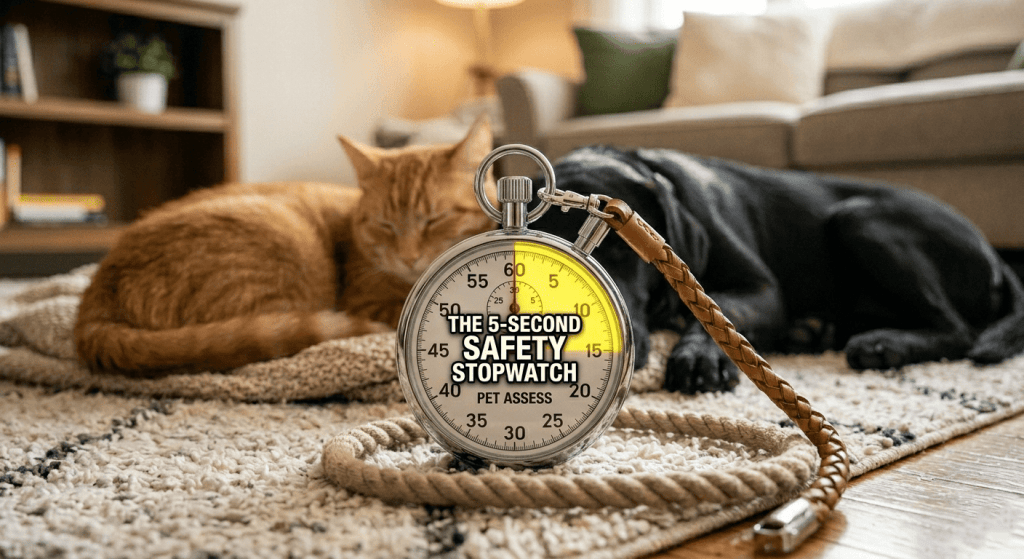
This is a simple rule with a big impact. Count in your head: 1, 2, 3, 4, 5. Separate.
The moment your dog locks eyes on your cat, freezes, or goes into a stiff stalk posture, you have five seconds before the predatory sequence is fully running. Beyond five seconds, the cat’s fight-or-flight cascade is already underway. The dog’s focus has narrowed. Your verbal commands become much less effective.
At five seconds, calmly remove the dog from the room or redirect with a high-value treat. Don’t wait to see what happens. Don’t hope it settles down. Five seconds, then move.
Practice counting. It feels fast. It is fast. That’s the point.

Dogs and cats read the world through their noses first. A visual introduction with no scent preparation is like being introduced to a stranger who breaks into your home. The brain reads it as a threat.
Olfactory habituation means getting both animals used to each other’s smell over 3 to 7 days, before any face-to-face contact. This is the step most people skip, and it’s why most first introductions go badly.
Day 1 to 2:
Take a worn T-shirt or a soft cloth and rub it on your cat. Place it near the dog’s sleeping area, not directly in front of them. Do the same in reverse: dog-scented cloth near the cat’s space.
Day 3 to 4:
Start feeding both animals on opposite sides of a closed door. Dog on one side, cat on the other. They can smell each other while doing something positive (eating). This is a conditioning trick and it works very well.
Day 5 to 7:
Move their food bowls 6 inches closer to the door each day. By day 7, they should be eating with only the door between them, calm and relaxed.
Only after the scent protocol is complete do you move to visual introduction through a baby gate or cracked door.
Feliway Classic is a synthetic version of the pheromone cats leave when they rub their face on furniture. It signals safety and familiarity. Use it in the cat’s safe room. Feliway Multicat targets the bonding pheromone and is better for homes with multiple cats, though it can help during introductions.
Adaptil is a dog-calming pheromone based on the signal a mother dog gives her puppies. Use it near the dog’s resting area.
Two important rules:

Cats need a minimum of 60 to 72 inches of vertical clearance (that’s 5 to 6 feet) to feel genuinely safe in a room with a dog. A shelf at 3 feet is not safe. The dog can still make eye contact, which maintains stress.
Think tall cat trees, tops of refrigerators, or wall-mounted cat shelves. The cat needs to look down at the dog from a position where the dog physically cannot reach it.
Walk into each shared room and ask:
If a room fails this audit, don’t allow unsupervised cohabitation in it yet.
Yes. Significantly. Research by Feuerstein and Terkel (2008) found that introductions made before a cat is 6 months old and a dog is 1 year old have a much higher chance of producing a genuinely friendly relationship. This is because both species have what’s called a critical socialization period. For dogs it runs roughly 3 to 12 weeks. For cats it’s 2 to 9 weeks. During these windows, the brain is actively learning “what is safe, what is normal, what is a friend.”
Adult introductions are absolutely possible. But they take longer, require more patience, and have a lower ceiling. The goal shifts from “best friends” to “calm coexistence,” and that’s a completely worthwhile outcome.

Days 1 to 7: Scent protocol only. Plug in Feliway and Adaptil on Day 1. No face-to-face contact.
Days 8 to 10: Baby gate or cracked door visual access. Dog on leash. Keep sessions to 5 minutes max. Watch for the 5-second rule.
Days 11 onward: Supervised shared room time only. Dog dragging a leash (not held, just dragging so you can step on it if needed). Cat has full vertical access and two exits. Increase time by 5 minutes each session when both animals are relaxed.
No unsupervised time until at least 30 consecutive minutes of calm, relaxed cohabitation has happened multiple times.
Calm takes time. But with the right sequence, a cat and dog sharing a couch is genuinely possible, even when things have already gone sideways.
Ultimately, utilizing the right resources—like your “Cats & Dogs Cohabitation Guide”—combined with your consistent efforts, will help build a strong, peaceful bond between them.
Copy and paste this after your breed-specific risk chart:
Here is something most pet owners do not realize.
Your pets are already telling you exactly how they feel about each other. You just need to know what to look for.
A 2020 study by Menchetti and colleagues observed cat-dog households and found a fascinating pattern. In homes where pets coexisted peacefully, there was a clear and consistent dynamic:
42.8% of dogs lick the cat. 41.8% of cats ignore the dog.
This is not random. It reveals something important about how cats and dogs actually interact.
| Behavior | What It Means |
|---|---|
| Dog licks the cat’s face or body | Submissive or grooming gesture. Your dog is trying to build a bond. |
| Dog licks the cat briefly then walks away | Respectful acknowledgment. “You’re here, I see you, I’m moving on.” |
| Dog licks the cat excessively | Over-arousal. Watch for signs the cat is getting annoyed. |
Good news: Licking is almost always a positive sign. Your dog is not being aggressive. They are trying to communicate that they are not a threat.
| Behavior | What It Means |
|---|---|
| Cat stays in same room but ignores dog | Comfort. Your cat has decided the dog is “not a threat.” |
| Cat walks past dog without reacting | Confident. Your cat feels safe enough to move freely. |
| Cat grooms, sleeps, or eats while dog is nearby | Very good. This is normal, relaxed behavior. |
Important: Ignoring is NOT a sign of dislike. Cats that are terrified or aggressive do not ignore — they run, hiss, swat, or freeze. If your cat is ignoring your dog, that is actually a win.
| What You Want to See | What It Means |
|---|---|
| Dog licks cat occasionally | Dog shows respect and submissiveness |
| Cat ignores dog most of the time | Cat feels safe and unthreatened |
| Both animals share the same room without fixation | Coexistence is working |
| Red Flag | What It Means |
|---|---|
| Dog stares at cat with stiff body | Prey drive engaged — intervene now |
| Cat runs away every time dog appears | Fear — not coexistence |
| Dog chases cat | High prey drive — needs more training |
| Cat hisses or swats at dog constantly | Stress — go back to scent protocol |
| Cat hides and refuses to come out | Extreme fear — may need professional help |
Try this simple exercise:
| Question | Answer |
|---|---|
| Does your dog lick the cat? | ☐ Yes / ☐ No |
| Does your cat ignore the dog? | ☐ Yes / ☐ No |
| Does your dog stare, chase, or fixate? | ☐ Yes / ☐ No |
| Does your cat run, hiss, or hide? | ☐ Yes / ☐ No |
If you answered YES to the first two and NO to the last two: Congratulations! Your pets have achieved peaceful coexistence. Keep doing what you are doing.
If you answered NO to the first two or YES to the last two: You are not there yet. Go back to the scent protocol. Slow down. Give it more time.
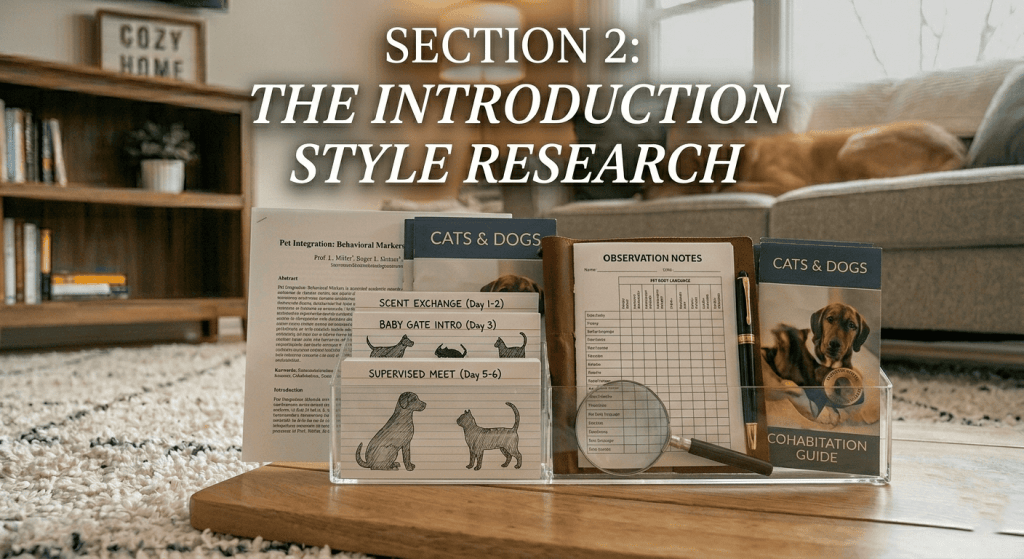
You have just read the scent protocol. But why does this method work? And why do some people fail?
Research from a 2022 study by Kinsman and colleagues gives us the answer.
The study identified two distinct ways people introduce a new dog to a resident cat:
| Introduction Style | What It Looks Like | Success Rate |
|---|---|---|
| Owner-Led | Structured, gradual introduction with controlled steps | Higher |
| Pet-Led | “Let them sort it out” with minimal structure | Lower |
Here is what the study found:
Owners who led introductions anticipated amicable relationships. Owners who let pets introduce themselves did not.
In other words: When you control the process, you control the outcome. When you leave it to chance, you get unpredictable results.
| Step | What It Looks Like |
|---|---|
| 1 | Scent swapping before any visual contact |
| 2 | Controlled visual access (baby gates, cracked doors) |
| 3 | Supervised face-to-face meetings (short, positive) |
| 4 | Gradual increase in time together |
| 5 | Ongoing management (separate resources, vertical space) |
This is exactly what the scent protocol in this article describes.
| Step | What It Looks Like |
|---|---|
| 1 | Bring new pet home |
| 2 | Let them see each other immediately |
| 3 | Hope for the best |
| 4 | Intervene only when conflict happens |
| 5 | Repeat Step 3 |
This approach often leads to:
| Reason | Explanation |
|---|---|
| Predictability | You control the sequence, so you control the outcome |
| Safety | No chasing incidents to create fear |
| Trust | Both pets learn you are a safe source of positive experiences |
| Calm | Slow, gradual exposure prevents overwhelm |
If you already let your pets “sort it out” and it did not go well, do not panic.
Here is what to do:
| Step | Action |
|---|---|
| 1 | Separate them completely |
| 2 | Go back to Step 1 of the scent protocol |
| 3 | Start over from the beginning |
| 4 | This time, be owner-led |
It is never too late to do it right. Even pets that have had bad experiences can learn to coexist peacefully with a slow, structured reintroduction.
Copy and paste this after your section on piloerection and prey drive:
Most conflict between cats and dogs happens because they speak different languages.
A dog’s wagging tail can mean excitement OR aggression. A cat’s slow blink means trust. Most owners do not know these signals. And they misinterpret what is happening right in front of them.
This section will help you become an interpreter. You will learn what each animal is saying — and what the other animal is hearing.
| Dog Signal | What It Means | How the Cat Reads It |
|---|---|---|
| Wagging tail (fast, stiff, high) | Excitement or arousal | Threat — “This dog is about to chase me” |
| Wagging tail (loose, wide, low) | Playful, relaxed | Neutral or curious — “Not a threat… maybe” |
| Stiff, frozen posture | Prey drive engaged | Danger — “I am about to be attacked” |
| Play bow | “I want to play” | Confusing — often seen as a threat |
| Soft, relaxed eyes | Calm and friendly | Trust — the cat will feel safer |
| Hard staring | Fixation or prey drive | Intense threat — cat may run or freeze |
| Yawning (not tired) | Stress release or calming signal | Confusing — cat may not understand |
| Turning head away | “I am not a threat” | Reassuring — cat may relax slightly |
| Cat Signal | What It Means | How the Dog Reads It |
|---|---|---|
| Slow blink | “I trust you” | Usually ignored — dogs do not use this signal |
| Tail twitching | Irritation or focus | May trigger chase instinct — “moving object!” |
| Puffed fur (piloerection) | Extreme fear or aggression | May trigger chase instinct — “I am bigger than I look” |
| Hiss or swat | “Back off NOW” | Clear warning — most dogs understand this |
| Ears flat against head | Fear or anger | Threat — “I am about to attack” |
| Tail straight up, puffed | Aggression | Challenge — may trigger defensive response |
| Tail tucked between legs | Fear | Confusing — dog may not understand |
| Purring | Contentment | Neutral — dog may not react |
| Meowing | Attention or distress | Usually ignored or triggers curiosity |
| Situation | Why It Happens | What to Do |
|---|---|---|
| Dog chases running cat | Cat runs → triggers dog’s prey drive | Prevent chasing. Keep cat calm. Use leashes. |
| Cat swats dog | Cat feels cornered or threatened | Give cat escape route. Never corner a cat. |
| Dog stares at cat | Prey drive | Interrupt immediately. Redirect dog. |
| Cat freezes | Fear response | Remove dog. Cat is terrified. |
| Dog licks cat, cat hisses | Cat feels overwhelmed | Give cat space. End interaction. |
| Dog Signals | Cat Signals |
|---|---|
| Loose, wiggly body | Slow blinking |
| Play bow | Grooming (self) |
| Soft, relaxed eyes | Purring |
| Turning head away | Exploring the room |
| Yawning (stress release) | Eating or drinking |
| Lying down calmly | Sleeping |
| Ignoring the cat | Ignoring the dog |
When you see these signals, you are on the right track. Let them continue.
| Dog Signals | Cat Signals |
|---|---|
| Stiff, frozen posture | Hissing |
| Hard staring | Swatting or biting |
| Chasing | Running away |
| Growling | Puffed fur |
| Snapping | Ears flat against head |
| Fixation | Freezing |
When you see these signals, separate them immediately. Go back to an earlier step in the introduction protocol.
| Rule | Why It Matters |
|---|---|
| Watch both animals, not just one | Both are communicating |
| Do not assume your pets understand each other | They speak different languages |
| Step in at the first sign of tension | Prevention is easier than recovery |
| Praise calm behavior | Positive reinforcement works |
| Separate at the first red light | Do not wait for an incident |
Copy and paste this after your section on vertical space and separate zones:
You have set up the space. You have done the introductions. But there is one factor that most owners overlook:
Where your pets sleep.
Research from a 2024 study by Menchetti and colleagues found something surprising:
Keeping cats indoors and allowing both cats and dogs to sleep in the owner’s bedroom were associated with a stronger perceived pet-owner bond.
In other words: Where your pets sleep affects how they feel — about each other and about you.
| Sleeping Arrangement | Effect on Bonding |
|---|---|
| Both pets in bedroom (separate spots) | Stronger pet-owner bond |
| Cat indoors + dog in bedroom | Stronger bond |
| Cat outdoors or confined away from family | Weaker bond |
| One pet banned from bedroom | Jealousy and territorial tension |
| Reason | Explanation |
|---|---|
| Shared territory | The bedroom is usually the most “family” space. Sharing it signals belonging. |
| Nighttime security | Being near the owner at night lowers stress for both cats and dogs. |
| Calm interactions | Nighttime is quiet. Interactions are less intense. |
| Bonding opportunity | Shared sleeping space = shared positive experience. |
This does NOT mean they have to sleep together. In fact, they probably should not.
What works:
| Arrangement | Good For |
|---|---|
| Dog bed on the floor, cat tree in the corner | Both feel safe, both are in the same room |
| Dog in a crate, cat on a high perch | Both feel secure, both are present |
| Dog on one side of the bed, cat on the other | Both are close to you, but not forced to interact |
What does NOT work:
| Arrangement | Why It Fails |
|---|---|
| Both pets forced to share one small bed | Conflict risk |
| One pet locked out of the bedroom | Jealousy, stress |
| Both pets in separate rooms alone | No bonding opportunity |
| Step | Action |
|---|---|
| 1 | Allow both pets in the bedroom at night |
| 2 | Give each pet their own bed or perch |
| 3 | Dog bed on the floor or near you |
| 4 | Cat bed on a high shelf, cat tree, or nightstand |
| 5 | No forced sharing — let them choose their own spot |
| 6 | If either pet seems stressed, move their bed farther apart |
| Situation | Solution |
|---|---|
| Dog sleeps in a crate | Put crate in the bedroom near your bed |
| Cat is afraid of dog | Cat gets a high perch, dog stays in crate at night |
| Both are calm together | Let them choose their own spots in the room |
| Challenge | Solution |
|---|---|
| No separate room | Create “bedroom zones” within the same space |
| Dog bed on one side of the room | Cat tree or perch on the other side |
| Use room dividers or furniture | Creates visual separation for sleeping |
Throughout this guide, we have talked about “peaceful coexistence” and “calm cohabitation.” But what does that actually mean?
Here is the scene you are aiming for:
The dog is lying down or resting comfortably. The cat is in the same room. The cat is on a high perch, or on the floor moving naturally. Neither animal is fixated on the other. The cat is grooming, sleeping, or exploring — not hiding, freezing, or staring. The dog responds to your voice without escalating. Both animals are calm. Both are relaxed.
This is the goal. Not “best friends.” Not “cuddling together.” Just… calm. Two animals sharing a space without stress.
| Dog Behaviors | Cat Behaviors |
|---|---|
| ☐ Lying down or resting | ☐ In the same room |
| ☐ Not staring at the cat | ☐ On a perch OR moving normally |
| ☐ Loose, relaxed body | ☐ Grooming, sleeping, exploring |
| ☐ Responds to your voice | ☐ Not hiding or freezing |
| ☐ Ignores the cat most of the time | ☐ Ignores the dog most of the time |
| Dog Behaviors | Cat Behaviors |
|---|---|
| ❌ Staring, fixating, chasing | ❌ Hiding, freezing, running |
| ❌ Stiff, frozen posture | ❌ Hissing, swatting, growling |
| ❌ Growling or snapping | ❌ Puffed fur, flat ears |
| ❌ Excessive barking | ❌ Tail twitching violently |
| Milestone | What It Means |
|---|---|
| Both pets can be in the same room without you managing them | Level 1 achieved |
| Both pets sleep peacefully in the same room | Level 2 achieved |
| Cat moves naturally through the room while dog is present | Level 3 achieved |
| Dog looks at you instead of chasing the cat | Level 4 achieved |
| You can leave the room and both pets stay calm | Level 5 achieved |
we do not need all of these to succeed. But the more of these we have, the more peaceful your household.
Here is an important truth:
our pets do not need to be best friends. They just need to coexist without fear or aggression.
| Outcome | Is It Success? |
|---|---|
| Best friends (cuddling, playing) | ✅ Yes |
| Peaceful coexistence (calm, ignoring each other) | ✅ Yes |
| Tolerate each other (same room, minimal stress) | ✅ Yes |
| Constant conflict (chasing, hissing, fighting) | ❌ No — go back to the protocol |
| Problem | Solution |
|---|---|
| Dog chases cat | Go back to Step 2 (scent exchange) |
| Cat hides all the time | Give more vertical space, more escape routes |
| Dog fixates on cat | Add management (leash, crate, barriers) |
| Cat hisses at dog | Slow down. Give cat more space. |
| Both ignore each other but seem tense | Add positive experiences (treats, play) near each other |
| Section | Purpose | Where to Add |
|---|---|---|
| The “Licking vs. Ignoring” Test | Diagnostic tool to assess relationship | After breed chart |
| Owner-Led vs. Pet-Led Introduction | Explains why the protocol works | After scent protocol |
| Body Language Dictionary | Decodes cross-species miscommunication | After piloerection/prey drive |
| Sleeping Arrangement | Shows how management builds bonding | After vertical space |
| What Calm Cohabitation Looks Like | Defines the goal clearly | Near the end, before FAQ |
Q: How can I tell if my pets are actually friends or just tolerating each other?
A: Use the “Licking vs. Ignoring” Test above. If your dog licks the cat and your cat ignores the dog, that is peaceful coexistence. If they play together or cuddle, that is even better. But coexistence without fear or aggression is already a success.
Q: My cat hisses at my dog sometimes but they seem fine otherwise. Is that okay?
A: Occasional hissing is normal — it is your cat setting boundaries. As long as the hissing is not constant and your cat is not hiding all the time, this is usually fine. Watch for the “red light” signals in the body language dictionary above.
Q: Should I let my cat and dog sleep together?
A: Only if they both want to. Do not force it. A better approach is to let them sleep in the same room with separate sleeping spots. This builds bonding without conflict. See the sleeping arrangement section above.
Q: My pets have been together for months and still do not get along. Is it too late?
A: No. Separate them completely. Go back to Step 1 of the scent protocol. Start over from the beginning. Even pets with a history of conflict can learn to coexist peacefully with a slow, structured reintroduction.
Q: What if nothing works?
A: If you have followed all the steps in this guide for 4-6 months and there is still serious conflict, consult a veterinary behaviorist. Some cases need professional help. There is no shame in that — it shows you care enough to get expert support.
Pingback: Dog Not Eating? 5 Things To Check First (Before You Panic) | Paws & Antlers
Pingback: How To Have Cat Gain Weight Safely (Vet-Backed Guide 2026) | Paws & Antlers
Pingback: Before The New Pet Arrives | Paws & Antlers