Dog Signs of Overheating vs. Normal Behavior
You’ve seen it a hundred times. Your dog comes in from a walk, tongue hanging out, breathing fast and heavy. You think nothing of it—that’s


You’ve seen it a hundred times. Your dog comes in from a walk, tongue hanging out, breathing fast and heavy. You think nothing of it—that’s just what dogs do, right?
But sometimes, that panting isn’t normal. Sometimes, it’s a warning sign.
The tricky part is telling the difference. Because dogs don’t sweat like we do, panting is their primary way of cooling down. But when does healthy panting cross the line into dangerous overheating?
Let me walk you through everything you need to know—so you can keep your furry friend safe.
First, let’s understand why dogs pant in the first place.
Unlike humans, dogs have very few sweat glands. The ones they do have are mostly on their paw pads—and that’s not nearly enough to cool a whole body.
So instead, they pant.
When a dog pants, they breathe rapidly with their mouth open and tongue hanging out. This allows moisture to evaporate from their tongue, mouth, and upper respiratory tract. As that moisture evaporates, it carries heat away from their body.
In simple terms: Panting is your dog’s built-in air conditioning system.
Normal panting is healthy, controlled, and expected in certain situations.
Normal panting happens when:
| Situation | Why It’s Normal |
|---|---|
| After exercise | They’re cooling down after physical activity |
| When it’s warm | They’re regulating their body temperature in hot weather |
| During excitement | Happy, playful, or anxious moments can trigger panting |
| In anticipation | Waiting for a walk, treat, or car ride |
Signs of normal panting:
The key point: Normal panting is proportional to the situation. It makes sense given what your dog has been doing or the temperature they’re in.
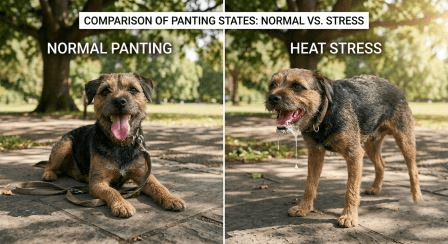
Overheating is a medical emergency. It happens when your dog’s body temperature rises above a safe level and they can’t cool themselves down.
The danger zone: Normal body temperature for a dog is 101-102.5°F (38.3-39.2°C). When it hits 104°F (40°C), you’re in the danger zone. At 106°F (41°C) or higher, organ damage and death can occur.
| Sign | What It Looks Like |
|---|---|
| Excessive, uncontrolled panting | Panting that doesn’t slow down, even with rest |
| Bright red or dark red tongue/gums | Instead of normal pink |
| Thick, sticky drool | Excessive saliva that’s ropey and thick |
| Lethargy or weakness | Slow to respond, wobbly, or unable to stand |
| Vomiting or diarrhea | Digestive distress |
| Dizziness or disorientation | Stumbling, confusion |
| Rapid, loud breathing | Breathing that sounds harsh or strained |
| Anxious behavior | Pacing, restlessness, seeking shade but can’t settle |
| Body temperature over 104°F | If you can measure it, this is a red flag |
| Collapse or seizures | Emergency—this is the final stage |
| Feature | ✅ Normal Panting | 🚨 Overheating Signs |
|---|---|---|
| Tongue & Gums | Pink or light red | Bright red, dark red, purple, or pale |
| Panting Quality | Steady, matching activity level | Frantic, heavy, out of control; or noisy, labored breathing |
| Behavior | Alert, active, can respond | Restless, lethargic, weak, stumbling |
| Other Symptoms | Usually none | Excessive drooling, vomiting, diarrhea, high fever (over 104°F), seizures |
Some dogs are much more vulnerable to overheating. If you have one of these breeds, you need to be extra careful.
These breeds have shortened airways that make breathing and cooling less efficient.
Why they’re at risk: Their flat faces mean they can’t move air as efficiently. They can overheat even in temperatures and humidity levels that other dogs handle easily.
| Group | Why They’re at Risk |
|---|---|
| Puppies | Still developing temperature regulation |
| Senior dogs | Less efficient cooling systems |
| Overweight dogs | Insulation traps heat |
| Dogs with thick or dark coats | Absorb more heat from the sun |
| Dogs with health conditions | Heart, lung, or thyroid issues affect cooling |
| Working dogs | Hunting, herding, or sled dogs that push themselves too hard |
This is an emergency. Act fast.
Step 1: Move them to a cool place
Step 2: Start cooling them down
⚠️ Important:
Step 3: Call your vet immediately
Sometimes panting isn’t about temperature. Here are other reasons your dog might be panting.
Dogs in pain often pant. It’s one of the subtle signs they show when something hurts.
Signs:
What to do: If you suspect pain, see a vet.
Just like us, dogs can pant when they’re stressed.
Common triggers:
Signs: The panting will often stop once the stressor is removed. If it’s ongoing, your dog may have anxiety that needs management.
Some medical conditions cause panting as a symptom.
| Condition | Other Signs |
|---|---|
| Heart disease | Coughing, fatigue, swelling in legs |
| Lung problems | Labored breathing, coughing |
| Anemia | Pale gums, lethargy, weakness |
| Cushing’s disease | Increased appetite, pot-bellied appearance |
| Hypoglycemia (low blood sugar) | Weakness, collapse |
| Fever | Lethargy, loss of appetite |
What to do: If your dog is panting excessively without an obvious cause (heat, exercise, excitement), see a vet.
Some medications, particularly steroids, can cause panting as a side effect.
If your dog started panting after starting a new medication: Talk to your vet. Don’t stop the medication without consulting them first.
Call the vet or go to an emergency clinic if panting is accompanied by:
Call your vet within 24 hours if:
The best treatment for overheating is prevention.
In Hot Weather:
During Exercise:
Overall Health:
I can’t say this strongly enough: never leave your dog alone in a parked car.
Even on a mild 70°F (21°C) day, the temperature inside a car can reach 100°F (38°C) in just 20 minutes. On an 85°F (29°C) day, it can reach 120°F (49°C) in the same time.
Cracking the windows doesn’t help. It only drops the temperature by a few degrees.
If you see a dog trapped in a hot car, call the authorities immediately.

| Feature | ✅ Normal | 🚨 Overheating |
|---|---|---|
| After exercise | Panting stops within 10 minutes | Panting continues |
| Tongue/gums | Pink | Bright red, dark red, or pale |
| Breathing | Steady, normal | Harsh, loud, or frantic |
| Behavior | Alert, responsive | Lethargic, confused, weak |
| Other signs | None | Vomiting, diarrhea, collapse |
Panting is normal. It’s how your dog stays cool. But it can also be a warning sign—and knowing the difference could save your dog’s life.
Here’s what to remember:
Your dog can’t tell you when they’re too hot. But they can show you. Now you know what to look for.
Pingback: Why Is My Dog Limping? A Step-by-Step Guide To Diagnosis & Care | Paws & Antlers