
Gastritis in Dogs: Causes, Symptoms, and Treatment
Hi seekers! If your dog has started vomiting suddenly or seems to have lost their appetite, gastritis might be the culprit. The good news? Most
Hi seekers! If your dog has started vomiting suddenly or seems to have lost their appetite, gastritis might be the culprit. The good news? Most
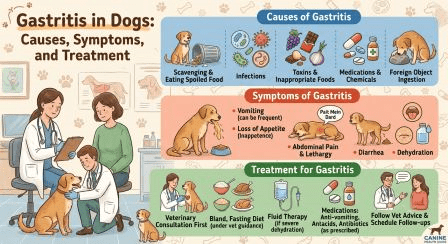
Hi seekers! If your dog has started vomiting suddenly or seems to have lost their appetite, gastritis might be the culprit. The good news? Most cases are mild and resolve quickly. But knowing what to look for—and when to call the vet—can make all the difference.
Gastritis is simply inflammation of the stomach lining. It can appear as a short episode (acute) or persist for a long time (chronic), and it may be linked to more serious underlying conditions.
Acute gastritis comes on suddenly and is very common in dogs. Most dogs recover within one to three days with supportive care.
Chronic gastritis involves vomiting that persists for 7–14 days or longer. It usually requires identifying and treating an underlying cause.
The most common signs are sudden vomiting and decreased appetite. Other symptoms to watch for include:
Dogs can’t tell you their stomach hurts, but their behavior will give it away. Look for:
Acute gastritis is frequently caused by dietary indiscretion—a fancy way of saying your dog ate something they shouldn’t have. Common triggers include:
Chronic gastritis may stem from:
Seek veterinary care right away if you notice:
Puppies, senior dogs, pregnant dogs, and those with chronic conditions should be assessed promptly.
Diagnosis typically starts with a thorough history and physical exam. Your vet may recommend:
For acute cases, only minimal testing is usually needed. Chronic cases require more involved diagnostics to find the underlying cause.
Most acute gastritis cases resolve without medical intervention. At-home care guidelines include:
Good short-term options for sensitive stomachs include:
Note: These are short-term fixes and don’t provide complete balanced nutrition for the long term.
If your dog needs veterinary intervention, treatment may include:
| Medication Type | Examples | Purpose |
|---|---|---|
| Anti-emetics | Maropitant (Cerenia®), Metoclopramide (Reglan®) | Stop vomiting |
| Fluid therapy | IV or subcutaneous fluids | Treat dehydration |
| Proton pump inhibitors | Omeprazole | Reduce stomach acid in severe cases |
| Gastrointestinal protectants | Sucralfate (Carafate®) | Protect stomach lining |
| H2 receptor antagonists | Famotidine (Pepcid®), Ranitidine (Zantac®) | Reduce acid when ulcers are suspected |
For chronic gastritis caused by Helicobacter infection, a triple therapy with amoxicillin, metronidazole, and omeprazole for 21 days has been shown to resolve symptoms.
Acute gastritis has a good prognosis – most dogs recover fully within 1–3 days.
Chronic gastritis prognosis depends entirely on the underlying cause. Identifying and treating the root issue is essential for long-term recovery.
How Casinos Are Rebounding After COVID-19: Recovery Strategies Revealed The COVID-19 pandemic has had a
Олимп казино официальный сайт в Казахстане – Olimp Casino ▶️ ИГРАТЬ Содержимое Преимущества игры в
Олимп казино официальный сайт в Казахстане – Olimp Casino ▶️ ИГРАТЬ Содержимое Преимущества игры в
Олимп казино официальный сайт в Казахстане – Olimp Casino ▶️ ИГРАТЬ Содержимое Преимущества игры в
Олимп казино официальный сайт в Казахстане – Olimp Casino ▶️ ИГРАТЬ Содержимое Преимущества игры в
Олимп казино официальный сайт в Казахстане – Olimp Casino ▶️ ИГРАТЬ Содержимое Преимущества игры в