Hi seekers! Let’s be honest—setting up lighting for a bearded dragon can feel overwhelming at first. Heat lamps, UVB tubes, timers, temperatures… it’s a lot.
Table of Contents
Hi seekers! Let’s be honest—setting up lighting for a bearded dragon can feel overwhelming at first. Heat lamps, UVB tubes, timers, temperatures… it’s a lot.
But here’s the thing: getting this right is the single most important thing you can do for your scaly friend. Without proper lighting, they can’t digest food, absorb calcium, or even stay awake during the day. It’s not optional—it’s survival.
The good news? Once you understand the basics, it’s actually pretty straightforward. Let me break it down for you in plain English.
Why Lighting Matters So Much
Bearded dragons come from the sunny, arid regions of Australia. In the wild, they bask under direct sunlight for 10–14 hours per day, exposing themselves to some of the highest natural UVB radiation of any commonly kept pet reptile. That sunlight does two critical things:
Provides heat so they can warm up, digest food, and stay active
Provides UVB rays so they can make vitamin D3 and absorb calcium
In captivity, we have to replicate that sunlight artificially. Ordinary white light, LED strips, and standard household bulbs emit no meaningful UVB. Without a dedicated UVB source, your bearded dragon is living in a permanently overcast environment—regardless of how bright the enclosure looks to your eyes.
Get it wrong, and your dragon can develop Metabolic Bone Disease (MBD)—a painful, debilitating condition that’s entirely preventable.
Part 1: Temperature – Creating the Right Heat Gradient
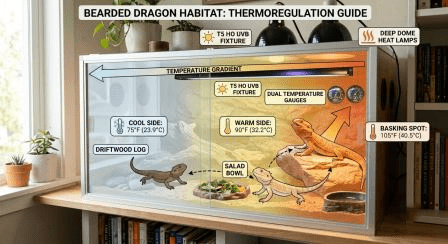
Bearded dragons are ectothermic—they rely on external heat sources to regulate their body temperature. They need to move between warm and cool areas throughout the day to maintain their ideal body temperature. This is called a temperature gradient.
The Three Temperature Zones
Area
Temperature
Why It Matters
Basking surface
100–110°F (38–43°C)
Where they warm up and digest food
Warm side air
88–92°F (31–33°C)
Ambient warmth for daily activity
Cool side air
75–85°F (24–29°C)
Where they cool down when needed
A temperature gradient in your bearded dragon’s enclosure allows them to choose between a cold, warm, and hot spot to warm up or cool down.
Nighttime Temperatures
At night, all lights should go off, but temperatures should still be monitored. Keep nighttime temperatures around 70–75°F (21–24°C), and never let them drop below 65°F (18°C).
If your home gets cold at night, use a ceramic heat emitter (CHE) connected to a thermostat. These produce heat without any visible light, so they won’t disturb your dragon’s sleep.
How to Measure Temperatures
Don’t guess—measure. Use:
Digital thermometers placed at both the cool and hot ends of the enclosure
An infrared temperature gun to check the surface temperature of the basking spot
Part 2: UVB – The Non-Negotiable Light
UVB isn’t an optional add-on for bearded dragons. It’s what allows them to produce vitamin D₃ in the skin, which is necessary for proper calcium absorption.
The Science in Simple Terms
Here’s how it works:
UVB photons penetrate the dragon’s skin
This converts a substance in the skin to pre-vitamin D3
Body heat converts it to vitamin D3
The liver and kidneys process it into active form
This enables the intestines to absorb dietary calcium
Break any link in this chain—especially step 1—and the entire process fails. A dragon eating a calcium-rich diet but living under inadequate UVB cannot absorb that calcium properly.
What Kind of UVB Bulb to Buy
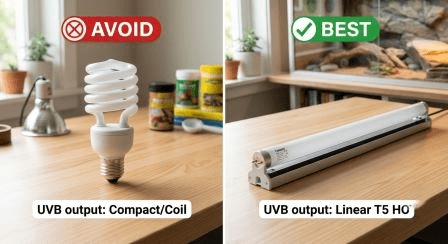
The short answer: You need a linear fluorescent T5 HO tube with 10–12% UVB output.
T5 vs T8: T5 bulbs produce significantly higher UVB output than T8 bulbs. A T8 bulb is often too weak and can lead to Metabolic Bone Disease. Spend the extra money on a T5—it’s worth it.
Recommended brands:
Arcadia T5 HO 12%
Zoo Med ReptiSun 10.0 T5 HO
What NOT to buy:
Coil or compact UVB bulbs (poor output, can cause eye problems)
Household bulbs (they emit no UVB)
Any bulb with less than 10% UVB output
Where to Place It
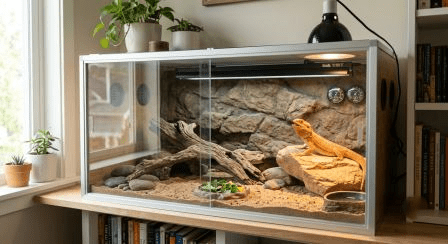
Mount the UVB tube inside the enclosure (not on top of a glass lid—UV rays cannot pass through glass or plastic)
Position it 12–18 inches from the basking spot
Place it side by side with the heat lamp above the basking area so your dragon gets both heat and UV exposure at once
The light should cover at least two-thirds of the enclosure
When to Replace It
Every 6 months. Even if the bulb still looks bright, UVB output diminishes over time. Mark your calendar and change it religiously.
Part 3: Day/Night Cycles – The Daily Rhythm
Bearded dragons are diurnal—active during the day and asleep at night. They require a stable and consistent day/night cycle.
The Basic Schedule
Period
Duration
What’s Required
Daytime
12–14 hours
Full-spectrum basking light + UVB
Nighttime
10–12 hours
Complete darkness—no white light, no UVB, no coloured bulbs
Most bearded dragons do well with about 12 hours of light and 12 hours of darkness each day. Consistency matters more than chasing a perfect number.
A Simple Daily Schedule
Time
Activity
7:00 AM
UVB and basking lights turn on
7:30–8:00 AM
Dragon warms up
8:00 AM onward
Feeding and normal activity
5:00–6:00 PM
Last major feeding opportunity
7:00 PM
Lights turn off
The exact times don’t matter—a schedule running from 8 AM to 8 PM works just as well as 7 AM to 7 PM. What matters is that the schedule fits your household and remains reasonably consistent from day to day.
Two important feeding tips:
Wait about 30–60 minutes after lights come on before feeding—your dragon needs time to warm up before they can digest properly
Avoid major feedings during the last 1–2 hours before lights-out—your dragon needs time to bask and digest afterward
Seasonal Adjustments
You can adjust the schedule slightly by season:
Summer: 14 hours of light, 10 hours of darkness
Winter: 10–12 hours of light, 12–14 hours of darkness
The Easy Way: Use a Timer
Here’s the best advice I can give you: buy a timer plug. Set it once, and your lights will turn on and off at the same time every day, automatically. No forgetting, no late nights, no early mornings.
Common Mistakes to Avoid
Mistake
Why It’s Bad
Using a coil/compact UVB bulb
Poor UVB output, can cause eye damage
Placing UVB behind glass or plastic
UV rays can’t penetrate—completely useless
Leaving lights on 24/7
Disrupts sleep, causes stress, harms health
Using red or blue “night lights”
Disturbs sleep—they can still see the light
Forgetting to replace UVB bulbs
UVB output drops long before the bulb burns out
Putting UVB too far from basking spot
Dragon doesn’t get enough UVB exposure
A note on supplements: Calcium powders with added D3 are useful, but they’re meant to work alongside proper UVB exposure, not replace it.
Quick Setup Checklist
Before you bring your dragon home, run through this list:
UVB: Linear T5 HO tube (10–12% output) from Arcadia or Zoo Med
UVB mounted: Inside enclosure, 12–18 inches from basking spot
Heat lamp: Halogen flood or reptile basking bulb at one end
Basking temperature: 100–110°F (38–43°C)
Cool side temperature: 75–85°F (24–29°C)
Nighttime: Above 65°F (18°C)—use ceramic heat emitter if needed
Here are the most common questions about bearded dragon lighting setups, with clear, practical answers to help you create the perfect environment for your scaly friend.
UVB Lighting
Q: Why is UVB lighting so important for bearded dragons?
A: UVB light is essential for vitamin D3 synthesis. Without it, your bearded dragon cannot properly absorb calcium from their diet. This can lead to Metabolic Bone Disease (MBD), a debilitating and often fatal condition. UVB is non-negotiable—it’s a matter of survival.
Q: What kind of UVB bulb should I buy?
A: You need a linear fluorescent T5 HO tube with 10–12% UVB output. The recommended brands are Arcadia T5 HO Desert 12% and Zoo Med T5 HO ReptiSun 10.0. Do not use compact or coil UVB bulbs—they don’t emit enough UVB and can cause eye problems.
Q: Where should I place the UVB bulb?
A: Mount the UVB tube inside the enclosure or on top of the mesh, as close as possible to the basking area. Glass and plastic block UVB rays completely, so there must be nothing between the bulb and your dragon.
Q: How far should the UVB bulb be from my dragon?
Q: The exact distance depends on the bulb and whether you have mesh: Zoo Med T5 HO ReptiSun 10.0 – 11″ with mesh, 16-17″ without mesh Arcadia T5 HO Desert 12% – 11″ with mesh, 16-17″ without mesh Arcadia T5 HO Dragon 14% – 11-12″ with mesh, 17-18″ without mesh
Q: How often should I replace the UVB bulb?
A: Replace UVB bulbs every 6 months. Even if the bulb still looks bright, UVB output diminishes over time. Some sources recommend 6-12 months, but 6 months is safer.
Q: Can I use a mercury vapor bulb instead of a tube?
A: Mercury vapor bulbs provide both heat and UVB, but they can be challenging to manage in smaller enclosures due to their high output. The heat produced can be excessive, and their higher intensity UVB can be harmful if used incorrectly. In very large enclosures, they can be an option, but require careful monitoring. For most owners, a separate UVB tube and heat lamp setup is safer and more reliable.
Temperature Management
Q: What should the basking spot temperature be?
A: The basking surface should be 100–110°F (38–43°C) during the day. Some sources recommend 95–110°F (35–43°C). Use a digital thermometer or temperature gun to measure surface temperature accurately.
Q: What should the cool side temperature be?
A: The cool side should be 75–85°F (24–29°C). This allows your dragon to move between warm and cool areas to regulate their body temperature.
Q: What should the temperature be at night?
A: Nighttime temperatures should drop to 65–75°F (18–24°C). A natural temperature drop at night is normal and healthy.
Q: How cold is too cold at night?
A: The temperature should never drop below 65°F (18°C). Prolonged exposure to cold conditions can be detrimental to your bearded dragon’s health.
Q: How can I measure temperatures accurately?
A: Use digital thermometers placed on both the warm and cool sides of the enclosure. Use an infrared temperature gun to measure the surface temperature of the basking spot.
Q: What if my house gets cold at night?
A: If nighttime temperatures drop below 65°F (18°C), use a ceramic heat emitter (CHE). This produces heat without emitting any light, so it won’t disturb your dragon’s sleep.
Day/Night Cycles
Q: How many hours of light do bearded dragons need?
A: Most bearded dragons do well with about 12 hours of light and 12 hours of darkness each day. A consistent 12-hour cycle is simple, predictable, and works well for most setups.
Q: Should I adjust the schedule seasonally?
A: In the wild, bearded dragons experience roughly 14-15.5 hours of daylight in summer and only 9-10.5 hours in winter. Some keepers adjust seasonally: Summer: 14 hours on / 10 hours off Winter: 10-12 hours on / 12-14 hours off
Q: Do UVB and heat lamps need to turn on at the same time?
A: Yes. In most setups, UVB and basking lights should turn on and off together. In nature, bearded dragons receive heat, visible light, and UVB from the sun at the same time. Running them together encourages normal basking behavior.
Q: Do bearded dragons need light at night?
A: No. Bearded dragons need complete darkness for 10 to 12 hours each night. Leaving lights on overnight disrupts their circadian rhythm, suppresses hormone production, prevents restorative sleep, and causes chronic stress over time.
Q: Can I use red, blue, or black “night lights”?
A: No. Do not use red, blue, or black night bulbs. Bearded dragons can perceive these wavelengths and they disrupt sleep. These lights can also hurt their eyesight. If extra heat is needed at night, use a ceramic heat emitter (CHE).
Common Questions & Myths
Q: Can I use a regular household bulb for UVB?
A: No. Household bulbs provide heat but not UVB. Your bearded dragon needs a dedicated UVB bulb specifically designed for reptiles.
Q: Can UVB penetrate glass?
A: No. UVB rays are blocked by glass and plastic. The UVB bulb must be mounted inside the enclosure or on top of the mesh with nothing between it and your dragon.
Q: Can I leave the UVB light on 24/7?
A: No. Never leave the UVB light on 24/7. Constant exposure to UVB can lead to hypercalcemia (excessive calcium levels), which can be harmful. Always provide a proper day/night cycle.
Q: How do I know if my bearded dragon is too hot?
A: Signs of overheating include gaping (mouth open), panting, and avoiding the basking spot. If you see these signs, check your temperatures immediately.
Q: How do I know if my bearded dragon is too cold?
A: A beardie that is too cold will be lethargic, have a poor appetite, and may have difficulty digesting food.
Equipment & Setup
Q: Do I need a timer for my lights?
A: Yes. A timer is one of the best investments you can make. It ensures consistent day/night cycles and prevents you from accidentally leaving lights on or off for too long.
Q: What wattage heat bulb should I use?
A: Generally a 60-100 watt bulb provides the necessary heat, but the exact wattage depends on your enclosure size and room temperature. You’ll need to experiment to achieve the correct basking temperature.
Q: Should I use an under-tank heater?
A: Under-tank heaters are useful to gently raise the overall temperature of the tank, but should be used with a thermostat or rheostat.
Quick Summary
Element
Requirement
UVB bulb type
Linear T5 HO, 10-12% output (Arcadia 12% or ReptiSun 10.0)
UVB distance
11-18″ depending on bulb and mesh
UVB replacement
Every 6 months
Basking temperature
100-110°F (38-43°C)
Cool side temperature
75-85°F (24-29°C)
Nighttime temperature
65-75°F (18-24°C)
Day length
12-14 hours
Night length
10-12 hours of complete darkness
Night heat
Ceramic heat emitter (no light)
Timer
Essential for consistency
The Bottom Line
Proper lighting is one of the most important aspects of bearded dragon care. Get it right, and your dragon will stay strong, active, and healthy. Get it wrong, and you risk serious health problems like Metabolic Bone Disease.
Your simple checklist:
✅ Never use red, blue, or black night bulbs
✅ Use a linear T5 HO UVB tube (10-12% output)
✅ Mount it 11-18 inches from the basking spot
✅ Replace UVB bulbs every 6 months
✅ Provide a basking spot of 100-110°F
✅ Maintain a cool side of 75-85°F
✅ Keep nighttime temperatures above 65°F
✅ Provide 12-14 hours of light and 10-12 hours of complete darkness
✅ Use a timer for consistency
✅ Use a ceramic heat emitter if nighttime heat is needed
Getting the lighting right isn’t complicated—it just takes a little planning. Two lights (UVB + heat), a consistent schedule (12 on, 12 off), and a timer to automate it all. That’s really it.
The golden rule: UVB + heat together during the day. Total darkness at night.
Your bearded dragon will thank you with bright eyes, a fat tail, and plenty of energy to explore and eat. And honestly? Watching them bask contentedly under their warm, bright setup is one of the simple joys of keeping these amazing creatures.

Pingback: Bearded Dragon Brumation: What It Is And How To Handle It | Paws & Antlers
Pingback: My Bearded Dragon Breeding Journey: What I Learned The Hard Way | Paws & Antlers