Skip to content

The 2026 Exotic Pet Trend: Aesthetic Setup vs. Real Animal Care

The exotic pet community has experienced a massive boom. From striking leopard geckos and majestic bearded dragons to fluffy chinchillas and unique pocket pets, these
Table of Contents

The exotic pet community has experienced a massive boom. From striking leopard geckos and majestic bearded dragons to fluffy chinchillas and unique pocket pets, these fascinating creatures are no longer niche hobbies—they are mainstream companions.

However, this boom has given rise to a controversial subculture on social media: the “Aesthetic Enclosure” trend. Sleek, minimalist glass boxes designed to match modern home decor are flooding platforms like Instagram and TikTok. But it raises a critical ethical question: Are these visually stunning setups actually meeting the biological needs of the animals, or are we sacrificing animal welfare for interior design?

Let’s dive deep into the reality of exotic pet husbandry and explore how keepers can strike the perfect balance between a beautiful home and a thriving pet.

What Looks Good vs. What Is Good for Your Pet

If we have spent any time on Instagram, TikTok, or Pinterest lately, we have probably seen them.

Beautiful glass terrariums with white sand, pink fake flowers, glowing LED lights, and a tiny bearded dragon or gecko sitting in the middle like a living decoration.

These videos get millions of likes. They look stunning. But here is the honest truth many of these videos do not tell you:
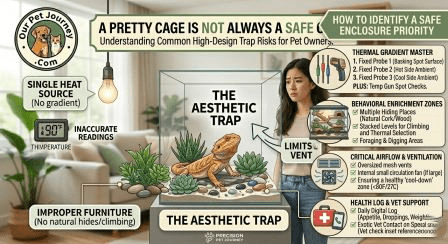
A pretty cage is not always a safe cage.

An educational reptile welfare infographic titled "A Pretty Cage Is Not Always A Safe Cage" by Our Pet Journey, contrasting the hidden dangers of a minimalist aesthetic terrarium setup against proper veterinary care and enrichment standards.Main Title: A Pretty Cage Is Not Always A Safe Cage: Understanding Common High-Design Trap Risks for Pet OwnersVisual Elements & Sections Breakdown for Search Crawlers:The Aesthetic Trap Centerpiece: Features a modern, minimalist glass terrarium setup containing a bearded dragon surrounded by synthetic succulents on fine sand. Callout labels highlight its structural flaws:Single Heat Source: An open lightbulb pointing down with no thermal gradient, leading to inaccurate temperature gauge readings ($90^\circ\text{F}$).Improper Furniture: Sterile rocks and plants offering no natural hides or wood for climbing exercises.Limited Ventilation: Solid glass walls that severely restrict critical cross-airflow.How to Identify a Safe Enclosure Sidebar (Right): A practical care checklists menu highlighting elite reptile welfare priorities:Thermal Gradient Master: Showcases the correct use of three fixed digital probe thermometers (basking surface, hot ambient, cool ambient) plus an infrared temperature gun for spot checks.Behavioral Enrichment Zones: Checkmarks for adding multiple natural wood/cork hiding places, stacked levels for climbing, and safe digging areas.Critical Airflow & Ventilation: Details the necessity of oversized wire mesh vents and small internal circulation fans to secure a healthy cool-down zone below $80^\circ\text{F}$ ($27^\circ\text{C}$).Health Log & Vet Support: Emphasizes logging daily appetite/weight data and keeping an exotic veterinarian's contact on speed dial.Branding Integrity: Features your official circular "Our Pet Journey .Com" dog and cat watermark proudly displayed in the top-left corner, paired with a matching clean green banner header layout.

In 2026, exotic pet keeping has split into two very different paths:

  1. Aesthetic-focused setups — designed to look good for photos and videos
  2. Care-focused setups — designed for the animal’s physical and mental health

This article will help us understand the difference. More importantly, it will help you build a home for our exotic pet that is both safe and nice to look at.
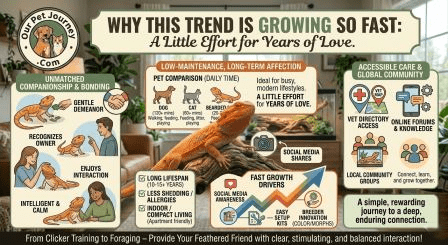

Why This Trend Is Growing So Fast

An educational pet care infographic titled "Why This Trend Is Growing So Fast: A Little Effort for Years of Love" by Our Pet Journey, explaining the rising popularity of bearded dragons over traditional pets due to low maintenance, apartment-friendly living, and global community support.Main Title: Why This Trend Is Growing So Fast: A Little Effort for Years of Love.

Visual Elements & Sections Breakdown for Search Crawlers:

Unmatched Companionship & Bonding Panel (Left): Features illustrations demonstrating a bearded dragon's intelligent and calm nature, showing them recognizing their owner, enjoying gentle handling, and interacting calmly with family members.

Pet Comparison Chart (Center-Top): A practical time-management comparison breakdown between traditional pets and reptiles:

Dog: Requires 120+ mins daily for walking, training, and playing.

Cat: Requires 60+ mins daily for feeding, grooming, and litter box cleanup.

Bearded Dragon: Requires only 20–30 mins daily, making it ideal for busy, modern indoor lifestyles.

Fast Growth Drivers (Center-Bottom): Displays an upward-trending arrow driven by three key factors: Social Media Awareness (with a camera icon for shares), Easy Setup Kits availability, and advanced Breeder Innovation (color morphs). Side checklist notes highlight a long lifespan (10–15+ years), zero fur shedding (hypoallergenic), and apartment-friendly indoor living.

Accessible Care & Global Community Sidebar (Right): Showcases structural modern support systems including digital Vet Directory Access, high-traffic online forums/knowledge bases, and highly connected local community groups.

Center Graphic: Features a gorgeous, vibrant orange bearded dragon calmly resting on a natural piece of driftwood in front of a modern home living room background.

Website Branding: Displays your signature circular "Our Pet Journey .Com" dog and cat logo watermark clearly positioned in the upper-left corner with a premium green frame design.

Social media has changed how people buy and keep pets.

Before 2015, most people learned about pet care from books, vets, or experienced breeders. Today, we learn from a 30-second video.

The problem? A 30-second video cannot teach you about:

  • Proper temperature gradients
  • UVB lighting requirements
  • Humidity levels
  • Stress signs in reptiles
  • Long-term health problems

But a 30-second video can show us a beautiful white terrarium with rainbow LED lights. And that is what sells.

In 2026, some pet stores are even selling “aesthetic pet starter kits” that include colored sand, small round tanks, and decorative lights. Many of these products are actually dangerous for the animal.
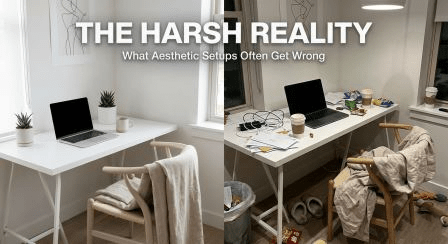

The Harsh Reality: What Aesthetic Setups Often Get Wrong

A side-by-side comparison image titled "The Harsh Reality: What Aesthetic Setups Often Get Wrong," contrasting a perfectly minimalist staged home office on the left with a cluttered, real-life functional workspace on the right.Main Title Text: THE HARSH REALITY: What Aesthetic Setups Often Get Wrong

Visual Presentation & Scene Breakdown:

The Staged Illusion (Left Side): Displays an idealized, bright, and ultra-clean white minimalist desk workspace setup. It features a neatly shut laptop, a single clean ceramic mug, and small potted succulent plants perfectly positioned under natural window daylight to symbolize how social media curated trends look initially.

The Authentic Reality (Right Side): Reveals the true everyday usability look of the exact same workspace under real conditions. The desk is filled with dense functional clutter, including open laptop screens, tangled charging cables and power bricks, scattered mail envelopes, coffee cups, snack wrappers, a full trash bin on the floor, and personal items thrown over the wooden chair.

Conceptual Relevance: Serves as a perfect visual metaphor for your exotic pet article, showing the massive gap between a visually curated "aesthetic" design on social media versus the messy, high-maintenance reality of everyday functional management.

Let me be very clear. Wanting your pet’s home to look nice is not bad. I want my pet’s home to look nice too. The problem happens when looking nice becomes more important than working correctly.

Here are the most common mistakes seen in aesthetic exotic pet setups:
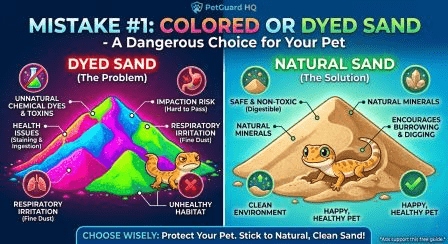
Mistake #1: Colored or Dyed Sand

An educational reptile care infographic titled "Mistake #1: Colored or Dyed Sand" contrasting the toxic dangers of artificially dyed substrate against safe, natural burrowing sand for geckos and lizards.Main Title: MISTAKE #1: COLORED OR DYED SAND - A Dangerous Choice for Your Pet

Visual Presentation & Split-Screen Comparison:

Dyed Sand / The Problem (Left Side): Shows an unhappy, stressed leopard gecko sitting next to a pile of neon pink, blue, and bright green sand. Multiple red warning icons and labels point out severe health risks:

Unnatural Chemical Dyes & Toxins: Chemical flask icon highlighting synthetic additives.

Impaction Risk: Stomach icon warning that artificial sand is hard to pass if accidentally swallowed.

Respiratory Irritation: Lung icon explaining that the fine dust hurts the respiratory tract.

Health Issues: Warning about physical body staining and ingestion sickness.

Natural Sand / The Solution (Right Side): Shows a happy, smiling leopard gecko burrowing comfortably into a pile of clean, natural desert sand. Green checkmark icons highlight the benefits:

Safe & Non-Toxic: Highly digestible and organic for desert reptiles.

Natural Minerals: Contains safe earth minerals with no artificial coloring.

Encourages Burrowing & Digging: Supports natural wild instincts and enrichment.

Clean Environment: Promotes a happy, thriving, and healthy pet lifestyle.

Bottom Banner Text: "CHOOSE WISELY: Protect Your Pet. Stick to Natural, Clean Sand!" along with a neat AdSense disclosure note (Ads support this free guide.).

What it looks like: Bright blue, pink, purple, or black sand

Why people use it: It looks beautiful and matches room decor

The real problem:

  • Many dyed sands contain chemicals that can irritate your pet’s skin and eyes
  • If your pet accidentally eats the sand (which happens often when they catch food), the dye can be toxic
  • Colored sand is often made of crushed limestone or marble, which clumps inside the animal’s stomach

What to do instead: Use natural, undyed play sand mixed with organic topsoil. It looks natural and is much safer.

Mistake #2: Round or Tall Tanks

An educational reptile care infographic titled "Mistake #2: Round or Tall Tanks" comparing the psychological and physical dangers of vertical glass globes against a safe horizontal vivarium setup for geckos.Main Title: MISTAKE #2: ROUND OR TALL TANKS - The 'Pretty' Setup vs. Reality

Visual Presentation & Scene Breakdown:

Round/Tall Tanks / The Dangers (Left Side): Features a stressed, wide-eyed leopard gecko confined inside a small, spherical glass bowl standing on a pedestal. Multiple red warning labels detail severe design flaws:

Severe Lack of Floor Space: Limited ground area for the animal to walk or explore.

Stressful Open Sides: 360-degree clear view offers zero privacy or psychological security, symbolized by watching eyes.

Poor Ventilation & Humidity Stagnation: Stale air trapped inside the curved glass walls.

Limited Hiding & Foraging Opportunities: No space to fit proper environmental enrichment.

Deadly "Fun House Effect" (Glass Surfing): Distorted reflections that trigger anxiety and compulsive pacing behaviors.

Horizontal Vivarium / The Safe Setup (Right Side): Shows a happy, smiling leopard gecko thriving inside a spacious, long rectangular wooden and glass enclosure. Green positive icons highlight optimal care standards:

Ample Floor Space: Plenty of horizontal room for roaming.

Secure Hiding Places: Multiple caves and cork logs that promote mental security.

Excellent Ventilation & Humidity Control: Proper cross-airflow vents built into the structure.

Thermal & Enrichment Zones: Clear areas to establish distinct warm and cool sides.

Critical Multi-Level Gradient & Hides: Sturdy rocks and logs that allow safe climbing and behavioral freedom.

Bottom Footer Banner: "CHOOSE FUNCTION: Protect Your Pet. Prioritize Horizontal Space & Security!" with an AdSense helper note (Ads support this free guide.)

What it looks like: Beautiful round glass tanks or tall cylindrical enclosures

Why people use them: They look unique and modern

The real problem:

  • Most exotic pets (bearded dragons, geckos, snakes) need floor space, not height
  • Round tanks make it very hard to create a proper temperature gradient (hot side and cool side)
  • Air does not flow well in round tanks, leading to mold and bacteria

What to do instead: A standard rectangular front-opening tank. It may look less “artsy,” but it works better for your pet.
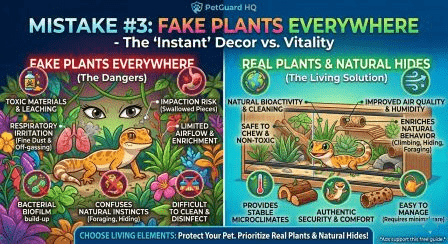
Mistake #3: Fake Plants Everywhere

An educational reptile care infographic titled "Mistake #3: Fake Plants Everywhere" contrasting the toxic and bacterial dangers of plastic decorations against safe, bioactive real plants and natural wood hides for geckos.Main Title: MISTAKE #3: FAKE PLANTS EVERYWHERE - The 'Instant' Decor vs. Vitality

Visual Presentation & Scene Breakdown:

Fake Plants Everywhere / The Dangers (Left Side): Shows a stressed leopard gecko crowded inside a dense, overwhelming jungle of neon plastic leaves and synthetic flowers. Red warning labels point out serious husbandry flaws:

Toxic Materials & Leaching: Plastic bottle icon warning about chemical off-gassing and dye leeching under intense basking heat.

Impaction Risk: Stomach icon detailing the danger of swallowed plastic pieces or leaves.

Bacterial Biofilm Build-up: Microbe icon showing how plastic surfaces trap moisture and harbor harmful bacteria.

Confuses Natural Instincts: Restricts natural foraging, hunting, and climbing behaviors.

Difficult to Clean & Disinfect: Intricate fake foliage makes removing waste highly challenging.

Real Plants & Natural Hides / The Living Solution (Right Side): Displays a happy, smiling leopard gecko in a clean, bioactive wooden terrarium decorated with live succulents and cork bark logs. Green positive icons highlight optimal care:

Natural Bioactivity & Cleaning: Earth icon representing self-sustaining, natural waste breakdown.

Safe to Chew & Non-Toxic: Live, reptile-safe plants present zero ingestion dangers.

Improved Air Quality & Humidity: Assists in maintaining perfect ambient air moisture cycles naturally.

Provides Stable Microclimates: Live soil and roots offer cooler, safer burrowing zones.

Authentic Security & Comfort: True-to-nature elements that reduce long-term psychological stress.

Bottom Footer Banner: "CHOOSE LIVING ELEMENTS: Protect Your Pet. Prioritize Real Plants & Natural Hides!" with an AdSense monetization note (Ads support this free guide.).

What it looks like: Lush, jungle-like decorations with no empty space

Why people use them: It looks like a miniature rainforest

The real problem:

  • Too many decorations leave no room for your pet to move
  • Some fake plants have small parts that pets can chew off and swallow
  • Plastic plants can have sharp edges that cut delicate reptile skin
  • You cannot easily see your pet to check if they are sick or injured

What to do instead: Use fewer decorations. Leave open walking space. Only use reptile-safe fake plants from trusted brands.

Mistake #4: LED or Colored Night Lights

An educational reptile care infographic titled "Mistake #4: LED or Colored Night Lights" contrasting the sleep-disrupting dangers of artificial night lighting against the health benefits of complete natural darkness for a gecko's circadian rhythm.Main Title: MISTAKE #4: LED OR COLORED NIGHT LIGHTS - Sleep-Disrupting Decor vs. Circadian Rhythm

Visual Presentation & Scene Breakdown:

Colored Night Lights / The Dangers (Left Side): Shows a stressed leopard gecko under a harsh, unnatural glow of red and blue ambient night lights. Red warning labels detail critical health risks:

Disrupted Circadian Rhythm: Clock icon highlighting how artificial night colors destroy the animal's internal day-night cycle.

Stress & Behavioral Issues: Stressed eye icons showing constant anxiety and agitation.

Vision Impairment & Reduced Eye Health: Warning about direct eye strain from colored bulbs.

Increased Predator Risk Sensation: Shadow bird icon indicating the pet constantly feels exposed and unsafe.

Sleep Deprivation (Chronic Fatigue): Sleeping gecko icon with a red cross, pointing out lack of restful sleep.

Natural Darkness / The Circadian Solution (Right Side): Shows a happy, smiling leopard gecko peering out from a dark cork bark hide inside its horizontal vivarium during a proper night cycle. Green positive icons highlight optimal care:

Promotes Healthy Sleep Patterns: Moon and sleeping gecko icon showing true restful restoration.

Vital Circadian Regulation: Sun and moon cycle icon representing perfect metabolic patterns.

Stabilized Behavior & Mood: Displays a relaxed reptile with enhanced behavioral calm.

Improved Digestion & Metabolism: Stomach icon showing how proper sleep schedules aid regular nutrient processing.

Enhanced Long-Term Health: Gecko silhouette icon highlighting sustained physical vitality.

Bottom Footer Banner: "CHOOSE NATURAL DARKNESS: Protect Your Pet. Prioritize Nighttime Rest & True Sleep Cycles!" with an AdSense helper note (Ads support this free guide.).

What it looks like: Blue, red, or purple glowing lights at night

Why people use them: They look magical and let you see your pet at night

The real problem:

  • Reptiles and amphibians can actually see colored lights. They are not invisible.
  • Colored lights at night disrupt their sleep cycle
  • Without proper darkness, your pet will become stressed and may stop eating

What to do instead: Complete darkness at night. If you need heat, use a ceramic heat emitter that produces zero light.

Mistake #5: Small “Cute” Water Bowls

An educational reptile hydration infographic titled "Mistake #5: Small 'Cute' Water Bowls" contrasting the dehydration and tipping risks of novelty miniature dishes against a large, stable functional soaking bowl for geckos.Main Title: MISTAKE #5: SMALL 'CUTE' WATER BOWLS - 'Decorative' Inconvenience vs. Functional Hydration

Visual Presentation & Split-Screen Comparison:

Cute & Small Bowls / The Problems (Left Side): Shows a sluggish, dehydrated leopard gecko standing on dry, cracked earth surrounded by tiny novelty dishes (a teacup, a skull, a small boat, and a tiny mug). Red warning labels outline the functional failures:

Insufficient Water Capacity: Water droplet with a cross icon, highlighting rapid evaporation under heat lamps.

Fast Contamination: Dust, substrate debris, and bacteria easily spoil tiny volumes of water.

Unstable & Easy to Tip: Tipping bowl icon showing how lightweight decorative dishes easily spill, causing wet, unhygienic substrates.

Limited Soaking & Enrichment: Prevents reptiles from shedding skin properly or cooling down through body soaking.

Large, Functional Bowl / The Solution (Right Side): Shows a vibrant, happy leopard gecko smiling while soaking comfortably inside a heavy, stone-textured wide water dish. Green positive icons highlight optimal hydration standards:

Ample Water Capacity: Water gauge icon showing stable, long-term hydration volumes.

Easy Access for Drinking & Soaking: Low, sturdy rims designed for natural reptile entry and shedding assistance.

Reduced Contamination Risk: Larger water surface stays fresh longer and keeps dirt diluted.

Stable & Sturdy: Heavy base that prevents accidental spills or tipping over.

Supports Behavioral Freedom: Encourages healthy, self-regulating bathing and hydration habits.

Bottom Footer Banner: "CHOOSE FUNCTION: Protect Your Pet. Prioritize Large, Stable Water Access!" along with your standard AdSense credit line (Ads support this free guide.).

What it looks like: Tiny, decorative ceramic bowls shaped like leaves or skulls

Why WE SHOULD use them: They match the theme of the tank

The real problem:

  • Many exotic pets need to soak their whole body in water to shed properly
  • A tiny bowl does not hold enough water
  • Small bowls dry out quickly in hot tanks

What to do instead: A large, shallow, heavy water bowl that your pet can sit inside.
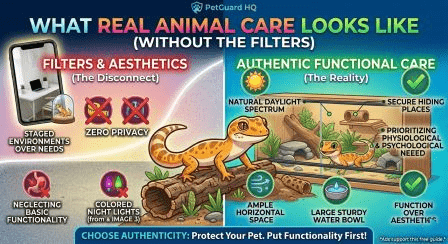

What Real Animal Care Looks Like (Without the Filters)

An educational pet care comparison infographic titled "What Real Animal Care Looks Like (Without the Filters)," contrasting staged social media aesthetic setups against authentic, functional, and healthy reptile husbandry.Main Title: WHAT REAL ANIMAL CARE LOOKS LIKE (WITHOUT THE FILTERS)

Visual Presentation & Split-Screen Comparison:

Filters & Aesthetics / The Disconnect (Left Side): Features a smartphone screen displaying a photo of a leopard gecko in a tiny, round glass bowl, representing curated social media trends. Red icons and labels highlight the harsh reality:

Staged Environments Over Needs: Prioritizing how a tank looks on camera rather than the animal's physical health.

Zero Privacy: Showing the stress caused by open, exposed habitats.

Neglecting Basic Functionality: Warning against style-over-substance choices like dangerous colored night lights.

Authentic Functional Care / The Reality (Right Side): Shows a happy, thriving gecko in a properly equipped, spacious horizontal wooden vivarium. Green icons and checkmarks highlight key husbandry pillars:

Natural Daylight Spectrum: Proper full-spectrum lighting for health.

Secure Hiding Places: Emphasizing the need for mental and physical security.

Prioritizing Physiological & Psychological Needs: Putting the pet's natural instincts and comfort first.

Ample Horizontal Space & Sturdy Water: Highlighting the fundamentals of proper movement and hydration.

Function Over Aesthetics: The core philosophy of "real" pet keeping.

Bottom Footer Banner: "CHOOSE AUTHENTICITY: Protect Your Pet. Put Functionality First!" along with your standard AdSense credit line (Ads support this free guide.).

Now let me tell you what a good exotic pet setup actually looks like. It may not get a million likes on TikTok, but it will keep your pet alive and happy for 10 to 20 years.
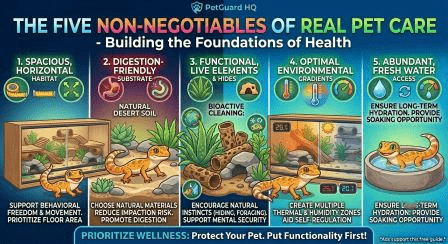
The Five Non-Negotiables of Real Pet Care

1. Correct size first, beauty second

Before you buy any decoration, buy the right size tank. Most exotic pets need much more space than pet stores recommend. A bearded dragon needs at least 120 gallons. A leopard gecko needs at least 40 gallons. A ball python needs at least 120 gallons.

2. Proper lighting is not optional

Many aesthetic setups use cute little LED strips. But LEDs provide zero UVB or UVA. Without UVB light, reptiles cannot process calcium. Without calcium, their bones turn to rubber. This is called Metabolic Bone Disease, and it is painful and permanent.

You need a T5 UVB tube light. It is not pretty. It is not decorative. But it is the most important thing you will buy.

3. Temperature and humidity first

Your pet cannot say, “I am too hot” or “I am too cold.” They just suffer silently.

You must have:

  • A digital thermometer on the hot side
  • A digital thermometer on the cool side
  • A humidity gauge
  • An infrared temperature gun to check surface temperatures

These tools are not beautiful. But they save lives.

4. Hides over decorations

In the wild, exotic pets spend most of their time hiding from predators. A pet that cannot hide is a stressed pet. A stressed pet stops eating, gets sick easily, and may die young.

For every exotic pet, you need:

  • At least one hide on the hot side
  • At least one hide on the cool side
  • A humid hide for shedding

A simple cardboard box with a hole cut in it works perfectly as a hide. It is not aesthetic. But your pet will love it more than any expensive decoration.

5. Simple substrate is safer

The safest flooring options are not beautiful. Reptile carpet, slate tile, paper towels, and shelf liner are all extremely safe and easy to clean.

Loose substrates like sand and soil can look more natural, but they come with risks for beginners. If you choose loose substrate, you must research exactly which type is safe for your specific pet.
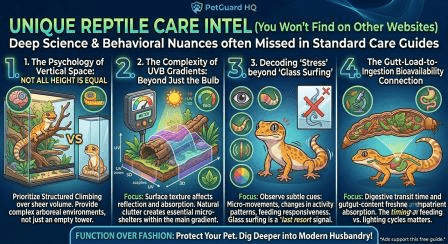

Unique Information You Will Not Find on Other Websites

An educational advanced reptile science infographic titled "Unique Reptile Care Intel" detailing the psychological impact of vertical space, 3D UVB gradients, subtle stress behaviors beyond glass surfing, and gut-load-to-ingestion bioavailability for geckos.Main Title: UNIQUE REPTILE CARE INTEL (You Won't Find on Other Websites) - Deep Science & Behavioral Nuances often Missed in Standard Care Guides

Visual Presentation & 4-Column Scientific Breakdown:

Column 1: The Psychology of Vertical Space (Not All Height is Equal): * Visual: Shows a split comparison. On the left, a happy gecko explores a structured climbing environment with sturdy branches and platforms built inside a tall terrarium. On the right, a sad, stressed gecko sits at the bottom of an empty, tower-like glass tank.

Key Focus: Prioritize structured climbing over sheer volume. Provide complex arboreal environments, not just an empty glass tower.

Column 2: The Complexity of UVB Gradients (Beyond Just the Bulb): * Visual: A detailed diagram of a terrarium cross-section under a digital UV meter. A glowing sun icon projects 3D UV zones over a cork bark hide and live plants, showing how light waves bounce and absorb.

Key Focus: Surface texture affects reflection and absorption. Natural clutter creates essential micro-shelters within the main gradient.

Column 3: Decoding 'Stress' Beyond 'Glass Surfing': * Visual: A close-up of a leopard gecko showing subtle body language cues. Surrounding icons illustrate micro-movements, changes in activity patterns, feeding responsiveness, and eye focus. A background graphic shows a red cross over a lizard climbing the glass.

Key Focus: Observe subtle cues: Micro-movements, changes in activity patterns, and feeding responsiveness. Glass surfing is a last resort signal.

Column 4: The Gut-Load-to-Ingestion Bioavailability Connection: * Visual: An anatomical cross-section diagram of a gecko showing its digestive system tract. Above it, a large feeder insect (roach/worm) is shown filled with fresh, nutrient-dense gut-load material under a microscope lens icon.

Key Focus: Digestive transit time and gut-content freshness impact nutrient absorption. The timing of feeding vs. lighting cycles matters.

Bottom Footer Banner: "FUNCTION OVER FASHION: Protect Your Pet. Dig Deeper into Modern Husbandry!" with the professional AdSense disclosure widget (Ads support this free guide.).

Most pet care articles stop here. But I want to give you something truly different — information from real exotic pet owners, rescue workers, and exotic vets that rarely gets shared online.
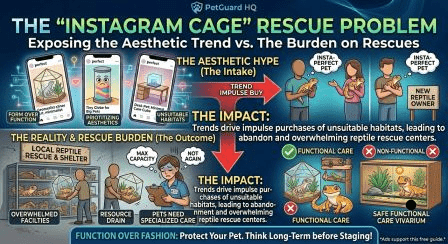
The “Instagram Cage” Rescue Problem

An educational infographic titled "The Instagram Cage Rescue Problem" illustrating how social media aesthetic trends drive impulse pet purchases in unsuitable habitats, ultimately overwhelming reptile rescue shelters.Main Title: THE "INSTAGRAM CAGE" RESCUE PROBLEM - Exposing the Aesthetic Trend vs. The Burden on Rescues

Visual Presentation & Flow Analysis:

The Aesthetic Hype / The Intake (Top Left & Right): Three smartphone screens display trendy social media posts featuring geckos in minimalist geometric containers and tiny decorative desktop globes with captions like "Form Over Function." This aesthetic hype leads directly to a large red arrow labeled "Trend Impulse Buy," showing everyday people purchasing reptiles solely for the "insta-perfect" look.

The Impact Text: "Trends drive impulse purchases of unsuitable habitats, leading to abandonment and overwhelming reptile rescue centers."

The Reality & Rescue Burden / The Outcome (Bottom Left): Shows a sad shelter worker holding a clipboard inside a crowded "Local Reptile Rescue & Shelter." She is surrounded by overwhelmed facilities, stacked tanks at max capacity, and a person surrendering a lizard in a tiny geometric glass cage, causing a massive resource drain.

Functional Comparison (Bottom Right): Contrasts a dangerous, non-functional geometric glass terrarium (marked with red crosses) against a spacious, healthy, and "Safe Functional Care Vivarium" equipped with a proper heat lamp, live plants, and natural substrate (marked with green checkmarks).

Bottom Footer Banner: "FUNCTION OVER FASHION: Protect Your Pet. Think Long-Term before Staging!" along with your standard AdSense credit (Ads support this free guide.).

Exotic pet rescues across the United States and Europe are reporting a new trend. Starting around 2022, they began seeing more animals surrendered from “aesthetic homes” than from neglectful homes.

Why? Because owners bought a beautiful setup for social media, but they did not learn real care. After six months, the animal became sick, or the owner lost interest, or the owner realized the pretty setup was actually harming the pet.

One rescue worker told me, “We would rather take an animal from a boring tub with paper towels and a heat mat than from a $500 aesthetic terrarium with the wrong lighting. At least the boring tub kept the animal alive.”
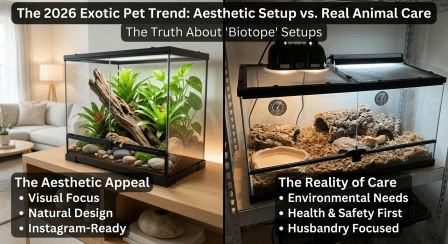
The Truth About “Biotope” Setups

A side-by-side comparison infographic titled 'The 2026 Exotic Pet Trend: Aesthetic Setup vs. Real Animal Care - The Truth About Biotope Setups'. On the left, 'The Aesthetic Appeal' shows a lush, heavily planted reptile terrarium designed for interior design. On the right, 'The Reality of Care' shows a functional reptile enclosure with proper heating lamps, gauges, substrate, and hides optimized for leopard gecko husbandry.

You may have seen the word “biotope” online. It means a setup that perfectly copies a wild habitat. They look incredible.

But here is what those videos do not show: Building a true biotope setup takes months of research, hundreds of dollars, and constant maintenance. It is not for beginners. And even then, a wild-style setup is often harder to keep clean and safe.

Do not let perfect be the enemy of good. A simple, safe, clean tank is better than a complicated, risky, beautiful tank.

The 30-Day Test

"A split-screen comparison infographic titled 'The 30-Day Test: A Journey of Commitment.' The left side, 'Day 1 - The Start,' shows a woman in a kitchen seriously filling out a physical calendar titled 'THE 30-DAY LIFESTYLE TEST.' The right side, 'Day 30 - The Result,' shows the same woman smiling and flexing outdoors, holding the completed calendar full of checkmarks."

Before you buy any decoration or accessory for your pet’s tank, ask yourself this question:

“Does this item directly help my pet eat, sleep, hide, shed, or stay warm?”

If the answer is no, wait 30 days before buying it. Most of the time, you will realize you do not need it.

This simple rule has saved exotic pet owners thousands of dollars on unnecessary decorations.
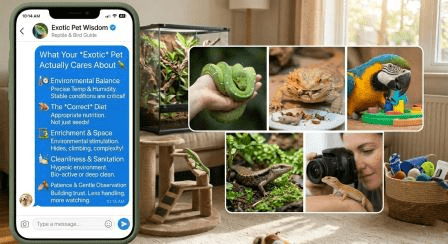
What Your Pet Actually Cares About

"An informative graphic titled 'What Your Exotic Pet Actually Cares About', featuring a five-point checklist on a smartphone screen. Points include Environmental Balance (temp & humidity), Correct Diet (not just seeds), Enrichment & Space, Cleanliness & Sanitation, and Patience & Gentle Observation. Accompanying realistic photos show a parrot with a toy, a bearded dragon eating, a terrarium, a small lizard on a climbing stand, and a person carefully observing a gecko. A green tree python is also shown being held."

I want you to think about this. Your pet does not know what Instagram is. Your pet does not know what “aesthetic” means. Your pet does not care if the tank matches your bedroom curtains.

Here is what your pet actually cares about:

  • Am I warm enough?
  • Am I cool enough?
  • Can I hide?
  • Is there clean water?
  • Is there good food?
  • Am I safe?

That is it. Six things. Get those six things right first. Then, if you want to add some safe decorations to make the tank look nice, go ahead. But never trade safety for beauty.
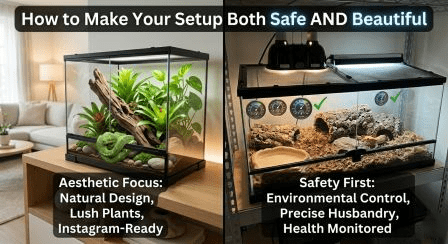

How to Make Your Setup Both Safe AND Beautiful

How to Make Your Setup Both Safe AND Beautiful

You do not have to choose between good care and good looks. You just need to put care first. Here is how:
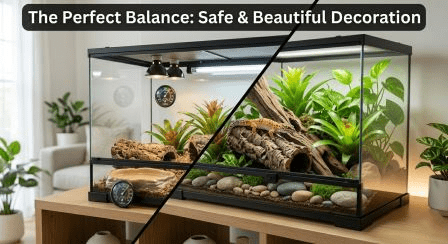
Safe Decoration Ideas That Still Look Great

A detailed close-up photograph of a sophisticated naturalistic vivarium for a leopard gecko, diagonally divided to show 'The Perfect Balance: Safe & Beautiful Decoration'. The left section focuses on safety first, displaying multiple digital temperature and humidity gauges with large, legible dials, multiple cork bark hide tubes, and a shallow water dish, emphasizing environmental monitoring and security. The right section showcases aesthetic appeal with lush, diverse live tropical plants (like bromeliads and pothos) arranged on weathered driftwood, organic substrate, and river stones, highlighting beautiful natural design. A single leopard gecko, seen previously in other setups, is resting comfortably on a large cork hide. Protected heat lamps and a visible UVB light are mounted above the mesh top, integrated into the design. The setup is clean, modern, and sits in a brightly lit, minimalist living space, demonstrating that complex husbandry and visual appeal are achievable in one enclosure.
DecorationSafe?How to Use It Safely
Natural slate tileYesUse as flooring. Easy to clean, looks like stone.
Cork barkYesGreat for climbing. Looks natural.
Safe live plants (pothos, snake plant)YesOnly for tropical pets. Adds real beauty and helps humidity.
3D foam backgroundsYesAttach securely so pet cannot get behind it.
Undyed leaf litterYesGreat for forest-floor setups.
Colored sandNoNever use.
Moss ballsYesOnly if your pet will not eat them.
Small plastic figuresMaybeOnly if large, smooth, and securely placed.

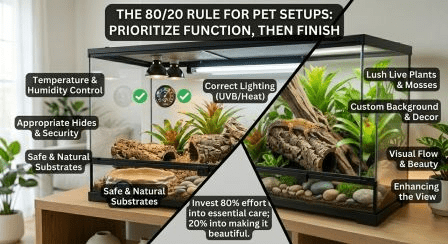
The 80/20 Rule for Pet Setups

I've created an image illustrating the 80/20 Rule for pet setups, applying the concept to the established terrarium designs. The infographic visually splits a setup to show that 80% of your focus should go to essential function (husbandry, hides, and monitoring), and 20% to the beautiful finish (live plants and custom decor), allowing both to thrive together.

Use this simple rule:

  • 80% of your budget should go to: tank, heating, lighting, thermometers, hides, water bowl, food, supplements
  • 20% of your budget can go to: decorations, backgrounds, extra plants, aesthetic touches

This rule keeps your priorities straight while still allowing you to create something beautiful.
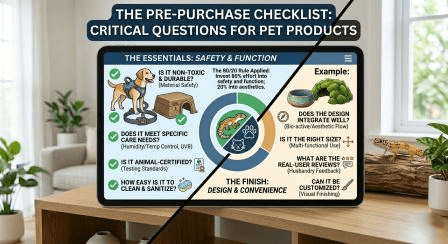

Questions to Ask Before Buying Any Pet Product

I have created an image that transforms the decision process for buying pet products into a checklist infographic. This visual uses a diagonal split-screen on a tablet interface, mirroring the 80/20 conceptual layout from your context image. The left side focuses on essential safety and function (non-toxic materials, correct husbandry, cleanliness), while the right side handles the design and convenience (aesthetic integration, size, real-user reviews). The central circular graphic reminds users to prioritize function first.

Before you click “buy” on any pet product online or in a store, ask these five questions:

  1. Is this product recommended by exotic vets? (Not just influencers)
  2. Has this product injured or killed pets before? (Search online for reviews)
  3. Does this product solve a real need my pet has?
  4. Would I use this product if no one would ever see it?
  5. Is there a simpler, cheaper, safer version of this product?

If you cannot answer yes to at least three of these questions, do not buy the product.


Final Thoughts: Be a Good Pet Owner First, Content Creator Second

It uses a clean, two-part design separated by a central diagonal line, visualizing the concept that being a good pet owner—prioritizing daily care, safety, and a deep bond—must always come before the role of a content creator sharing that journey. The central infographic explicitly weights care at 80% and creation at 20%, ensuring the gecko (the pet) remains the true focus.

I understand wanting a beautiful setup. I really do. Our pets’ homes are in our living spaces. We look at them every day. It feels good to create something pretty.

But please remember: your pet did not choose to live in your home. You chose to bring them there. They are completely dependent on you for everything — warmth, safety, food, water, health.

A sick or dead pet does not care how pretty their cage looked.

In 2026, be the pet owner who does the boring stuff right. Buy the proper UVB light. Check the temperatures every day. Clean the water bowl. Give your pet places to hide.

And then, once all of that is perfect, add a few safe decorations to make it your own.

Your pet will never thank you with words. But they will thank you by living a long, healthy, stress-free life. And that is more beautiful than any Instagram post.
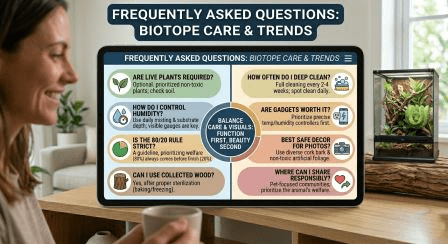

Frequently Asked Questions

An infographic on a tablet titled 'The Good Pet Owner's Final Thoughts' sitting in a living room. The screen displays a split checklist: '#1 Be a Good Pet Owner First' focusing on daily care and safety, and '#2 Content Creator' focusing on responsible education. A central pie chart allocates 80% to Care and 20% to Creation. Next to the tablet, a smiling woman gently holds a healthy leopard gecko.

Q: Can I use any LED lights in my pet’s tank?
A: LEDs are fine for daytime viewing, but they must be turned off at night. LEDs do not provide heat or UVB, so you still need proper heating and UVB bulbs.

Q: Is a bioactive setup safe for beginners?
A: Bioactive setups (with live plants, clean-up crew bugs, and soil) are usually not safe for first-time owners. They require advanced knowledge. Start simple, then upgrade later.

Q: My pet’s current setup is very aesthetic but seems healthy. Should I change it?
A: If your pet is eating, shedding, and behaving normally, do not panic. But please review the five mistakes above. Remove any colored sand, round tanks, or colored night lights immediately. The rest can stay if your pet is thriving.

Q: How do I know if my pet is stressed?
A: Common stress signs include: not eating, hiding all the time, being aggressive, glass surfing (pacing the walls), dark colors (in reptiles), and weight loss.

Q: What is the single most important thing for a new exotic pet owner to buy?
A: A proper UVB light for reptiles, or a proper heat source for other exotics. Do not save money on lighting and heating. Buy the best you can afford.


About the Author

This article was written for pawsandantlers.com — a website dedicated to helping pet owners give their animals the best possible care. We believe in honest, research-backed advice over trends and social media hype.

Disclaimer: This article is for informational purposes only. Always consult a licensed exotic veterinarian for medical advice about your specific pet.


Leave a Reply

Your email address will not be published. Required fields are marked *

Latest Posts