You know your dog better than anyone. You know when they’re happy, when they’re nervous, when they’re plotting to steal that sandwich off the counter.
Table of Contents
You know your dog better than anyone. You know when they’re happy, when they’re nervous, when they’re plotting to steal that sandwich off the counter.
But here’s the thing: scientists have been busy studying your dog too. And in 2025 and 2026, they’ve made some genuinely mind-blowing discoveries that most pet owners haven’t heard about yet.
This isn’t the usual “dogs are great” fluff. These are real, peer-reviewed studies that reveal just how extraordinary our four-legged friends really are.
1. Your Dog Can “Smell” Joy and Stress in Other Dogs
We already knew dogs could smell fear in humans. But a 2026 study published in Scientific Reports took this a step further.
Researchers collected odor samples from dogs during three different emotional states: joyful (play sessions), stressful (vet visits), and relaxed (baseline). Then they presented these odors to other dogs.
The results were remarkable. Dogs not only distinguished between the different emotional odors, but they also changed their behavior depending on what they smelled.
Here’s the really cool part: When dogs smelled “stress” odors from another dog, they showed attachment-related behaviors—they stayed closer to their owners and avoided strangers.
In other words, dogs aren’t just smelling “something.” They’re smelling emotions. And they’re responding in ways that suggest they actually feel what the other dog is feeling—a phenomenon scientists call “emotional contagion.”
What this means for you: Your dog is constantly picking up emotional cues from other dogs through scent. If you’re at the dog park and your dog suddenly gets clingy, they might be smelling stress from another dog—not just reacting to what’s happening around them.
2. The “Fear Gene” Has Been Found
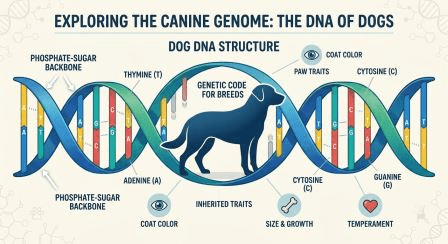
This is huge. A 2026 study identified a specific gene called HMGA2 that regulates fear in dogs.
Here’s why this matters: fear is strongly correlated with body size in dogs—smaller dogs tend to be more fearful. But scientists always wondered: is the fear itself linked to size, or are these two traits controlled by the same gene?
The answer: The HMGA2 gene controls both fear and body size—but the researchers proved that its effect on fear is independent of its effect on growth.
They even confirmed this by experimenting with mice. When they increased HMGA2 activity in specific brain regions, the mice showed reduced fear memory. When they knocked the gene out, the mice showed enhanced fear memory.
The deeper implication: Dogs naturally experience fear behaviors that mirror human anxiety disorders, making them a powerful model for understanding the genetics of fear in humans. This research could potentially help us understand—and eventually treat—anxiety disorders in both species.
What this means for you: If your dog is naturally fearful, it might not be “bad training” or “lack of socialization.” It could be written in their genes. That doesn’t mean you can’t help them—but it does mean you should be patient and understanding.
3. Dogs and Humans Evolved to Think Alike—More Than We Do With Chimps
This one will blow your mind.
A 2025 study published in Scientific Reports compared the regulatory DNA sequences of dogs, wolves, foxes, and several primates—including humans and chimpanzees.
What they found was astonishing: dogs have evolved cognitive abilities that are more similar to humans than chimpanzees are.
Wait, what? Our closest genetic relatives—chimpanzees—share about 98% of our DNA. But when it comes to regulatory sequences (the parts of DNA that control when and where genes are activated), dogs are more like us than chimps are.
The study found that genes involved in myelination, long-term memory, and cochlear development are significantly enhanced in both humans and dogs—but not in wolves.
Translation: During domestication, dogs evolved to think more like us. Their brains are wired in ways that parallel our own cognitive abilities. They understand our pointing, our gestures, our voice commands—and they do it better than our closest primate relatives.
What this means for you: When you feel like your dog “gets” you, science says you’re not imagining it. Thousands of years of evolution have literally reshaped your dog’s brain to be more like yours.
4. Your Dog Might Be Addicted to Their Favorite Toy
Ever seen a dog obsess over a toy to the point of exhaustion? A 2025 study finally investigated this behavior scientifically.
Researchers studied 105 dogs who were described by their owners as “motivated to play with toys.” They identified behaviors that mirror behavioral addictions in humans—like gambling or internet gaming addiction.
The findings: 33 of the 105 dogs exhibited addictive-like behaviors, including:
Excessive fixation on their toy
Lack of interest in alternatives (food, playing with their owner)
Persistent efforts to access the toy when it was unavailable
Inability to calm down for 15 minutes after the toy was removed
Prioritizing access to the toy over food or social interaction
Here’s the important part: This is the first published scientific evaluation of such behaviors in dogs. The researchers note that further study is needed to understand whether this negatively impacts welfare.
What this means for you: If your dog is absolutely obsessed with a particular toy, it might not just be “cute.” It could be a genuine compulsive behavior. Watch for signs that the obsession is interfering with normal activities—eating, socializing, resting. If it is, talk to your vet or a behaviorist.
5. Gut Bacteria Are Linked to Anxiety and Aggression
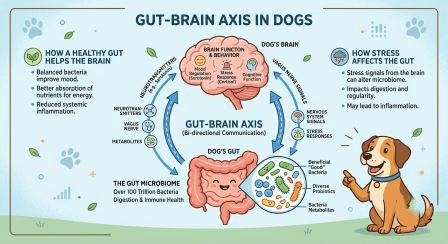
We’ve heard a lot about the “gut-brain axis” in humans. But a 2025 study confirmed it applies to dogs too—and identified specific bacteria linked to behavioral issues.
Researchers analyzed fecal samples from pet dogs and compared their gut microbiome composition to their anxiety and aggression scores (measured through a validated questionnaire called C-BARQ).
The key finding: One specific bacterial genus—Blautia—was consistently linked to higher anxiety scores.
The study, led by Memorial University researcher Sarita Pellowe, found that the gut microbiome composition could predict behavioral group membership using machine learning.
What’s the takeaway? The gut-brain connection is real in dogs. An unhealthy gut might contribute to anxiety—and anxiety might disrupt the gut in a vicious cycle.
What this means for you: If your dog is anxious, talk to your vet about gut health. Probiotics, dietary changes, and other gut-supporting interventions could potentially help—but always consult a professional first.
6. Dogs Can Read Human Intentions—Even Without Seeing Us
A 2025 study challenged dogs to anticipate the behavior of a human they couldn’t see.
The setup was clever: dogs were prohibited from doing something (like taking a treat) by a human who was present. Then the human left the room. Researchers tested whether the dogs understood that the rule still applied even though the human was gone.
The findings provided “evidence that dogs anticipate the behavior of humans without relying on observable visual cues.”
In plain English: Your dog doesn’t just follow your commands. They understand that you have intentions—and they can predict what you would want, even when you’re not there to tell them.
This is a form of perspective-taking—the ability to understand that others have mental states that differ from your own. It’s a cognitive skill that’s rare in the animal kingdom.
What this means for you: Your dog knows you better than you think. They’re constantly modeling your intentions, predicting your behavior, and adjusting accordingly. That’s not just obedience—that’s genuine understanding.
7. Dogs Yawn Contagiously Because They Empathize (Not Because They’re Stressed)
We’ve known for years that dogs yawn when they see humans yawn. But there was always a question: is this empathy or stress?
A 2025 study finally settled the debate.
Researchers exposed 25 dogs to humans (either their owner or a stranger) who were either yawning or making a control open-mouth movement. They measured the dogs’ heart rates to evaluate stress.
The results: Dogs yawned significantly more in response to real yawns. They yawned more in response to their owner than to a stranger. And most importantly—heart rates did not change.
This confirms that contagious yawning in dogs is an empathetic response, not a stress response.
Here’s the kicker: Dogs don’t yawn contagiously with other dogs—only with humans. The researchers suggest that this ability may have evolved specifically for communicating with humans.
What this means for you: When your dog yawns after you yawn, they’re not just copying you. They’re showing genuine empathy. And they developed this ability just for you.
What This All Means
Here’s the bigger picture: science is confirming what dog lovers have always known.
Dogs don’t just seem to understand us. They have actually evolved to think like us at a genetic level. They feel our emotions—and the emotions of other dogs. Their gut health affects their behavior. Their genes influence their fear. And some of them might even be addicted to their toys.
These aren’t just “cute dog facts.” These are real scientific discoveries from 2025 and 2026—published in peer-reviewed journals, backed by data, and confirmed by researchers around the world.
The bottom line: Your dog is even more extraordinary than you thought. And science is finally catching up to what you’ve always known.

Pingback: Dog Shedding: 10 Natural Ways To Reduce Hair In Your Home | Paws & Antlers