Ferrets as Pets: The Complete Guide to These Mischievous Little Carnivores
Hi seekers! So you’re thinking about getting a ferret. Maybe you’ve seen those hilarious videos online—ferrets stealing socks, “dooking” their way across the room, or


Hi seekers! So you’re thinking about getting a ferret.
Maybe you’ve seen those hilarious videos online—ferrets stealing socks, “dooking” their way across the room, or squeezing into impossibly small spaces. They look like endless fun, right?
Well, you’re not wrong. Ferrets are absolutely hilarious, incredibly intelligent, and full of personality. But here’s the thing most people don’t realize: owning a ferret is a lot like having a puppy that never grows up—and that’s both the best and most challenging part.
Before you bring one of these furry little tornadoes into your home, let me walk you through everything you need to know. Because ferrets aren’t like hamsters or guinea pigs. They’re complex, demanding, and absolutely worth it—if you know what you’re signing up for.
First things first: ferrets (Mustela putorius furo) belong to the Mustelidae family, which includes otters, stoats, weasels, and badgers. They’re not rodents. They’re actually more closely related to predatory animals like dogs and cats.
Here’s something cool: Ferrets have been domesticated for over 2,000 years. Images of ferret-like animals have been discovered on the walls of Egyptian tombs. The Romans are thought to have brought them to Britain around 2,000 years ago. They were originally used for pest control and hunting—basically, they were nature’s pest control experts.
Ferret lingo you need to know:
Lifespan: Ferrets typically live 5 to 8 years, though some can live up to 10 years or more with excellent care. They’re considered “geriatric” at around 3-4 years of age.
Let me be straight with you: ferrets are not low-maintenance pets.
They’re generally good-natured, inquisitive, and playful animals that enjoy the company of humans. They can build social and cognitive bonds similar to those we associate with dogs and cats.
Their personality in a nutshell:
A study on ferret personalities identified four main personality dimensions in domestic ferrets: Extraversion, Sociability, Attentiveness, and Neuroticism. Just like people, each ferret has their own unique personality.
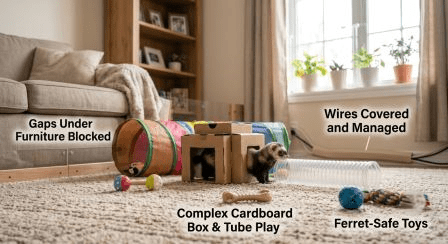
Here’s something I cannot emphasize enough: ferrets are escape artists and chewers.
They will burrow into the foam of couches, chairs, and mattresses. They’ll climb into the back of stereo speakers, closets, and drawers. They will find holes you didn’t even know existed.
ALL FOAM, PLASTIC, AND RUBBER OBJECTS MUST BE KEPT OUT OF THEIR REACH.
This includes:
Why is this so serious? If a ferret swallows any of these materials, it can cause a gastrointestinal obstruction (blockage). This may require expensive surgery to remove—or, in prolonged cases, can cause death.
Ferrets love to chew. This isn’t something you can train out of them—it’s instinct. Your job is to remove the dangers before they find them.

Ferrets shouldn’t be confined to their cage all day, but they do need a safe, secure home base.
Cage size: The cage should be as large as you can afford. A suggested minimum size is 24″ x 24″ x 18″ high (60 cm x 60 cm x 45 cm), but many experts recommend 3 feet high, 3 feet wide, and 2 feet deep for a single ferret. Multi-tiered cages are preferred.
What goes in the cage:
One warning: Some ferrets will chew on cloth bedding. If you see yours doing this, remove it immediately.
Here’s where many new owners mess up. Ferrets are not meant to spend their lives in a cage.
They need at least 2 to 3 hours out of their cage every day. Some experts say 3 to 4 hours minimum. The more, the better.
During out-of-cage time, they need:
Think about it this way: Confining a ferret to a cage for 20 hours a day is similar to confining a young Lab puppy to a crate for the same period. It’s not enough room or stimulation.
This is one of the most important things to understand about ferrets. They are obligate carnivores—they must eat meat to survive.
Their dietary requirements are very specific:
| Nutrient | Requirement |
|---|---|
| Protein | 30-40% high-quality animal protein |
| Fat | 15-20% fat |
| Carbohydrates | Low (<3% fibre) |
| Protein-to-fat ratio | Approximately 2:1 |
Ferrets have very short digestive tracts—food passes through in as little as 3 hours. They have high metabolic rates and need to eat 8 to 10 small meals daily. Food should be available all day.
What to feed:
What NOT to feed:
How much to feed: A ferret typically eats 5-7% of their body weight daily—about 50-75 grams for a 1 kg ferret. They need about 200 to 300 kcals per kg of body weight per day.
Ferrets are prone to several health issues. Being aware of them can save your pet’s life.
Common health problems in ferrets:
Important: If your ferret shows signs of illness—lethargy, anorexia, vomiting, diarrhea, or weight loss—see a vet immediately. Ferrets deteriorate quickly when sick.
This is not optional.
Unless you plan to breed, surgical sterilization is highly recommended.
Why it matters:
De-scenting: Ferrets are often de-scented (anal glands removed) before purchase. Some states, like New York, have laws prohibiting descenting except when medically necessary.

This is crucial.
Ferrets are legal in most states, but not all.
Where ferrets are illegal or restricted:
Always check your local laws before getting a ferret. Laws can vary by city and county, not just state.
Let’s talk money, because ferrets aren’t cheap.
Initial costs:
Ongoing costs (monthly):
Emergency vet costs: These can be significant. Intestinal blockages can require surgery costing $1,000-$3,000+.
Bottom line: Ferrets are not budget pets. Be prepared for both routine and emergency expenses.
Ferrets are absolutely wonderful pets—intelligent, playful, and full of personality. They’ll make you laugh every single day.
But they’re also:
If you’re ready for the commitment, ferrets will reward you with more joy, laughter, and love than you can imagine. They’re not for everyone—but for the right person, they’re absolutely perfect.
Just remember: Do your research. Ferret-proof your home. Find a vet who knows ferrets. And be prepared for a life that’s never, ever boring.
Because with a ferret in the house, boring is simply not an option.
Pingback: The Ultimate Guide To Keeping A Sugar Glider As A Pet | Paws & Antlers
Pingback: The Age Of Discovery: 10 New Species That Will Amaze You (2025-2026) | Paws & Antlers