How Fish Grow : The Science, Secrets, and Surprising Truths
When I bring home a tiny fish from the pet store, it’s hard to imagine it could keep growing for years, even decades. But unlike

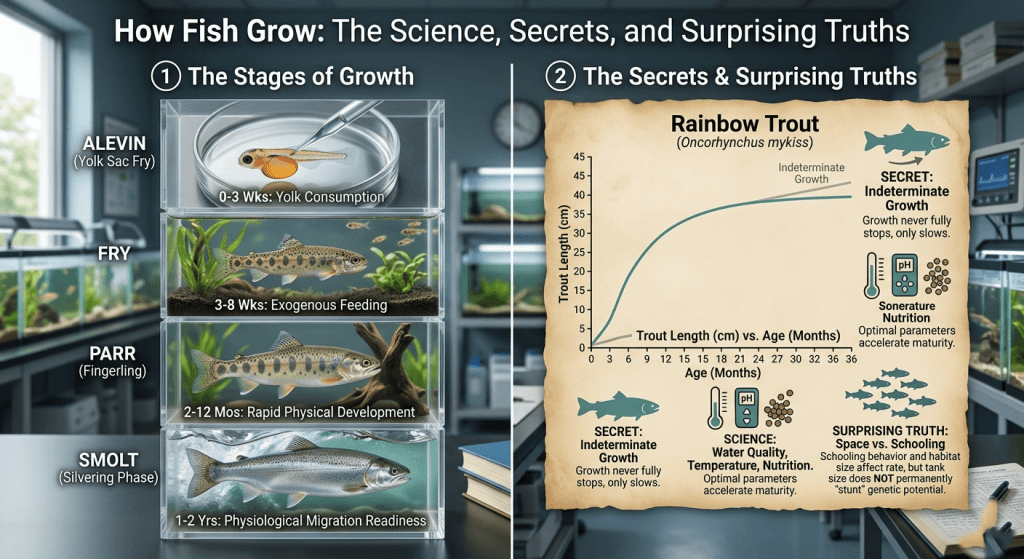
When I bring home a tiny fish from the pet store, it’s hard to imagine it could keep growing for years, even decades. But unlike mammals, most fish never really stop. Understanding how fish grow is one of the most fascinating parts of keeping them healthy—and it’s rarely explained well.
Here’s what actually happens beneath the surface.
Fish are indeterminate growers. They do not have a genetically fixed adult size. Growth slows with age but never biologically stops. That 2-inch pleco can reach 15+ inches because its muscles keep adding new fibers for life.
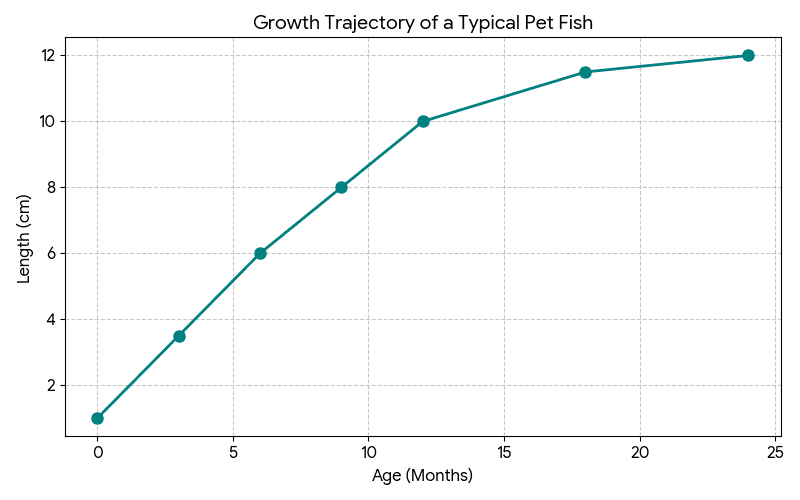
Most animals grow to a set size and stop. Mammals, birds, and reptiles reach adulthood and that’s it. Fish are different. The vast majority are indeterminate growers—they continue growing throughout their entire lives . That means my goldfish or pleco doesn’t have a “final size” programmed in the same way a dog does. Growth slows with age, but it never truly halts.
This is why you hear stories of goldfish outgrowing their bowls or plecos reaching a foot long. They didn’t “mutate”—they just kept doing what fish do.
Here’s where it gets interesting. Land animals mostly grow by making existing cells larger—a process called hypertrophy. Fish do that too, but they also grow by hyperplasia—creating entirely new muscle cells .
This unique ability is also why fish muscle stays healthier with age than mammalian muscle. Fish rarely suffer from age-related muscle wasting (sarcopenia) because their muscles keep regenerating .
Fish don’t grow at one steady rate. Their life is divided into growth stanzas—distinct phases where growth patterns shift dramatically .
Understanding these stanzas helps you know what to expect. A juvenile fish and an adult fish of the same species are almost operating under different biological rules.
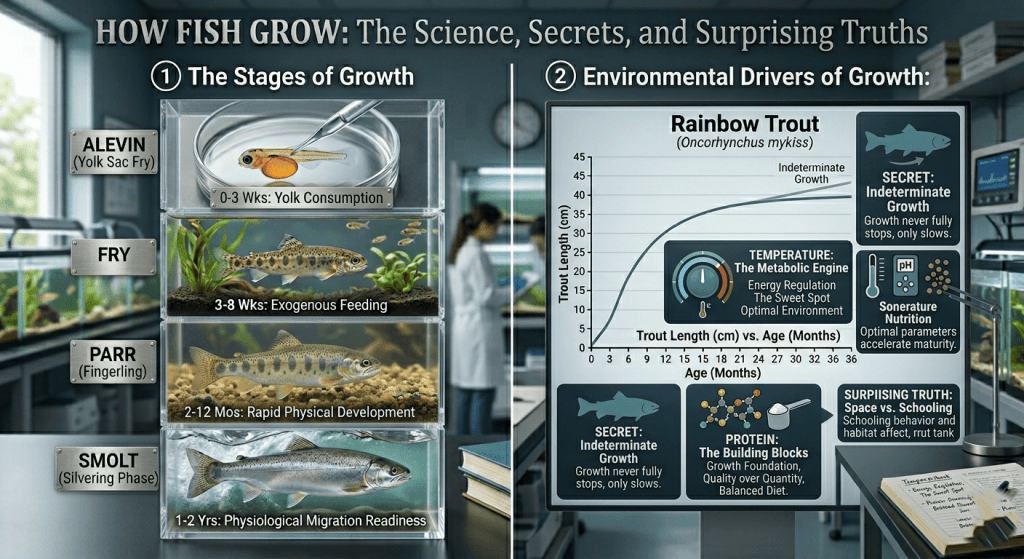
Even in a heated aquarium, fish feel the seasons. In the wild, growth follows a clear cycle: faster in warm months, slower or halted in winter . In some species, growth stops entirely when water drops below a certain temperature.
Research on whitefish shows growth is more closely tied to daylength than to water temperature. An internal seasonal rhythm may also be at play—even in captive fish . So if your fish seems to slow down in winter despite stable tank conditions, it’s not your fault. It’s biology.
If you want to maximize growth, two factors matter more than anything else: water temperature and dietary protein.
A 2024 study on Nile tilapia found:
Takeaway: Temperature and protein aren’t independent. Too hot without enough protein is worse than either one alone.
Here’s a real-world example from Indian carp studies :
| Species | Initial Weight (g) | Final Weight (g) | Specific Growth Rate (%/day) |
|---|---|---|---|
| Catla | 25.5 | 629.7 | 1.19 |
| Rohu | 22.5 | 669.7 | 1.28 |
| Mrigal | 21.3 | 503.7 | 1.19 |
These fish grew over 20 times their starting weight. That’s why planning for adult size—not baby size—is crucial.
Not all parts of a fish grow at the same rate. When proportions stay the same, it’s isometric growth. When one part grows faster, it’s allometric .
Many older studies got this wrong because they used ordinary regression instead of functional regression. The corrected methods show that changes in fish shape are more subtle than once thought .
Why do fish grow forever while we don’t? The answer may lie in anti-aging mechanisms.
Fast growth can promote aging in mammals. But fish that grow indeterminately seem to avoid this. The giant danio, a close relative of zebrafish, shows constant growth without slowing with age . This makes it a potential model for studying muscle regeneration and longevity.
Zebrafish, by contrast, show limited hyperplastic growth in fast muscle. They still add slow muscle fibers for life, but their fast muscle—which makes up most of the body—stops adding new fibers early . That difference may explain why some fish grow huge and others stay small.
Understanding how fish grow is the first step to keeping them healthy for life. And in a world where most guides repeat the same basics, knowing the science gives you a real edge.
Quick Checklist for Maximum Growth
Perform weekly water changes to keep cortisol low.
Feed high-protein pellets when water is above 26°C.
Reduce feeding by 50% when daylight drops below 10 hours.
lifelong aquarist and former veterinary technician. Alex has kept everything from bettas to stingrays and believes great fish care starts with understanding the biology beneath the scales. When not testing water parameters, Alex writes practical guides for first-time pet parents at pawsandantlers.com.
Pingback: How Is A Fish Adapted To Live In Water? Three Key Features