How Is a Fish Adapted to Live in Water? Three Key Features
Have you ever watched a fish glide effortlessly through the water and wondered how it does it? Unlike us, they don’t need scuba gear or

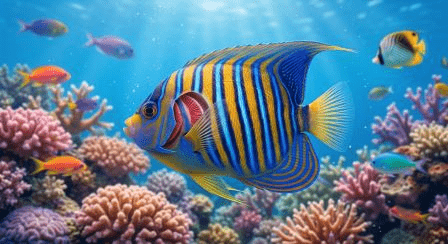
Have you ever watched a fish glide effortlessly through the water and wondered how it does it? Unlike us, they don’t need scuba gear or a boat. They are perfectly built for their underwater world. A fish’s body is a masterpiece of evolution, fine-tuned over millions of years for life in the water.
While fish have many amazing adaptations, three are the most fundamental: gills for breathing, fins for moving, and a swim bladder for floating. Let’s take a closer look at how each one works.
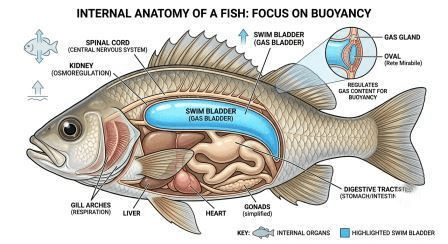
The biggest challenge for any animal living in water is getting enough oxygen to breathe. We humans can’t do it—we’d drown in seconds. Fish, however, have a perfect solution: gills.
How do gills work?
A fish takes water in through its mouth and forces it out over the gills, which are located on the sides of its head. Gills are made up of thin, feathery tissues packed with tiny blood vessels. As water flows over them, the blood absorbs the dissolved oxygen and releases carbon dioxide.
This system is incredibly efficient. It allows fish to extract the oxygen they need directly from the water around them. This is their version of breathing, and it’s the single most important adaptation for life underwater.
Living in water means you have to move through a substance that is nearly 800 times denser than air. To do this efficiently, fish use fins.
What do fins do?
Fins are the fish’s primary tools for propulsion, steering, and balance.
The variety of fins and their specific functions give fish incredible control and maneuverability in their watery home.
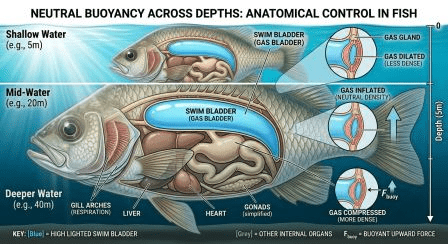
If you’ve ever tried to hold a beach ball underwater, you know that water wants to push things up. This is called buoyancy. For a fish, constantly fighting to stay at the right depth would be exhausting. That’s where the swim bladder comes in.
What does a swim bladder do?
The swim bladder is a balloon-like internal organ filled with gas. By changing the amount of gas in this bladder, a fish can perfectly control its buoyancy, allowing it to float at any depth without using any energy.
This ability to achieve “neutral buoyancy” is a huge advantage. It lets a fish rest, hunt, and explore different depths with very little effort.
Fish are not just creatures that live in water; they are creatures that are made for it. Their gills allow them to breathe in an environment that would suffocate us. Their fins provide the power and control they need to navigate a dense, three-dimensional world. And their swim bladder gives them the effortless ability to control their depth.
These three features—gills, fins, and swim bladder—are the key reasons why fish have been so successful for over 500 million years. They are a perfect example of how life adapts to thrive in every corner of our planet.
Pingback: How Fish Grow : The Science, Secrets, And Surprising Truths | Paws & Antlers