How to Have Cat Gain Weight Safely (Vet-Backed Guide 2026)
Learn how to have cat gain weight safely without risking fatal refeeding syndrome. Includes the BCS check, RER calculator, 72-hour safety checklist, and breed weight
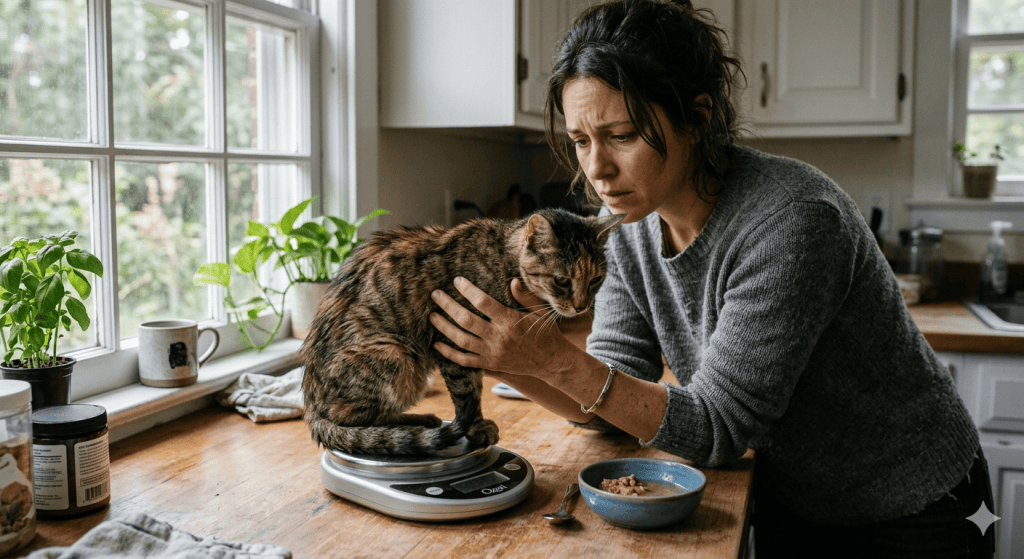
Your cat looks thin. The ribs feel sharp. The spine is easy to find without even pressing. You want to know how to have cat gain weight — but you’ve also heard stories about cats dying from being fed incorrectly after weight loss. Both fears are real, and they pull in opposite directions. This guide gives you the exact middle path: a clear triage system, a calorie formula, a safety checklist, and honest guidance on when home care is enough and when the vet visit is non-negotiable.
Before you open a single can of food, you need a number. Not a guess.
The BCS is a 9-point scale used by vets worldwide (WSAVA standard). You check three things with your hands and eyes:
Ribs: Run your fingers along the side of your cat’s chest. You should feel ribs with a thin layer of fat over them, like feeling your knuckles through a thin glove. If you feel nothing but sharp bone with zero cushion, that’s a BCS of 1 or 2 out of 9.
Waist from above: Look straight down at your cat. A healthy cat has a slight inward curve behind the ribs. A dangerously thin cat looks like a bony rectangle with no waist at all.
Abdominal tuck from the side: The belly should angle slightly upward from chest to hips. If it’s sucked in like a greyhound, or if the pelvis bones stick out visibly, you’re looking at a BCS of 2 or 3 out of 9 or lower.
A score of 3/9 or below = clinically underweight. A score of 1 or 2/9 = potentially medical emergency.
This is the calculation that tells you whether home care is safe or whether you need a vet today.
Step-by-step:
Formula: (Current Weight ÷ Ideal Weight) × 100 = % of Ideal Weight
Example: Your cat weighs 6 lb. The ideal weight for their frame is 9 lb.
(6 ÷ 9) × 100 = 66.7% → This is a medical emergency. Go to the vet before feeding anything beyond water.
% of Ideal Weight / What to Do:
Above 90% — Home refeeding is safe. Gradual increase.
80% to 90% — Home refeeding permitted with strict weekly +10% RER increments. Monitor daily.
80% or below — Mandatory vet visit before any home feeding. Risk of refeeding syndrome is real.
Don’t guess “8 to 12 lbs” for every cat. That range doesn’t apply to a Maine Coon or a Siamese.
Siamese: 6 to 10 lb
Persian: 7 to 12 lb
Maine Coon: 10 to 18 lb
Sphynx: 6 to 12 lb
Bengal: 8 to 15 lb
A Maine Coon at 9 lb is dangerously thin even though 9 lb sounds normal for an average cat. Always compare to breed standards, not a universal number.
If your cat is eating normally but still losing weight, the food isn’t the problem. The body is.
Any cat over 10 years old who eats well but keeps losing weight needs a Total Thyroxine (T4) blood test before you change their diet. Hyperthyroidism is extremely common in older cats. It speeds up the metabolism so fast that no amount of extra food keeps up. Starting a weight gain protocol without this test is like filling a bucket with a hole in it. Your vet can run this test quickly and cheaply.
Some cats absorb almost no nutrition from their food even when digestion looks normal. This is called malabsorption or maldigestion. Think of it like a leaky pipe: food goes in, but nutrients leak out before reaching the bloodstream.
Common causes include exocrine pancreatic insufficiency (the pancreas doesn’t make enough digestive enzymes), inflammatory bowel disease, and intestinal lymphoma. These cats need a diagnosis, not just more food.
Once your vet has cleared a medical cause, or if your cat is above 80% of ideal weight, here’s how to calculate what to feed.
Formula: 70 × (body weight in kg)^0.75
Example: A 4 kg cat: 70 × (4)^0.75 ≈ 200 to 220 kcal/day
For weight gain, feed between 1.2× and 1.8× RER.
1.2× RER = gentle, slow gain (good for cats 80 to 90% of ideal weight)
1.5× RER = moderate gain
1.8× RER = maximum safe rate at home — do not exceed this without vet supervision
Refeeding syndrome is a condition where reintroducing food too fast causes a cellular electrolyte crash — low phosphorus (hypophosphatemia), low potassium (hypokalemia), and red blood cell destruction (hemolytic anemia). It can kill a malnourished cat within 72 hours. This checklist is not optional.
Days 1 to 3: Feed only 50% of target RER.
Day 4: Move to 75% of target RER, but only if no red flags appear.
Day 7: Reach 100% of target RER.
Weigh your cat at the same time every day on the same scale. No weight gain after 7 days = vet reassessment required.
Neck ventroflexion: Head droops down, can’t hold neck up normally.
Severe lethargy: Won’t respond, won’t move toward food.
Pale or white gums: Press gum and release; color should return in under 2 seconds.
Sudden swelling: Legs, face, or belly look puffy without explanation.
If you see any of these: stop feeding and go to an emergency vet immediately. Refeeding syndrome kills within 72 hours — this checklist is non-negotiable.
High-protein, high-calorie wet food is your best starting point. Look for foods where the first ingredient is a named meat (chicken, turkey, salmon). Kitten food works well for underweight adult cats because it’s calorie-dense and high in protein. Avoid grain-heavy dry food as the primary diet during weight recovery since cats digest animal protein far more efficiently than carbohydrates.
Add small, frequent meals (4 to 6 per day) instead of one or two large portions. Small meals reduce digestive stress and lower the risk of triggering any refeeding complications.
Weight gain in cats is slow and should be slow. Even one pound of healthy gain over a month is a win. The goal isn’t speed — it’s keeping your cat alive and stable long enough for real recovery to happen
How Casinos Are Rebounding After COVID-19: Recovery Strategies Revealed The COVID-19 pandemic has had a
Олимп казино официальный сайт в Казахстане – Olimp Casino ▶️ ИГРАТЬ Содержимое Преимущества игры в
Олимп казино официальный сайт в Казахстане – Olimp Casino ▶️ ИГРАТЬ Содержимое Преимущества игры в
Олимп казино официальный сайт в Казахстане – Olimp Casino ▶️ ИГРАТЬ Содержимое Преимущества игры в
Олимп казино официальный сайт в Казахстане – Olimp Casino ▶️ ИГРАТЬ Содержимое Преимущества игры в
Олимп казино официальный сайт в Казахстане – Olimp Casino ▶️ ИГРАТЬ Содержимое Преимущества игры в
Pingback: How Fish Grow : The Science, Secrets, And Surprising Truths | Paws & Antlers