
The Snake and the Frog: A Personal Reflection on Nature’s Most Unlikely Arms Race
There’s a fact about poison dart frogs that has always stuck with me. I first read it years ago, long before I ever thought about
There’s a fact about poison dart frogs that has always stuck with me. I first read it years ago, long before I ever thought about
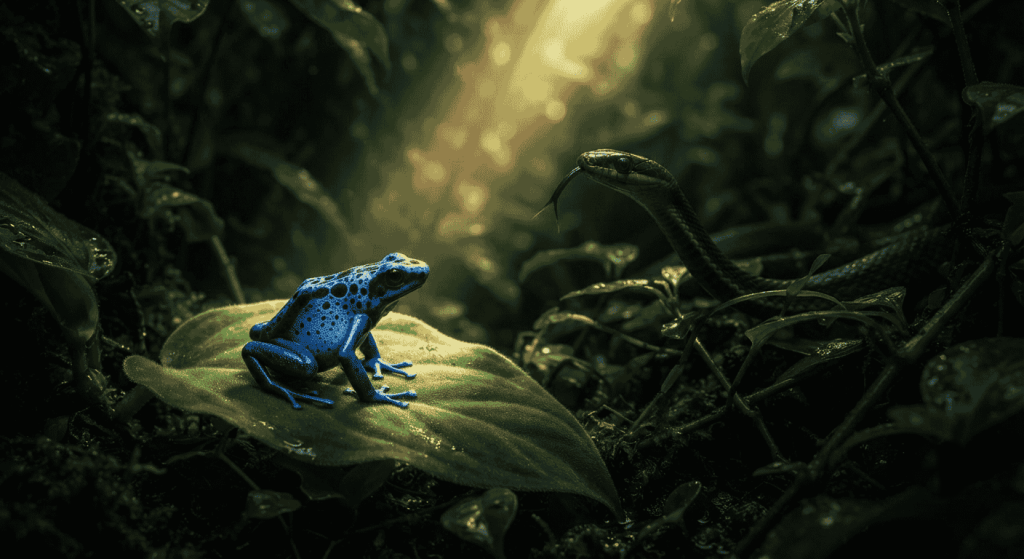
There’s a fact about poison dart frogs that has always stuck with me. I first read it years ago, long before I ever thought about keeping one myself. And honestly? It still gives me chills.
The fire-bellied snake (Leimadophis epinephelus) is the only natural predator of most poison dart frog species. Think about that for a moment. A creature so toxic that just one golden poison dart frog contains enough poison to kill ten grown men—and yet, there’s one snake that doesn’t just survive eating them, but actually specializes in it.
I remember sitting in my living room, staring at my own little dart frogs hopping around their terrarium, and thinking: How does that even work?
I got into dart frogs the way a lot of people do—I saw a picture online. A bright blue Dendrobates azureus sitting on a leaf like a tiny living jewel. I was hooked. Within a few weeks, I had a bioactive terrarium set up, humidity dialed in, and a pair of captive-bred Azureus settling into their new home.
The first thing I noticed about them was their confidence. These weren’t shy, hiding creatures. They were out and about during the day, hopping around, hunting fruit flies, defending their little territories. They had personality.
That’s when I started reading more about their wild counterparts. And that’s when I stumbled across the snake.
Here’s the science behind it.
The fire-bellied snake has evolved a physiological resistance to the batrachotoxins that make poison dart frogs so dangerous. It’s a prime example of co-evolution—two species locked in an evolutionary arms race, each pushing the other to adapt.
Scientists believe this resistance is due to modifications in the snake’s nervous system, specifically the receptors that the frog’s toxins target. The snake can eat the frog without experiencing paralysis or other harmful effects.
Think about that. This snake has literally rewired its own nervous system to survive something that would kill almost anything else.
The fire-bellied snake is slender and spends its time navigating the dense leaf litter of the rainforest floor. It relies on ambush tactics—lying in wait for an unsuspecting frog. Once a frog is within striking distance, the snake strikes, injecting a mild venom (which is inconsequential compared to the frog’s toxins) to subdue its prey.
It’s not a big, dramatic predator. It’s quiet, patient, and perfectly adapted.
Having dart frogs in my home changed how I think about this predator-prey relationship.
In captivity, my frogs were fearless. They’d hop right up to the front of the glass when I approached, expecting food. They had no natural enemies. No fire-bellied snake lurking in the leaf litter.
But in the wild, that snake is there. And my frogs would have spent their entire lives—every single day—navigating that risk. Their bright colors warn most predators away. But not this one.
It made me think about how much of an animal’s behavior is shaped by the threats they face. My pet frogs were bold and curious because they’d never known real danger. Wild dart frogs? They probably live with a constant, low-level vigilance. A snake in the leaf litter. A snake that can eat them. A snake that isn’t scared of their poison.
That changes how you move through the world.
The relationship between dart frogs and fire-bellied snakes is a reminder that nature doesn’t do absolutes. A golden poison dart frog can kill ten men with a single touch—but a snake can eat it for lunch.
And here’s the thing: despite the snake, the frogs persist. Their toxin, their warning colors, their diurnal activity—all of it evolved in the context of this one predator. Not in the absence of predators. In the presence of one very specialized predator.
That’s the difference between a defense that works and a defense that’s absolute. In nature, nothing is absolute. There’s always something that finds a way.
Keeping dart frogs has taught me a lot about attention to detail. Humidity, temperature, lighting, diet—everything has to be right. But it’s also taught me to appreciate the wildness of these animals, even in captivity.
When I look at my frogs, I don’t just see beautiful little pets. I see survivors. Creatures that have been shaped by millions of years of evolution to thrive in one of the most competitive environments on Earth. Their bright colors aren’t just pretty. They’re a statement. A warning to most—but an invitation to one.
The fire-bellied snake isn’t a villain in this story. It’s just another player in the same ancient game. And my frogs? They’ve learned to play it well enough to still be here, hopping through the leaf litter, hunting insects, and living their tiny, colorful lives.
The poison dart frog has only one natural predator: the fire-bellied snake. It’s a testament to the power of evolutionary adaptation. A snake that rewired its own nervous system to survive a lethal meal. A frog that became so toxic that almost nothing can eat it—except one thing.
When I think about that, my little terrarium feels a lot bigger.
A: The fire-bellied snake (Leimadophis epinephelus, also known as Erythrolamprus epinephalus) is the primary and almost exclusive natural predator of most poison dart frog species. This snake has evolved a remarkable resistance to the frogs’ powerful skin toxins, allowing it to consume them with relative impunity. It is found in Costa Rica, Panama, Colombia, Venezuela, Ecuador, and Peru.
A: The fire-bellied snake has developed a physiological resistance to the batrachotoxins that make poison dart frogs so dangerous. Scientists believe this resistance is due to modifications in the snake’s nervous system and possibly specialized enzymes that neutralize the toxins. Through countless generations of co-evolution, this snake has evolved the ability to eat these toxic frogs without experiencing paralysis or other harmful effects.
A: The snake is not completely immune, but it has developed a strong resistance to the frogs’ toxins. This resistance allows it to prey on poison dart frogs regularly, but it’s not absolute immunity—it’s an evolved adaptation that gives it a significant survival advantage.
A: Most predators have learned to associate the frogs’ bright colors with danger—a phenomenon called aposematic coloration. The toxins in poison dart frogs are potent enough to kill or severely sicken most animals. Over time, predators have evolved to avoid them. Only the fire-bellied snake has evolved the resistance needed to make them a regular part of its diet.
A: Yes. The relationship between the fire-bellied snake and the poison dart frog is a classic example of co-evolution. The frogs evolved stronger toxins to deter predators. The snake evolved resistance to those toxins. This back-and-forth adaptation, where each species drives the other’s evolution, is exactly what co-evolution looks like in nature.
A: No. Captive-bred poison dart frogs are completely non-toxic. In the wild, dart frogs get their toxins by eating specific insects and mites that contain alkaloid chemicals. These insects don’t exist in captivity. Captive-bred frogs are fed fruit flies, springtails, and other commercially available insects, so they never develop the poison.
A: Captive-bred poison dart frogs are safe to handle, but they are delicate and should generally not be handled. Handling can stress the frogs and risk transferring oils or chemicals from your skin to theirs. If you must handle them, use clean, moist hands or gloves, and wash your hands afterward.
A: They are insectivores and eat flightless fruit flies, springtails, and pinhead crickets. Juvenile frogs should be fed daily if possible, while adults can be fed three to four times per week.
A: Poison dart frogs need a bioactive terrarium with:
High humidity: 80-100%
Temperature: 72-80°F during the day
Full-spectrum lighting for plant growth and a natural day/night cycle
Live plants, leaf litter, and hiding spots
A shallow water dish
A: With proper care, poison dart frogs can live 10-15 years in captivity.
A: Poison dart frogs are not recommended for beginners. They require specific humidity, temperature, and diet, and they are delicate animals. However, some species like Dendrobates tinctorius are considered more forgiving and are often recommended as a first dart frog.
A: Dart frogs don’t require intense UVB lighting like some reptiles. However, a full-spectrum fluorescent or LED light is beneficial for plant growth and helps establish a natural day/night cycle.
A: Male dart frogs make a soft buzzing or chirping call during the day to attract females. It’s not loud like a bird or a dog—it’s a gentle, pleasant sound that many keepers enjoy.
A: Many poison dart frog species are threatened by deforestation, mining, and habitat loss in their native Central and South American rainforests. Some species are critically endangered. Captive breeding programs help preserve genetic diversity and reduce demand for wild-caught animals.
A: Laws vary by location. In most places, it is legal to keep captive-bred poison dart frogs, but wild-caught specimens are often protected and illegal to import. Always check your local regulations before acquiring any exotic pet.
How Casinos Are Rebounding After COVID-19: Recovery Strategies Revealed The COVID-19 pandemic has had a
Олимп казино официальный сайт в Казахстане – Olimp Casino ▶️ ИГРАТЬ Содержимое Преимущества игры в
Олимп казино официальный сайт в Казахстане – Olimp Casino ▶️ ИГРАТЬ Содержимое Преимущества игры в
Олимп казино официальный сайт в Казахстане – Olimp Casino ▶️ ИГРАТЬ Содержимое Преимущества игры в
Олимп казино официальный сайт в Казахстане – Olimp Casino ▶️ ИГРАТЬ Содержимое Преимущества игры в
Олимп казино официальный сайт в Казахстане – Olimp Casino ▶️ ИГРАТЬ Содержимое Преимущества игры в