How Do Leopard Geckos See the World in the Dark?
Imagine navigating your home on a moonless night without turning on a single light. For us, that would be nearly impossible. But for a leopard

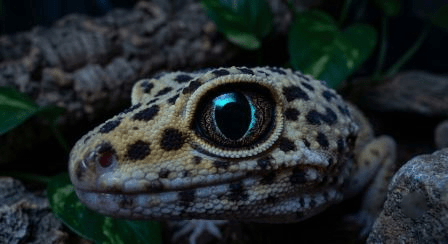
Imagine navigating your home on a moonless night without turning on a single light. For us, that would be nearly impossible. But for a leopard gecko, it’s just another Tuesday.
These fascinating little lizards are masters of the dark. While we stumble around bumping into furniture, they’re hunting, exploring, and living their best lives with clarity that seems almost supernatural.
So how do they do it? Let’s take a peek into the world as a leopard gecko sees it—or rather, how they see it when the lights go out.
Here’s something that surprises a lot of people. Leopard geckos aren’t strictly nocturnal (active only at night). They’re actually crepuscular, meaning they’re most active during twilight hours—dawn and dusk.
Their activity typically starts at dusk and carries on slightly into the night. This is when they hunt for insects in the wild, avoiding the heat of the day and the predators that come with it.
This twilight lifestyle is exactly why their eyes evolved to be so incredible in low-light conditions.
Really, really good.
Leopard geckos can see several hundred times better in dim light than humans can. Some estimates put their night vision at around 350 times more sensitive than ours.
To put that in perspective: if you can barely make out shapes in a dimly lit room, your leopard gecko can see everything clearly—colors, movement, and detail.
Can they see in complete darkness?
No. While their eyes are incredibly sensitive to low light, they still need some amount of light to see. But that “some amount” is so tiny that it might as well be nothing to us. They can navigate perfectly on moonless nights using just starlight.
Leopard geckos aren’t just lucky. Their eyes are biological marvels, fine-tuned by millions of years of evolution. Here’s how they work.
This is the superstar of their night vision.
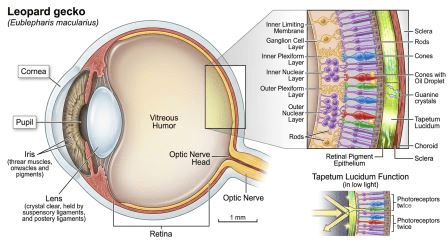
The tapetum lucidum is a specialized reflective layer located behind the retina in their eyes. Think of it like a mirror that bounces light back through the retina a second time.
This gives the light-sensitive cells two chances to capture the same photons of light. It’s like getting double the signal from the same amount of light.
You’ve probably seen this effect before. When you shine a light on a leopard gecko’s eye at night, you’ll see a distinctive shiny, glowing appearance. That’s the tapetum lucidum reflecting light back at you. It’s the same reason cats’ eyes glow in the dark.
Humans don’t have this. That’s one major reason we can’t see in the dark nearly as well.
Leopard geckos have eyes that are almost as large as their heads.
Why does size matter? A larger eye means a larger surface area for light to fall on. It’s like using a bigger bucket to catch rain—you collect more water (or in this case, more light).
The bulging structure also gives them special peripheral vision and the ability to collect light rays from different angles. This helps them spot both predators and prey from a wider range.
At night, a leopard gecko’s pupil dilates significantly, becoming a large, open aperture that maximizes light gathering.
Remember, they have those distinctive slit-like pupils that can open wide when it’s dark. During the day, those same pupils close into narrow slits to prevent excessive light from entering and damaging their sensitive eyes.
It’s like having built-in adjustable sunglasses that open wide at night.
Rods and cones are the two types of light-sensitive cells in eyes.
Leopard geckos have a rod-dominant retina, meaning they have more rods than cones. This makes them incredibly sensitive to light and movement, which is perfect for spotting insects skittering in the dark.
But here’s the twist:
Unlike humans, whose night vision is grayscale, leopard geckos can actually see colors in the dark thanks to specialized, highly sensitive cone cells.
Most nocturnal animals sacrifice color vision for better night vision. Not leopard geckos.
They have specialized cone cells that are incredibly sensitive to light—much larger than those in human eyes and optimized for capturing even the faintest light signals.
This allows them to distinguish colors even in dim, near-dark conditions.
Not all colors. But more than you might think.
Humans: We have three types of cone cells (trichromatic). We see red, green, and blue, which combine to give us the full color spectrum.
Leopard geckos: They are dichromatic—they have two types of cone cells.
They see:
What they can’t see:
Wait—didn’t I say they see colors in the dark? Yes! Their color vision in low light is actually better than most other nocturnal animals, which typically see only in grayscale at night. They can see colors like blue, green, and even UV under moonlight, where we would see nothing but shadows.
Here’s something really cool that most websites haven’t mentioned yet.
You already know leopard geckos can see UV light. But here’s what’s even more fascinating—they also have UV markings on their own bodies that they use to communicate with each other!
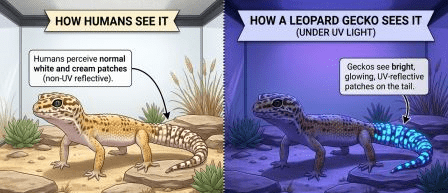
In recent studies using special UV photography, researchers found that leopard geckos have highly reflective white patches—especially on their tails (and on the heads of juveniles)—that strongly reflect UV light.
Here’s why this matters:
These are exactly the body parts that geckos display during defensive and social behaviors. This tells us these UV patterns aren’t random—they’re likely used as communication signals.
| Theory | What It Could Mean |
|---|---|
| Juvenile identification | Young geckos might signal their age to adults to avoid aggression |
| Anti-predator signals | Flashing UV tail patches could startle or warn predators |
| Species recognition | Helps geckos identify their own kind |
| Mate selection | Brighter UV signals could attract mates |
It’s like having a secret visual language that we’re completely blind to.
What this means for pet owners: While we can’t see these UV markings, they matter to your gecko. They’re constantly communicating in a visual language we can’t perceive. This is a great reminder that leopard geckos experience their world in ways we can only imagine.
Yes. This is one of the most fascinating facts about leopard gecko vision.
Leopard geckos have considerable UV reflectance in their white patches—especially on their tails (and on the heads of juveniles).
This suggests that UV vision may play a role in communication—perhaps helping them recognize other geckos, find mates, or identify each other.
It’s like having a secret visual language that we can’t see.
A recent study identified the exact wavelengths of light that leopard gecko eye cells respond to:
| Color | Wavelength | Detection |
|---|---|---|
| Ultraviolet | 364 nm | ✅ Yes |
| Blue | 460 nm | ✅ Yes |
| Green | 525 nm | ✅ Yes |
The study also found something unexpected: leopard geckos can distinguish blue from gray even in very dim light conditions.
A recent case report linked vitamin A deficiency to serious eye problems in leopard geckos, including:
Even more concerning: One case diagnosed a fungal infection (Acremonium and Trichosporon) causing fungal keratitis—a rare and serious eye condition.
What this means for owners: Always provide a varied diet with proper gut-loaded insects and dust with multivitamins. Don’t rely on a single insect type.
For years, scientists debated whether leopard geckos could see colors in the dark. Recent studies have confirmed they can—and their color vision in low light is actually better than most other nocturnal animals.
This is because they have specialized cone cells that are highly sensitive to light, allowing them to see blues, greens, and even UV under starlight.
| Feature | Leopard Gecko | Human |
|---|---|---|
| Night vision | 350x better than humans | Limited |
| Color vision in dark | Yes, can see colors in dim light | No, grayscale only |
| Color spectrum | Dichromatic (blue, green, UV, yellow) | Trichromatic (full spectrum) |
| Red color vision | No | Yes |
| Tapetum lucidum | Yes (reflective layer) | No |
| Visual acuity | Good for movement, less sharp detail | Sharp detail |
| Depth perception | Present, but less acute | Excellent |
| Clear vision distance | Shorter range | Up to 20 feet |
Leopard geckos lack the red cone photoreceptor, meaning they cannot see the color red the same way humans do. They can still perceive the light associated with the red spectrum, but not the specific hue.
For pet owners: This is why many keepers use red “night lights” to observe their geckos without disturbing them. Since the gecko can’t perceive red as a distinct color, it doesn’t disrupt their natural day/night cycle as much.
No. Leopard geckos cannot see infrared (IR) light.
Generally, different morphs do not significantly affect vision capabilities. Color mutations are primarily related to pigment variations in their skin, not fundamental differences in eye structure or function.
This is a tricky question. Their night vision is excellent. But their overall visual acuity (sharpness of detail) isn’t as impressive as their night vision.
They rely more on movement detection and color perception than fine detail because their main focus is spotting insect prey.
Unlike many other gecko species, leopard geckos have movable eyelids. This allows them to blink, close their eyes for sleeping, and protect their eyes from dust and debris in their arid environments.
(Other geckos, like crested geckos, don’t have eyelids and must lick their eyeballs clean!)
Leopard geckos see perfectly well in the dark. They don’t need a night light to navigate their enclosure or find food.
In fact, red or blue “night lights” can actually disrupt their natural photoperiods and should be avoided.
While they don’t need light at night, they still need proper UV lighting during the day for their overall health and metabolic function.
Stick to a natural schedule: 12 hours of light, 12 hours of darkness.
Vitamin A deficiency is a common health problem in leopard geckos that can lead to serious vision issues, including blindness.
Ensure your gecko gets a proper diet with adequate vitamin supplementation.
Retained shed around the eyes can cause vision problems. Check your gecko regularly during shedding to ensure the skin around their eyes comes off cleanly.
While they may not see all colors, leopard geckos benefit from enrichment with varying textures and shapes in their enclosure. They also rely on their sense of smell and vibrations, so a varied environment keeps them engaged.
Leopard geckos experience the world in a way that’s completely different from us—especially when the lights go out.
They’re not just “seeing” in the dark. They’re seeing colors in the dark, detecting UV light we can’t perceive, and navigating using a built-in mirror that bounces light back through their eyes for a second pass.
And here’s the coolest part: They’re communicating using UV signals we can’t even see—a secret language hidden in plain sight.
Their vision is perfectly adapted for their crepuscular lifestyle. It’s not better than human vision—it’s just different. Specialized. Perfect for hunting insects, avoiding predators, and living their best lives under the moon and stars.
The next time you see your leopard gecko exploring its enclosure at night, remember: to them, the darkness is as clear as day. And they might just be flashing a secret UV signal to a friend that you’ll never see.
Disclaimer
This article is for educational and informational purposes only.
Hi, I’m [Huma Sham]. I’ve been fascinated by exotic pets for years and love helping people understand these incredible creatures. When I’m not writing, I’m usually reading about wildlife or spending time with my own leopard gecko. Thanks for reading!