How to Have a Cat in a Small Apartment: The cat ecostructure Playbook
. The Big Myth About Small Spaces ( cat ecostructure) Here is something most people believe: “Cats need big houses to be happy.” That is

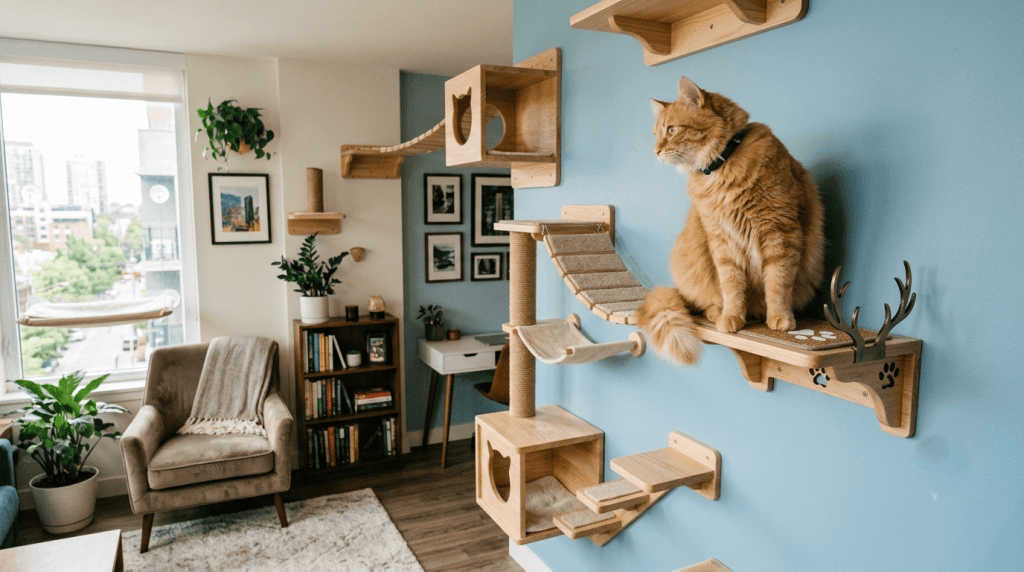
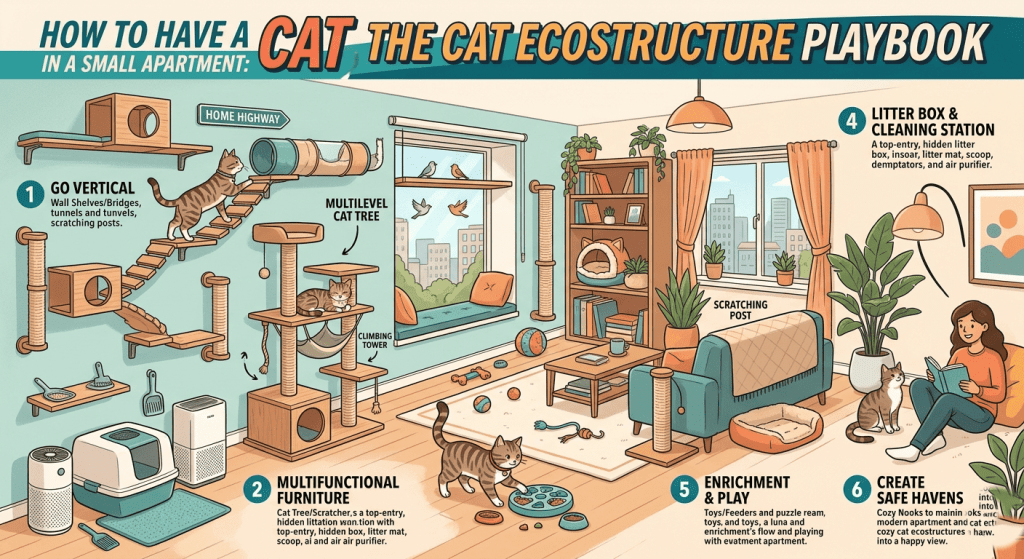
Here is something most people believe:
“Cats need big houses to be happy.”
That is simply not true.
In fact, many cats in huge homes are bored, stressed, and unhappy. And many cats in tiny studio apartments are thriving.Why?
Because cats do not measure happiness in square feet.
They measure happiness in:
A 300-square-foot apartment with the right cat ecostructure is better than a 3,000-square-foot house with nothing but empty floors and closed doors.
This guide will show you exactly how to build a cat ecostructure in ANY small apartment — no matter how tiny.
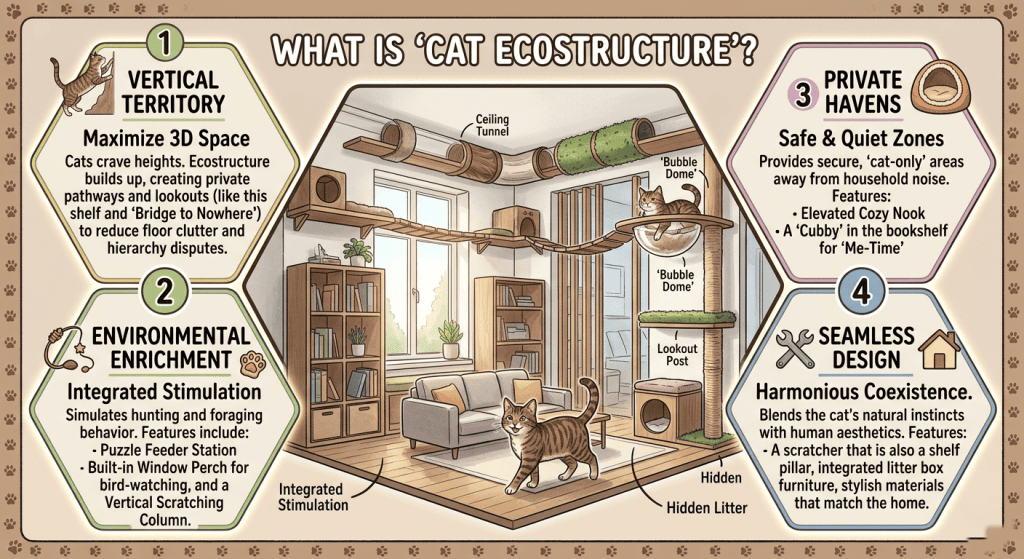
Cat Ecostructure is a fancy term for a simple idea:
Designing your home so your cat can move, hide, climb, and rest — just like they would in nature.
Think of it this way:
| Traditional Home | cat ecostructure Home |
|---|---|
| One cat tree in the corner | Vertical pathways across multiple walls |
| Food and water next to each other | Food, water, and litter separated |
| Cat bed on the floor | Resting spots at different heights |
| Closed doors everywhere | Strategic openings and pathways |
| One scratching post | Multiple scratching surfaces in key areas |
In nature, cats live in three dimensions — up trees, down holes, across logs, behind bushes.
Most human homes are designed in ONE dimension — flat floors and closed spaces.
Cat ecostructure adds back the missing dimensions.
A complete cat ecostructure has 5 layers:
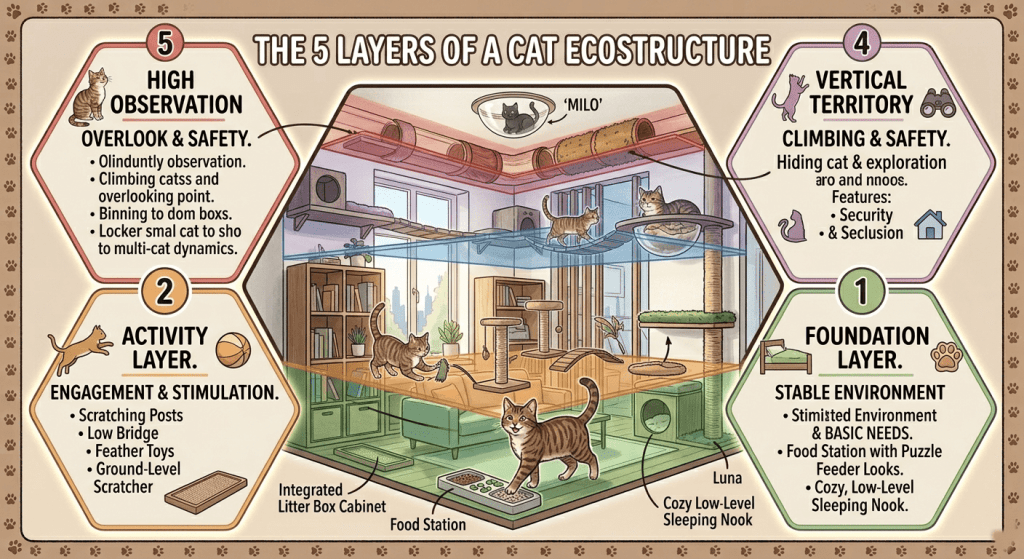
| Layer | Name | What It Does |
|---|---|---|
| 1 | Vertical Territory | Gives your cat height and safety |
| 2 | Horizontal Highways | Connects different areas of your home |
| 3 | Covert Observation Posts | Allows hiding and watching |
| 4 | Sensory Zones | Provides scratching, smelling, and resting |
| 5 | Human-Cat Flow | Makes the space work for both of you |
Let us build each layer, step by step.
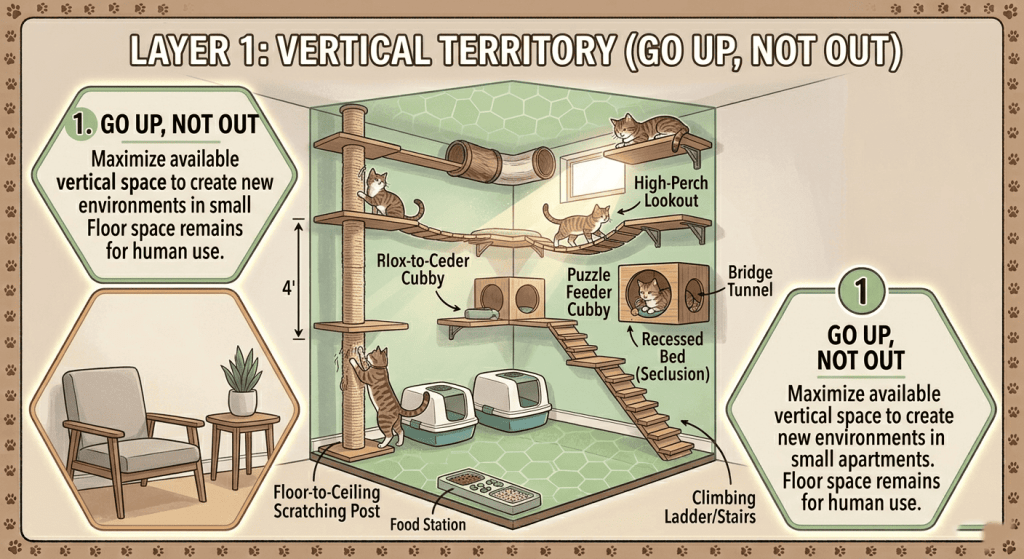
In a small apartment, you cannot add more floor space. But you CAN add wall space.
The goal: Give your cat places to climb that do not take up floor space.
| Item | Where to Put It | Why It Works |
|---|---|---|
| Wall-mounted shelves | Along one wall, stair-stepped up | Creates a climbing highway |
| Tall cat tree (floor to ceiling) | In a corner or near a window | Maximizes height, minimum floor space |
| Top of bookshelf | Clear off the top | Instant high perch |
| Window perch | On a window with a view | Entertainment + sunbathing |
| Behind-the-couch shelf | Mounted on wall behind couch | Hidden vertical path |
Do not put shelves in a straight vertical line. Cats need to jump sideways, not just up.
Good pattern: Staggered like stairs — left, right, left, right.
Distance between shelves: 12-18 inches apart. Most cats can jump this easily.
| Budget | Solution |
|---|---|
| $0 | Clear off the top of your fridge, bookshelves, and cabinets |
| $20 | Buy floating shelves from a discount store |
| $50 | Build your own shelves with brackets and wood from a hardware store |
| $100+ | Buy a floor-to-ceiling cat tree (best space-saving option) |
Vertical territory is great. But your cat also needs to move horizontally between different areas.
The goal: Create pathways so your cat can go from Point A to Point B without walking on the floor.
| Pathway | How to Create It |
|---|---|
| Couch to shelf to window | Place a shelf near the couch arm so cat can step up |
| Cat tree to bookshelf | Position them close enough to jump between |
| Shelf to shelf | Connect with a bridge or additional shelf |
| Window to cat tree | Put them next to each other |
Cats hate dead ends. If you put a shelf in a corner with no way out, your cat will not use it.
Every perch must have:
Good example: Shelf above couch → cat jumps from couch arm to shelf → jumps from shelf to window perch → jumps down to floor.
Bad example: Single shelf in a corner with nothing around it.
| Type of Wall | What to Use |
|---|---|
| Drywall | Drywall anchors (required, do not skip) |
| Concrete or brick | Masonry screws + drill |
| Rental apartment | Tension-mounted cat trees (no holes) |
Renter tip: Use command strips for lightweight shelves (under 5 pounds). For heavier shelves, fill holes with spackle before moving out.
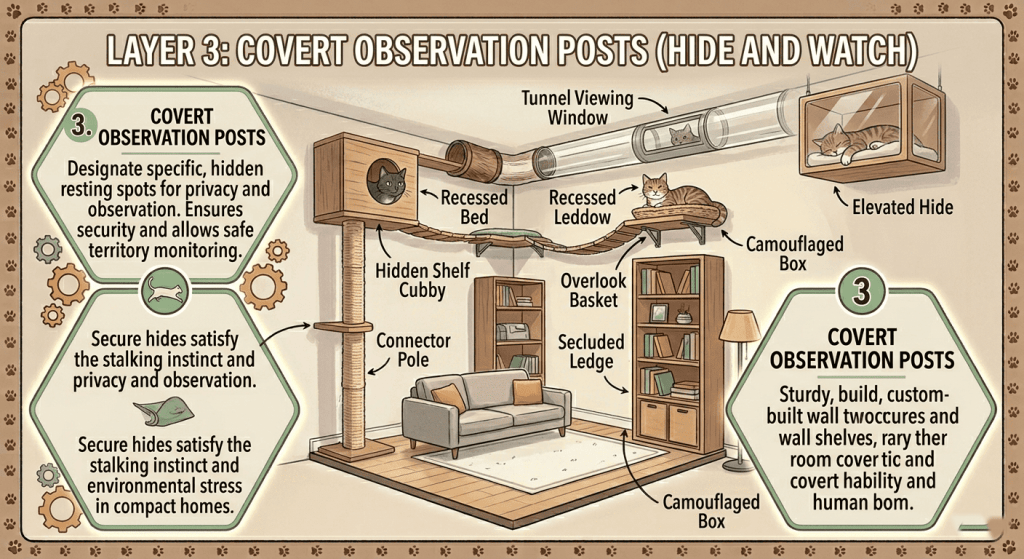
Cats are both predators AND prey. In the wild, they hide to avoid danger AND to ambush prey.
Your apartment needs places where your cat can hide while still seeing what is happening.
The goal: Give your cat “invisible” spots to observe from.
| Hiding Spot | How to Create It |
|---|---|
| Under-bed cave | Store less stuff under the bed. Leave one side open. |
| Box on its side | Place a cardboard box in a corner with a blanket inside. |
| Behind the couch | Leave a 6-inch gap between couch and wall. |
| Closet shelf | Leave the closet door slightly open. Cat can jump up and watch. |
| Covered cat bed | Buy a cave-style bed. Put it on a high shelf. |
Every hiding spot needs TWO exits. If your cat feels trapped, they will not use it.
Good example: Box with two holes cut in it (front and side).
Bad example: Box with only one opening facing the wall.
Cats feel safe when they can watch without being watched.
A cat who can hide and observe will be:
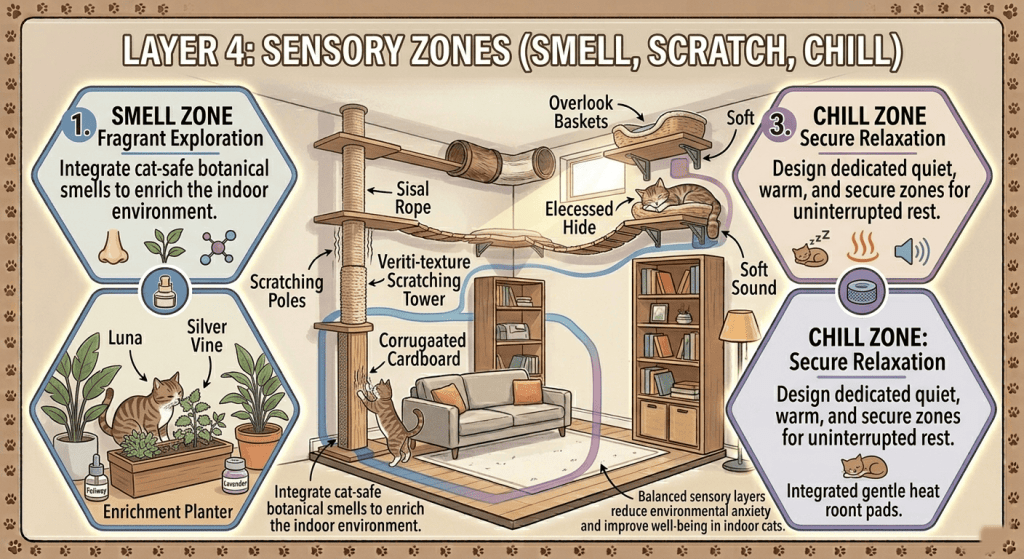
Cats experience the world through their senses. Your ecostructure needs to satisfy ALL of them.
| Sense | What Your Cat Needs | How to Provide It |
|---|---|---|
| Smell | Familiar scents, no bad smells | Keep litter box away from food. Add cat-safe plants (catnip, cat grass). |
| Scratch | Multiple surfaces to scratch | Vertical post + horizontal cardboard + sisal rope. One in each room. |
| Touch | Different textures | Soft beds, rough scratching posts, smooth window perches, cool tile floor. |
| Sight | Window views | Window perch facing outside. If no view, try a fish tank or bird videos on a tablet. |
Every cat needs at least THREE different scratching surfaces:
| Surface | Where to Put It |
|---|---|
| Vertical sisal post | Near where your cat sleeps |
| Horizontal cardboard | In the living room near where you sit |
| Carpet-covered post | Near the front door (territory marking) |
Why three? Cats scratch for different reasons. Vertical stretching = exercise. Horizontal scratching = territory marking. Giving choices prevents scratched furniture.
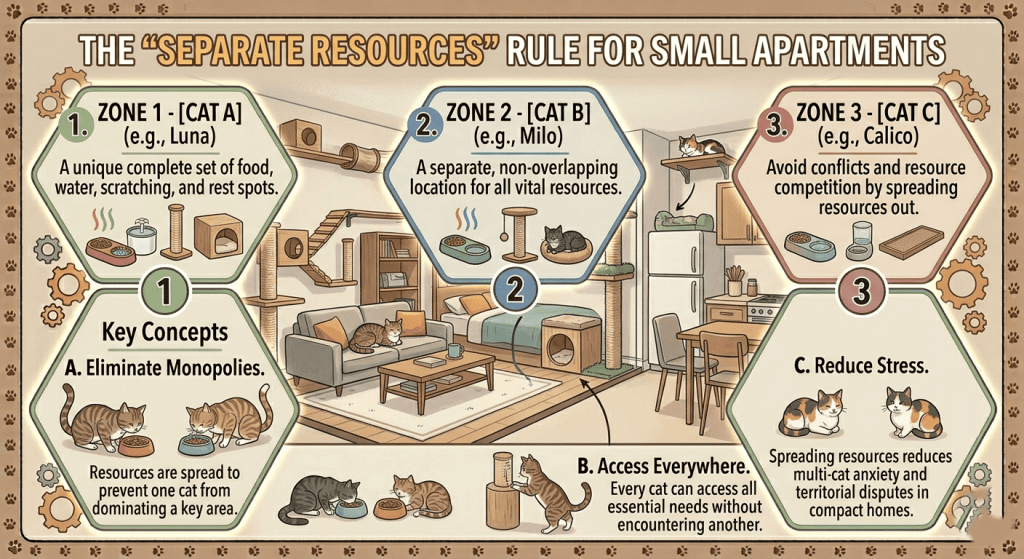
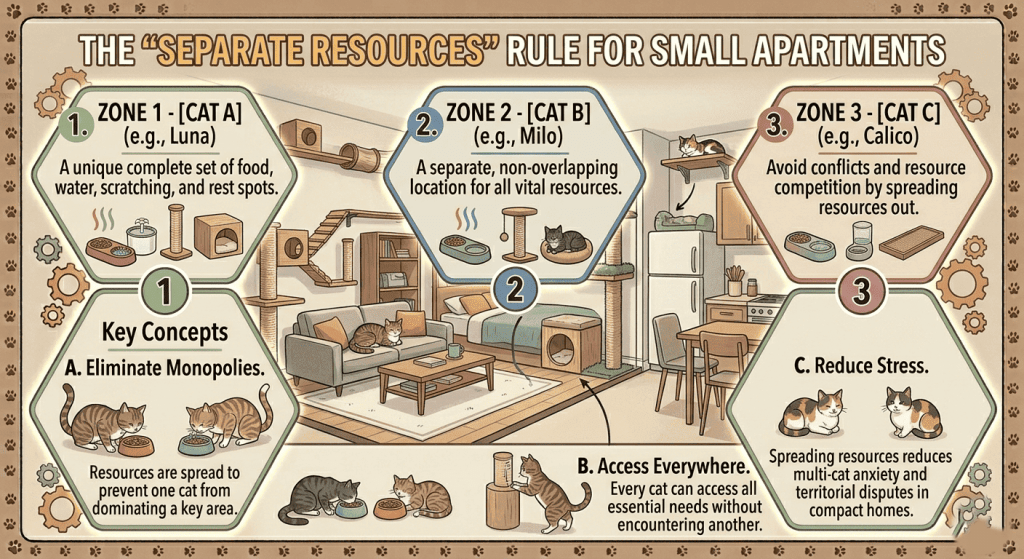
In a small apartment, you cannot spread things far apart. But you can spread them DIFFERENTLY.
| Resource | Minimum Distance | How to Achieve in Small Space |
|---|---|---|
| Food from water | 3 feet | Put on opposite sides of the same room |
| Litter from food | As far as possible | Put litter in bathroom, food in kitchen |
| Litter from bed | Not in same room | Put litter in closet with door slightly open |
The final layer is about YOU. Your apartment must work for BOTH of you.
The goal: Design your space so your cat’s needs do not constantly clash with yours.
| Problem | Solution |
|---|---|
| Cat walks on your laptop | Put a small cat bed or shelf next to your desk. Cat can be near you but not on your keyboard. |
| Cat knocks things off shelves | Do not put breakable items on cat shelves. Put breakables behind glass or on high shelves cats cannot reach. |
| Cat meows at bedroom door at night | Install a cat door or leave door slightly open. OR put a cozy bed in another room with a window view. |
| Cat scratches couch | Put a scratching post NEXT to the couch corner. Redirect every time. |
| Litter box smells | Use unscented clumping litter. Scoop twice daily. Add a litter box enclosure (looks like furniture). |
Instead of constantly saying “no” to your cat, create “yes spaces.”
| Instead of… | Create… |
|---|---|
| “No, do not scratch the couch” | A scratching post right next to the couch |
| “No, do not jump on the counter” | A high shelf near the counter where cat CAN jump |
| “No, do not go behind the TV” | Block the back of the TV and put a perch somewhere else |
| “No, do not knock over my plants” | Put cat grass in a stable pot they ARE allowed to touch |
Most articles stop at the 5 layers. Here is information that is very hard to find anywhere else.
When you add new shelves or cat furniture, your cat may ignore them for the first 3-7 days. This is normal.
What to do: Do not move the shelves. Do not put your cat on them. Let your cat discover them on their own. Put treats on the lowest shelf. Let curiosity win.
Do not fill every wall with shelves. Cats need empty space too. The spaces BETWEEN shelves are what make jumping fun.
Rule of thumb: For every shelf, leave at least 12-18 inches of empty wall above and below.
New shelves or cat trees do not smell like your cat yet. This makes them seem “unsafe.”
What to do: Rub a soft cloth on your cat’s cheeks (where their scent glands are). Then rub that cloth on the new shelves. Your cat will investigate immediately.
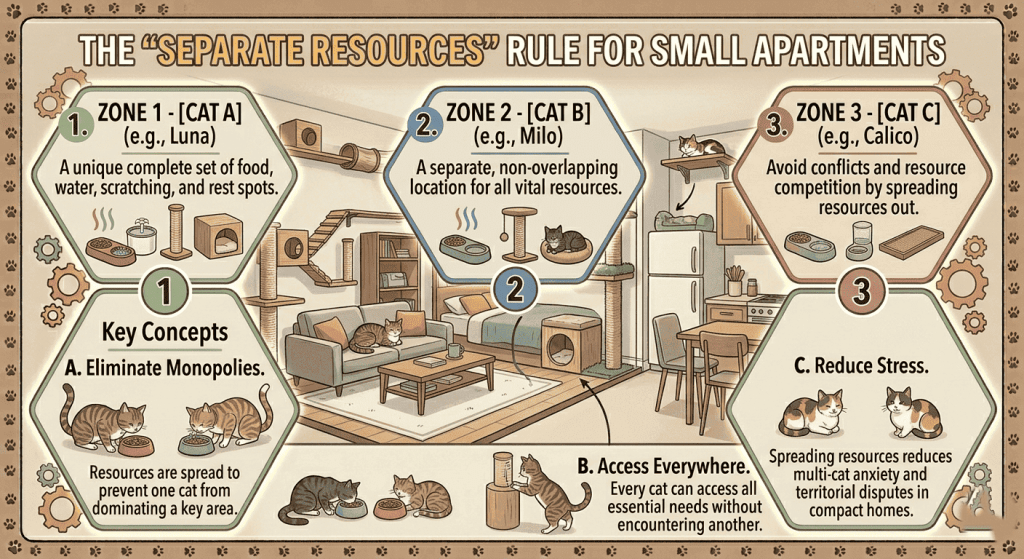
In a small apartment, one cat can block another cat from moving around. This causes stress and fighting.
What to do: Create at least TWO pathways between rooms. For example:
If one cat blocks the floor, the other cat can use the shelves.
Most people put one window perch. But cats get bored watching the same view.
What to do: If you have two windows, put perches on both. Rotate which perch has treats each week.
If you only have one window, add a second perch facing the room (not outside). Watching YOU is also entertaining for cats.
You do not need to buy expensive cat products. Use furniture you already have:
| Furniture | Cat Use |
|---|---|
| Bookshelf | Cat shelf (clear off top and one middle shelf) |
| Dresser | Cat can jump from dresser to closet |
| Headboard | Cat highway (if wide enough) |
| Couch arm | Launching pad to window |
| Fridge top | Warm perch (heat rises from the back) |
Q: My apartment is only 400 square feet. Is this even possible?
A: Yes. In fact, a very small apartment can be EASIER to ecostructure because everything is close together. Focus on vertical space. A 400 sq ft apartment with high shelves is better than a 1,000 sq ft apartment with empty floors.
Q: I rent. I cannot drill holes in the walls. What do I do?
A: Use these no-hole options:
Q: My cat ignores the shelves I installed. What did I do wrong?
A: Probably nothing. Give it time. Try these fixes:
Q: How much does a full cat ecostructure cost?
A:
| Budget | Cost | What You Get |
|---|---|---|
| $0-20 | Free | Clear off existing furniture (fridge, bookshelves, dressers) |
| $50-100 | Low | 3-4 floating shelves + 1 window perch |
| $150-250 | Medium | Floor-to-ceiling cat tree + shelves + scratching posts |
| $300+ | High | Full wall system with bridges, multiple perches, and custom pieces |
Q: I have two cats in a small apartment. Is this still possible?
A: Yes, but you need more of everything:
Q: Will my landlord allow this?
A: Ask before drilling. Many landlords allow small holes if you spackle them before leaving. Tension-mounted and command strip options leave no damage.
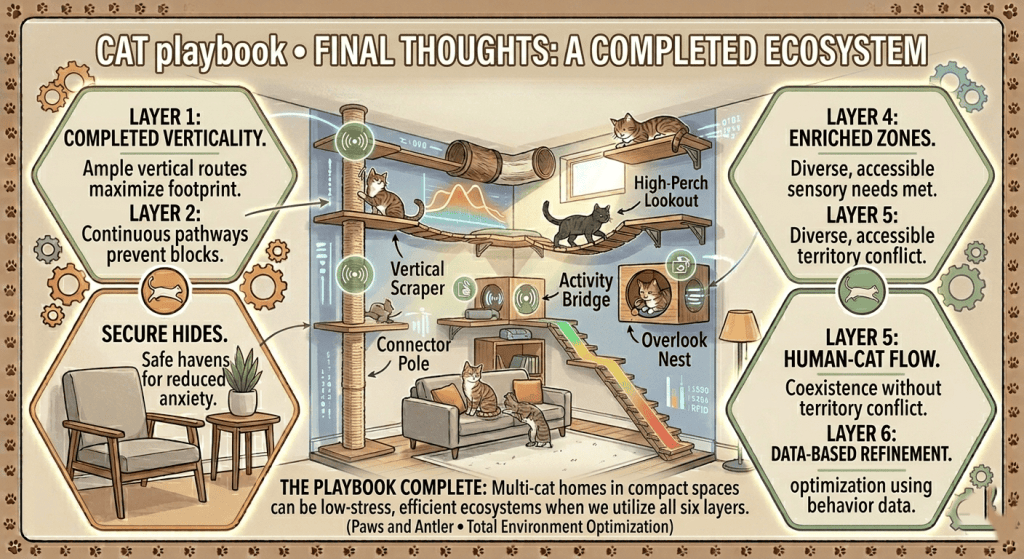
Here is what I want you to remember:
First: Your small apartment is NOT a problem for your cat. A boring apartment is the problem — no matter how big.
Second: You do not need to spend hundreds of dollars. Start with one shelf. Then another. Then a window perch. Build over time.
Third: Watch your cat. They will tell you what works and what does not. If they do not use a shelf, move it. If they love a window perch, add another one nearby.
Fourth: Small spaces can actually be BETTER for cats. Everything is close. They can patrol their whole territory in minutes. They feel secure because there are fewer “unknown” areas.
Fifth: The goal is not to turn your apartment into a cat jungle gym that you hate living in. The goal is balance. A few well-placed shelves. A hidden litter box. A window perch. Small changes make a huge difference.
Your cat does not need a mansion.
They need a home designed for THEM — not just for you.
That is what cat ecostructure is all about.
Now go build it. 🐾
This article was written for Paws and Antlers — a website dedicated to helping pet owners give their animals the best possible care using evidence, not folklore.
Disclaimer: This article is for informational purposes only. Always consult a licensed veterinarian for medical advice about your specific cat.
Pingback: Cat Litter Box Problems: 7 Simple Fixes That Actually Work | Paws And Antlers