Cat Litter Box Problems: 7 Simple Fixes That Actually Work
1. You Are Not Alone ( Cat Litter Box Problem) Your cat is peeing outside the litter box. Or maybe they are pooping right next

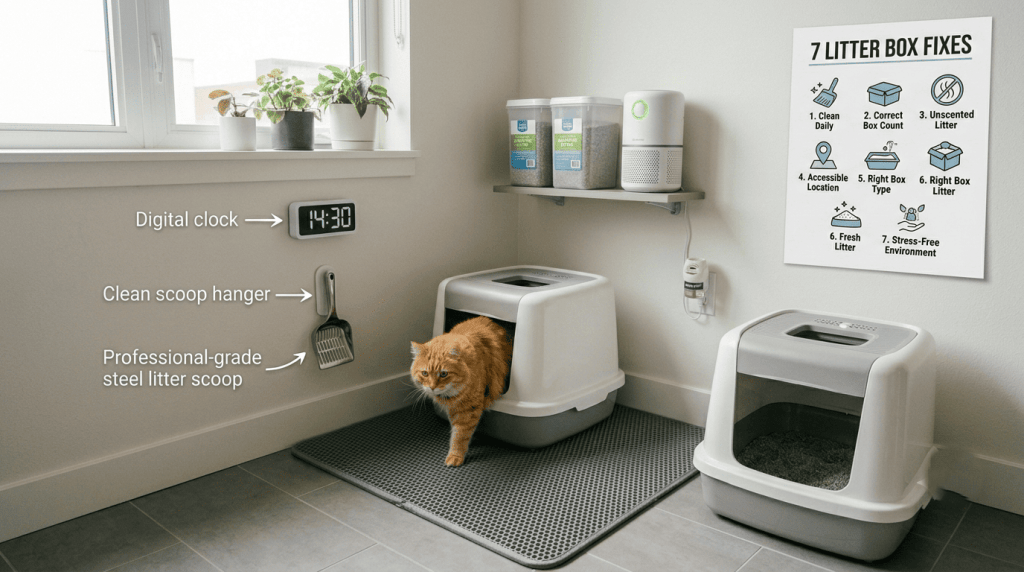
Your cat is peeing outside the litter box. Or maybe they are pooping right next to it. Or maybe they have stopped using it completely.
You are frustrated. You are worried. You might even be angry.
Stop. Take a breath.
You are not alone.
Litter box problems are the number one behavior issue cat owners face. In fact, studies show that nearly 1 in 4 cats will develop a litter box problem at some point in their lives.
Here is the most important thing to understand:
Your cat is not being bad. Your cat is not trying to make you angry. Your cat is trying to tell you something is wrong.
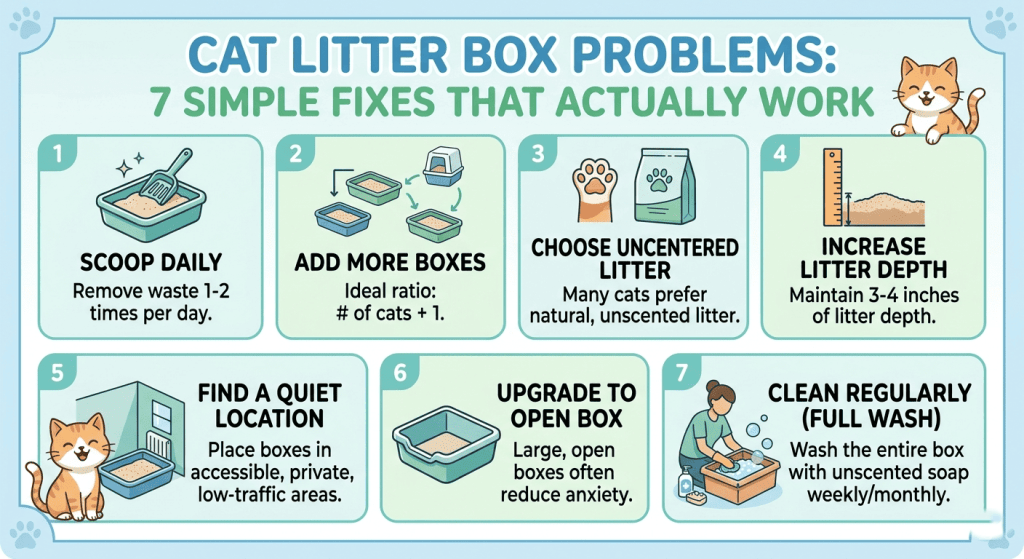
This guide will walk you through 7 simple fixes for litter box problems. Most of these cost little or no money. And most of them work within days.
But first — let us talk about when this is an emergency.
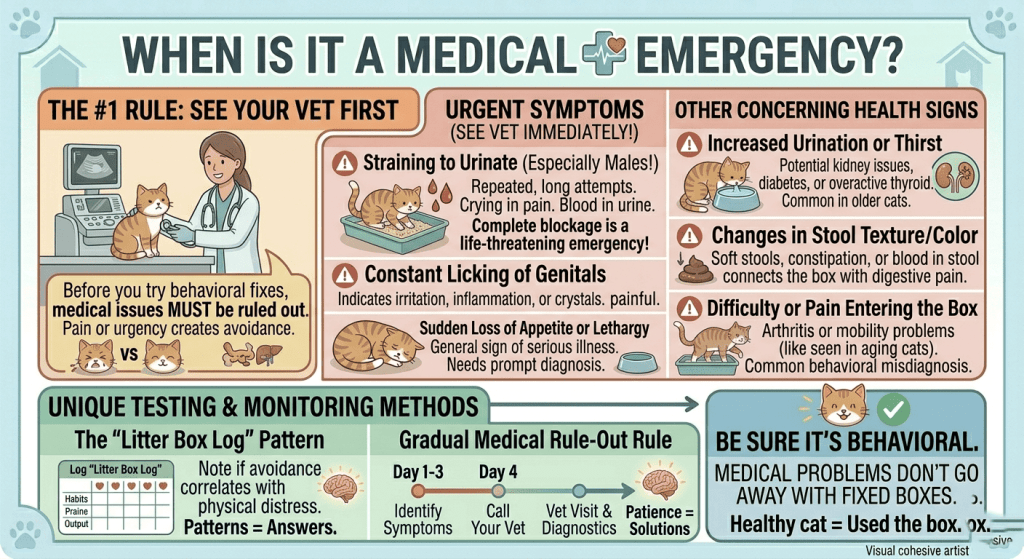
Before you try any of the fixes below, you need to rule out medical problems.
Go to a vet immediately if your cat: ( Cat Litter Box Problems )
| Warning Sign | What It Could Mean |
|---|---|
| Is straining to pee but only small drops come out | BLOCKAGE — life-threatening emergency |
| Is crying or yowling in the litter box | Pain while peeing or pooping |
| Has blood in their urine or poop | Infection, stones, or other serious issue |
| Is vomiting and not using the box | Severe illness |
| Is a male cat straining to pee | Male cats get urinary blockages easily. This can kill them in 24-48 hours. |
Make a vet appointment within 24-48 hours if your cat: (
| Warning Sign | What It Could Mean |
|---|---|
| Is peeing more often than usual | Diabetes, kidney disease, or UTI |
| Is drinking much more water | Diabetes or kidney disease |
| Has not pooped in 48 hours | Constipation or blockage |
| Has diarrhea outside the box | Digestive illness |
| Seems painful or cries when touched near the belly | Bladder stones or infection |
If none of these warning signs apply, your cat likely has a behavioral problem. And behavioral litter box problems are almost always fixable. Keep reading.
This is the single most effective fix for litter box problems. And it is the one most cat owners ignore.
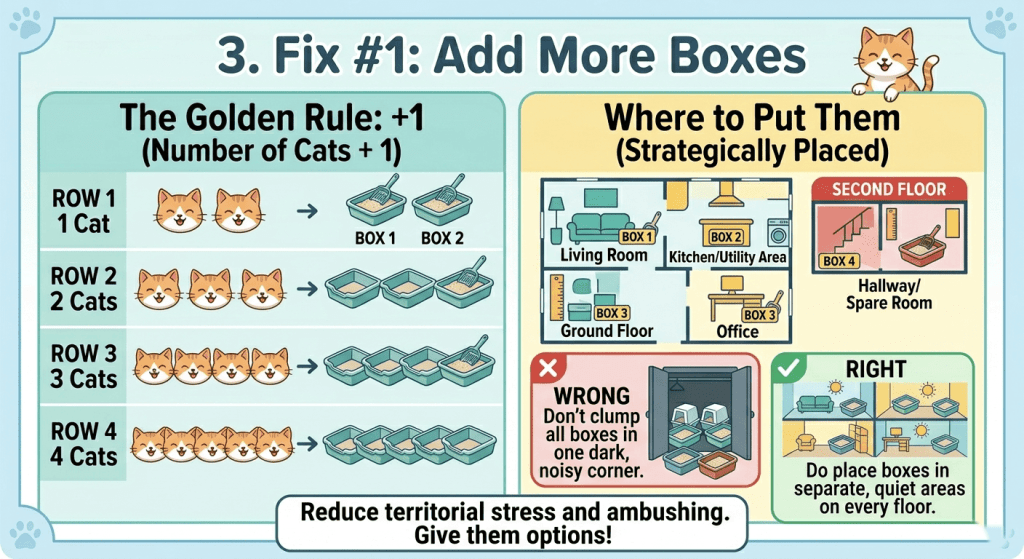
You need one litter box per cat, plus one extra.
| Number of Cats | Boxes You Need |
|---|---|
| 1 cat | 2 boxes |
| 2 cats | 3 boxes |
| 3 cats | 4 boxes |
| 4 cats | 5 boxes |
Cats are territorial. They do not like sharing. One cat might block another cat from using the box. One cat might ambush another near the box. Or one cat might simply want a clean box but the only box is dirty.
Having multiple boxes gives cats choices. Choices reduce stress. Less stress means fewer litter box problems.
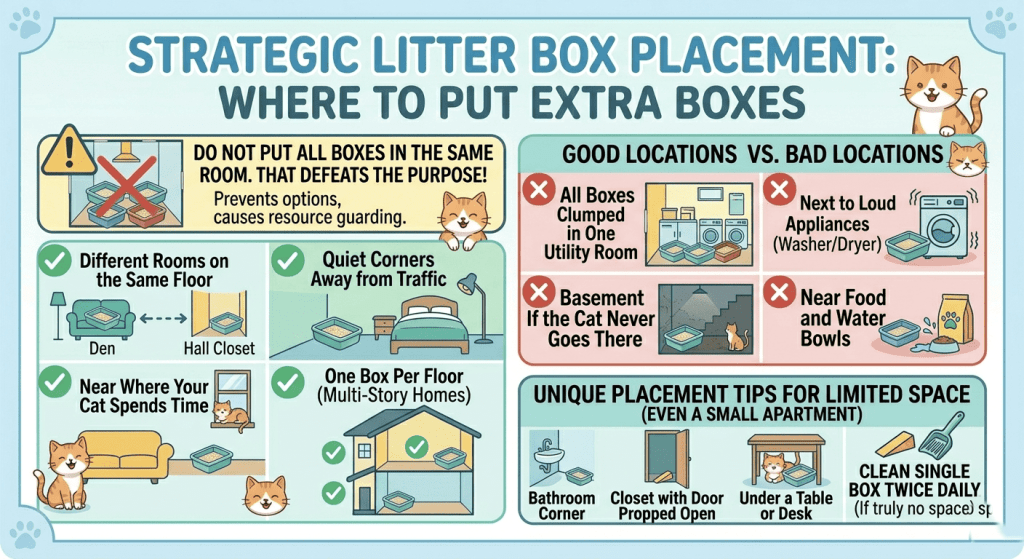
Do not put all boxes in the same room. That defeats the purpose.
| Good Locations | Bad Locations |
|---|---|
| Different rooms on the same floor | All boxes next to each other |
| Quiet corners away from traffic | Next to loud appliances (washer, dryer) |
| Near where your cat spends time | In the basement if the cat never goes there |
| One box per floor of your home | Next to the cat’s food and water |
Even a small apartment can fit two boxes. Try:
Unique tip: If you truly cannot fit a second box, try cleaning the single box twice per day. For some cats, this is enough.
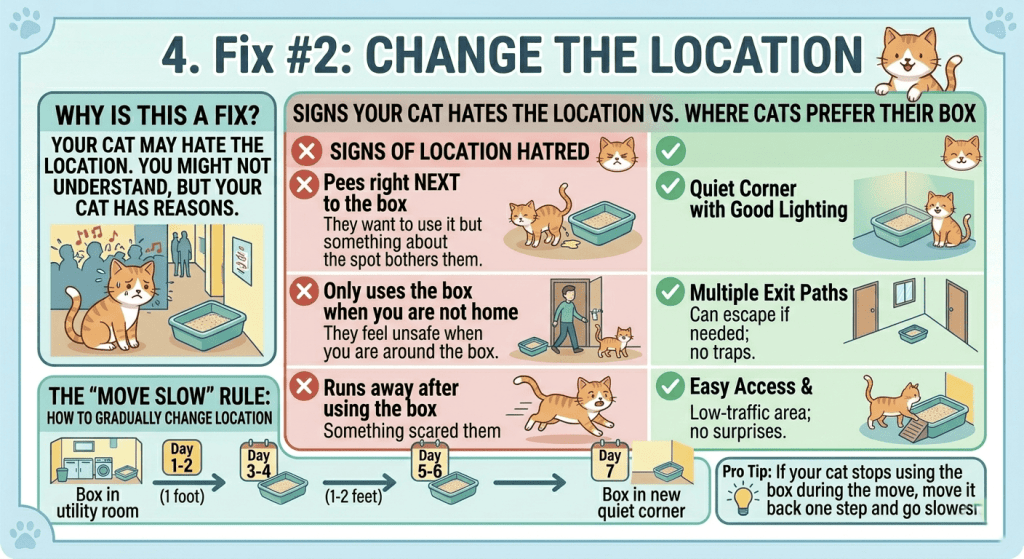
Your cat may hate where the litter box is right now. You might not understand why. But your cat has reasons.
| Your Cat’s Behavior | What It Means |
|---|---|
| Runs away after using the box | Something scared them near the box |
| Pees right NEXT to the box but not inside | They want to use the box but something about it bothers them |
| Only uses the box when you are not home | They feel unsafe when you are around the box |
| Uses the box less and less over time | Something has slowly made them dislike the spot |
| Bad Location | Why Cats Hate It |
|---|---|
| Next to washer/dryer | Loud noises, vibrations |
| In a dark, scary basement | Too isolated, hard to escape |
| In a high-traffic hallway | No privacy |
| Next to their food and water | Cats do not like to eat near where they poop |
| In a corner with only one exit | No escape route — cats feel trapped |
| On a different floor from where they spend time | Too much effort to get there |
| Good Location | Why Cats Like It |
|---|---|
| Quiet corner | Privacy |
| Multiple exit paths | Can escape if needed |
| Near where they sleep | Easy access |
| Low traffic area | No surprises |
| Good lighting (not too dark, not too bright) | Comfortable |
Do not move the box all at once. That can confuse your cat.
Instead:
| Day | Action |
|---|---|
| Day 1-2 | Move box 1 foot toward new location |
| Day 3-4 | Move box another 1-2 feet |
| Day 5-6 | Move box again |
| Day 7 | Box is in new location |
If your cat stops using the box during the move, move it back one step and go slower.
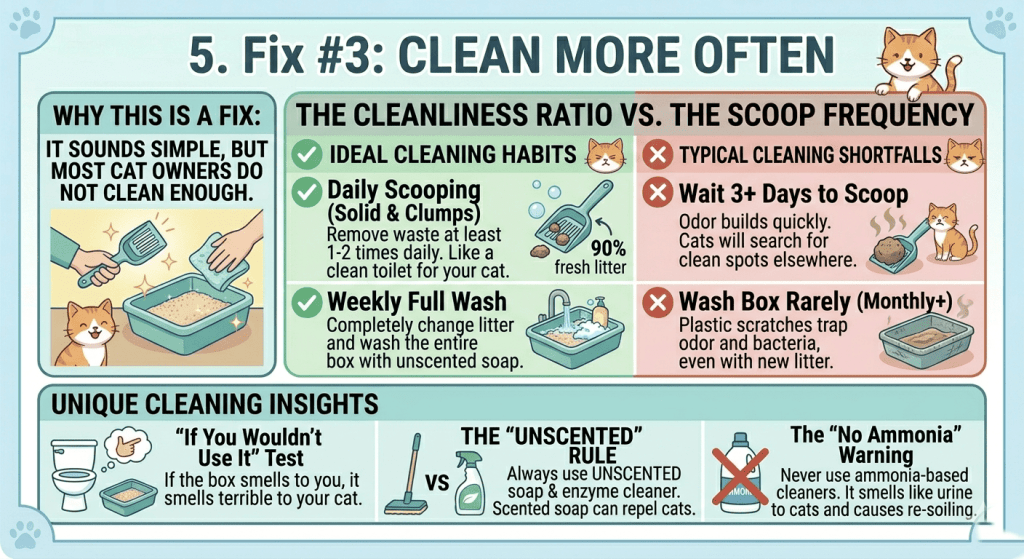
This sounds simple. But most cat owners do not clean enough.
| Task | Frequency |
|---|---|
| Scoop solid waste | Daily (at least once per day) |
| Scoop clumps (clumping litter) | Daily (at least once per day) |
| Full litter change | Every 1-2 weeks |
| Wash the box with soap and water | Every 1-2 weeks (when you change litter) |
Cats have a sense of smell 14 times stronger than humans.
A box that smells “a little” to you smells TERRIBLE to your cat. Would you want to step into a dirty public restroom every time you need to go? Neither does your cat.
Before you leave the house, ask yourself:
“Would I use this box right now?”
If the answer is no, scoop it.
| Safe Cleaners | Unsafe Cleaners |
|---|---|
| Hot water and dish soap | Bleach |
| White vinegar (diluted) | Ammonia (smells like pee to cats) |
| Enzyme cleaners (made for pet urine) | Pine-scented cleaners |
| Baking soda | Strong citrus cleaners |
Unique tip: Never use ammonia-based cleaners on a litter box. Ammonia smells like urine to cats. They will think the box is already dirty and may pee next to it instead.
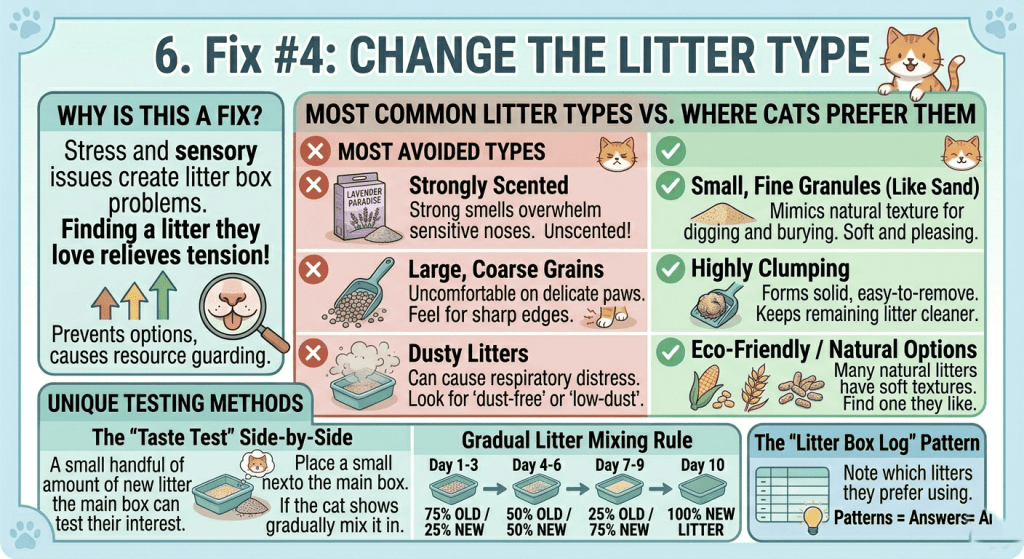
Your cat may simply hate the litter you are using.
| Problem | Why It Happens |
|---|---|
| Litter is too dusty | Some clay litters create clouds of dust |
| Litter hurts their paws | Crystal litter feels sharp on sensitive paws |
| Litter smells too strong | Scented litters can overwhelm cats |
| Litter feels wrong under their feet | Texture matters more than you think |
Try this process:
Step 1: Buy small bags of 3-4 different litter types:
| Type | Examples |
|---|---|
| Unscented clumping clay | Most common, cats usually like it |
| Paper-based | Soft, good for sensitive paws |
| Pine or wood | Natural smell, some cats love it |
| Corn or wheat | Natural, clumps well |
| Crystal/silica | Low dust, but some cats hate the texture |
Step 2: Put each litter in a separate box. Put the boxes next to each other.
Step 3: Watch which box your cat chooses.
Step 4: After a week, you will know their favorite.
Try unscented, fine-grained, clumping clay litter. This is the most widely accepted litter among cats. Start there.
If you find a new litter your cat likes, do not switch all at once.
Instead:
| Week | Action |
|---|---|
| Week 1 | 25% new litter + 75% old litter |
| Week 2 | 50% new litter + 50% old litter |
| Week 3 | 75% new litter + 25% old litter |
| Week 4 | 100% new litter |
Slow changes prevent litter box rejection.
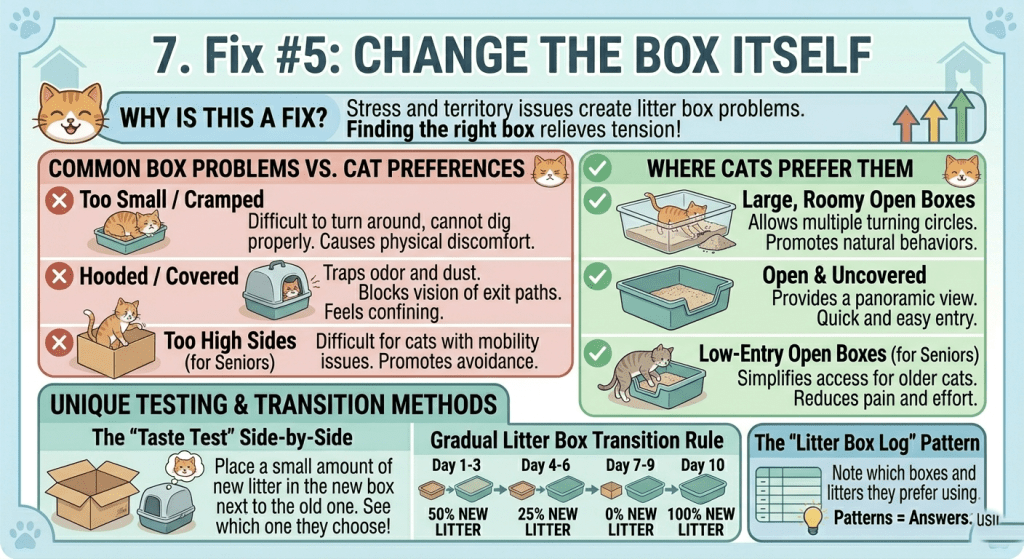
Sometimes the box is the problem.
| Problem | Why Cats Hate It |
|---|---|
| Box is too small | Cat cannot turn around comfortably |
| Box has a hood/lid | Traps smells, feels like a trap |
| Box is too high to step into | Hurts old cats or cats with arthritis |
| Box is old and scratched | Scratches trap bacteria and smells |
| Box is a different color | Some cats prefer certain colors (usually white or neutral) |
| Cat Type | Best Box |
|---|---|
| Most cats | Large, open, uncovered box |
| Older cats | Low-entry box (3-4 inch side) |
| Cats who spray | High-sided box (but still uncovered) |
| Cats who dig a lot | High-sided or top-entry box |
| Kittens | Small, low-entry box |
| Large cats (Maine Coon, etc.) | Extra large box (storage tub works great) |
Buy a large plastic storage tub (like for under-bed storage). Cut a low entry hole in one side. Sand the edges smooth.
You just made a $20 litter box that is bigger and better than anything at the pet store.
| Hooded Box Pros | Hooded Box Cons |
|---|---|
| Less litter tracking | Traps smells inside |
| More privacy (some cats) | Cat feels trapped |
| Looks nicer to humans | Harder for cat to escape |
| Contains mess | Some cats refuse to use them |
Verdict: Start with an uncovered box. If your cat is happy, you can try a hood. But 70% of cats prefer uncovered boxes.
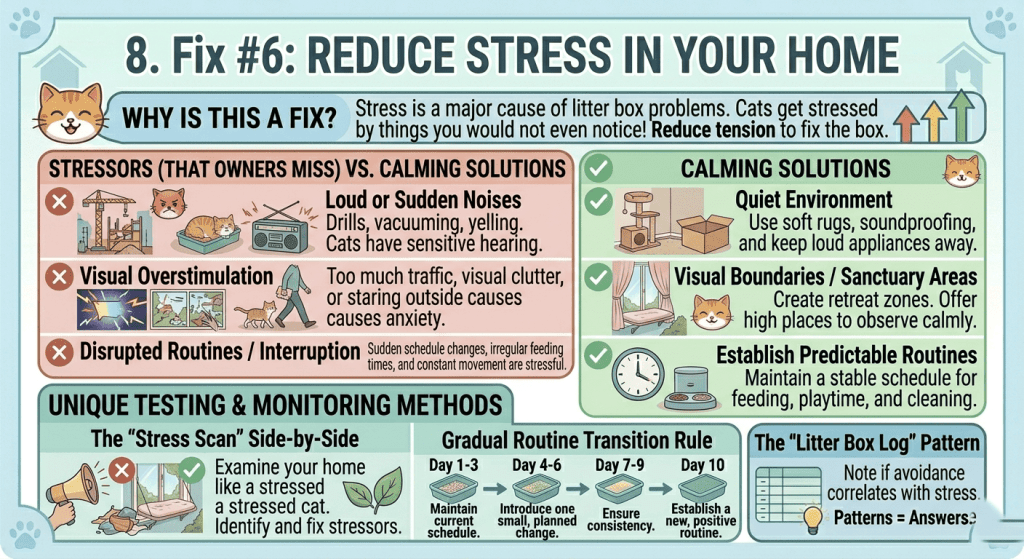
Stress is a massive cause of litter box problems. And cats get stressed by things you would not even notice.
| Stressor | Why It Affects Your Cat |
|---|---|
| New baby or pet | Jealousy, fear, territory changes |
| Construction or moving | Unfamiliar sounds, smells, spaces |
| New furniture | Changed territory |
| Outdoor cats walking by the window | Feels like intruders |
| Fighting between cats in the home | Fear, tension |
| Your own stress | Cats feel your emotions |
| Lack of hiding spots | Nowhere to feel safe |
Every cat needs places to hide where no one bothers them.
| Hiding Spot Ideas | Cost |
|---|---|
| Cardboard box on its side with a blanket inside | Free |
| Cat cave or covered bed | $15-40 |
| Space under a bed or couch | Free |
| High shelf or cat tree | $30-100 |
| Closet with door slightly open | Free |
If you have multiple cats, you need:
| Resource | How Many |
|---|---|
| Litter boxes | 1 per cat + 1 extra |
| Food bowls | At least 1 per cat |
| Water bowls | At least 1 per cat |
| Hiding spots | At least 2-3 per cat |
When cats have to share, stress increases. When stress increases, litter box problems start.
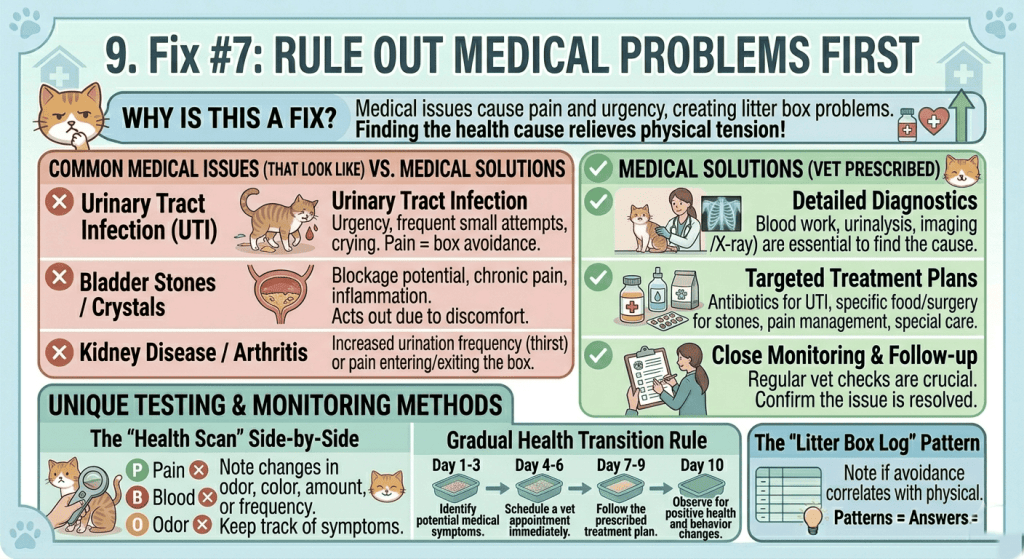
I mentioned this at the beginning, but it is so important that I want to say it again.
Before you try ANY of these fixes, take your cat to the vet.
Litter box problems are often the FIRST sign of:
| Medical Condition | Why It Causes Box Problems |
|---|---|
| Urinary tract infection (UTI) | Peeing hurts, so cat avoids box |
| Bladder stones | Painful to pee, may pee small amounts frequently |
| Kidney disease | Increased thirst and urination, may not make it to box |
| Diabetes | Same as kidney disease |
| Arthritis | Hurts to step into box |
| Constipation | Painful to poop, associates pain with box |
| Hyperthyroidism | Increased thirst and urination |
Any new litter box problem in a cat over 7 years old should see a vet first.
Any litter box problem with straining, crying, or blood should see a vet immediately.
Once medical problems are ruled out, the fixes above will work. But if there is a medical problem, no amount of cleaning or box changing will help.
Most articles stop at the 7 fixes above. Here is information that is very hard to find anywhere else.
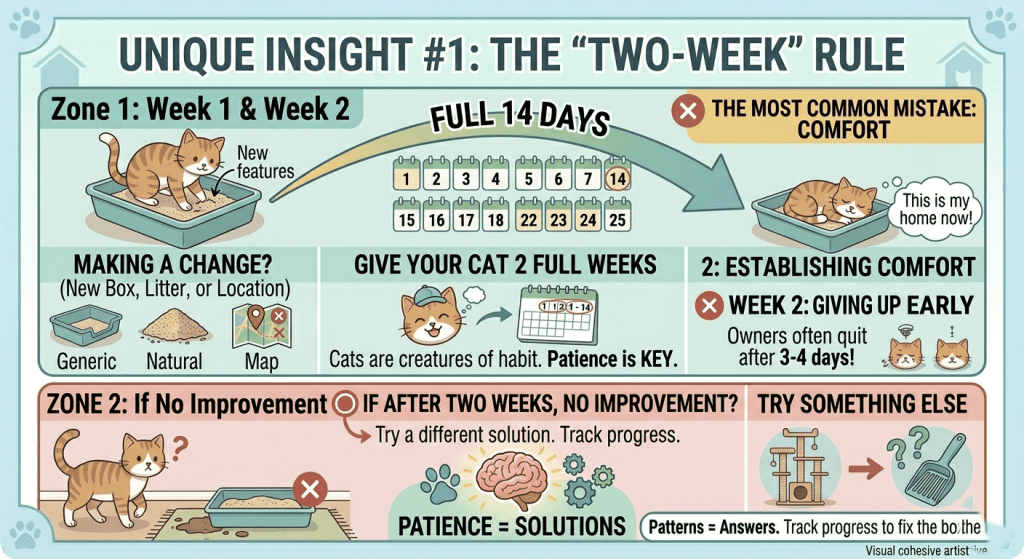
When you make a change (new box, new litter, new location), give your cat two full weeks to adjust. Many owners give up after 3-4 days. But cats are creatures of habit. They need time.
If after two weeks there is no improvement, try something else.
Put treats or catnip near the litter box (not inside it). This helps your cat form a positive feeling about the box location.
Do this for 2-3 days. Then stop. Your cat will still remember the positive association.
When your cat pees outside the box, regular cleaners do not remove the smell completely. Cats can still smell it. And they will pee in the same spot again.
You MUST use an enzyme cleaner made for pet urine. These cleaners break down the proteins in urine. Regular soap does not.
Brands that work: Nature’s Miracle, Rocco & Roxie, Simple Solution.
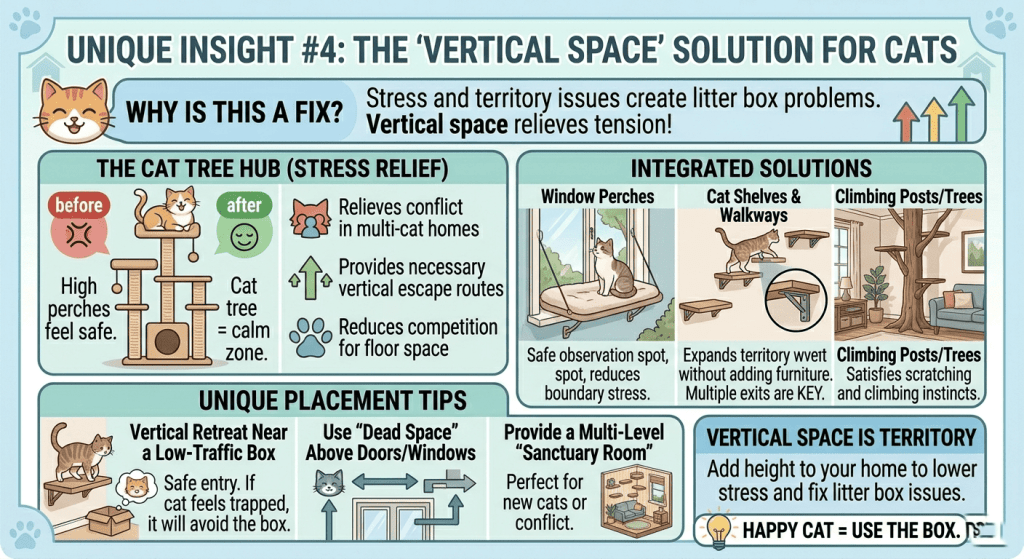
Many litter box problems come from tension between cats. The best way to reduce cat-to-cat tension is to add vertical space.
Cats feel safer when they can get up high. Add:
When cats can escape up high, they fight less. When they fight less, litter box problems decrease.
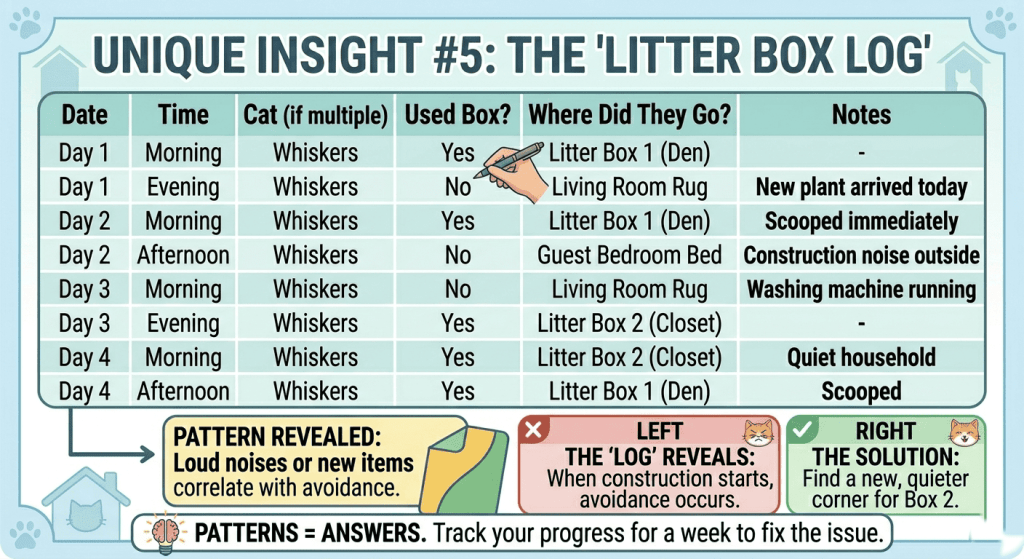
Keep a simple log for one week:
| Date | Time | Cat (if multiple) | Used Box? | Where Did They Go? | Notes |
|---|---|---|---|---|---|
| Day 1 | Morning | Whiskers | Yes | Box | – |
| Day 1 | Evening | Whiskers | No | Living room rug | New plant arrived today |
This log will reveal patterns. Maybe the problem only happens when the laundry is running. Maybe it only happens when a certain person visits. Patterns = answers.
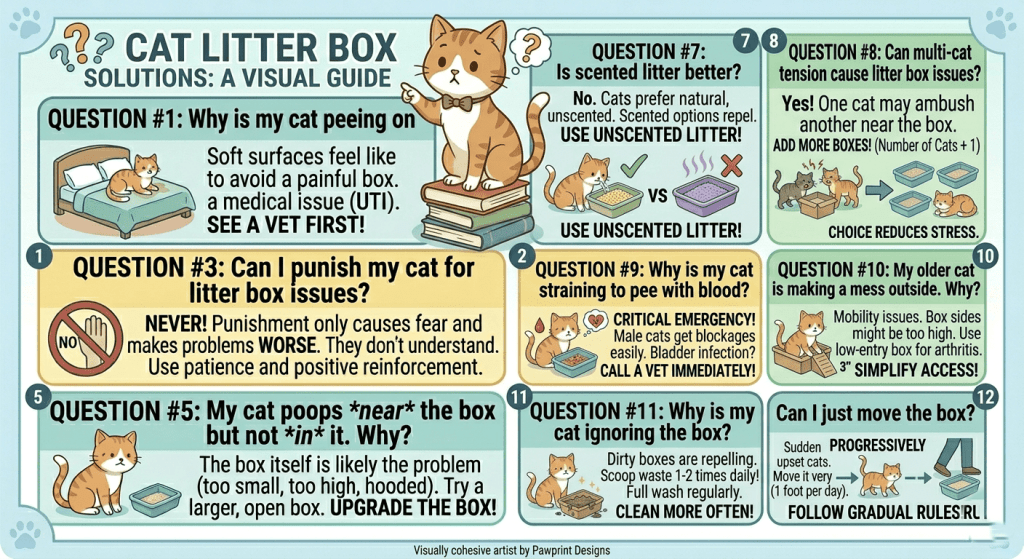
Q: My cat is peeing on my bed. Why?
A: Soft surfaces feel good to cats in pain. This often means a urinary tract infection or bladder stones. See a vet first. If medical is ruled out, try: closing bedroom doors, using a waterproof mattress cover, and adding a litter box in the bedroom temporarily.
Q: My cat poops right next to the box but not inside. Why?
A: This usually means the box itself is the problem. Try: a larger box, removing the hood (if you have one), changing to unscented litter, or cleaning more often.
Q: How many times should I scoop per day?
A: At least once. Twice is better. Some owners scoop every time they walk by. You cannot scoop too much.
Q: How often should I completely replace the litter?
A: Every 1-2 weeks for clumping litter. Every 2-3 days for non-clumping. If it smells before that, do it sooner.
Q: My cat used the box fine for years. Why did they suddenly stop?
A: Something changed. Think back 1-2 weeks before the problem started. New pet? New person? New furniture? Construction? Illness? Vet visit? Find the change. Fix the change. The problem often goes away.
Q: Can I punish my cat for going outside the box?
A: NEVER. Punishment makes cats afraid of YOU, not the behavior. They do not understand why you are angry. Punishment makes litter box problems WORSE, not better.
Q: How long does it take to fix a litter box problem?
A: 1-4 weeks, depending on the cause. Medical problems fix quickly with treatment. Behavioral problems take longer. Be patient.
Here is what I want you to remember:
First: Rule out medical problems first. Always. Every time.
Second: Your cat is not trying to make you angry. They are trying to tell you something is wrong. Listen to them.
Third: Start with the easiest fixes. Add a second box. Clean more often. Move the box to a better spot.
Fourth: Be patient. Change one thing at a time. Wait two weeks before trying something else.
Fifth: If you have tried everything and your cat still avoids the box, talk to a veterinary behaviorist. Some cats need professional help. That is okay.
You love your cat. Your cat loves you. With patience and the right information, you will solve this problem together.
This article was written for Paw and Antler — a website dedicated to helping pet owners give their animals the best possible care using evidence, not folklore.
Disclaimer: This article is for informational purposes only. Always consult a licensed veterinarian for medical advice about your specific cat
Pingback: Cat In Small Apartment: The Cat Ecostructure Playbook