
Newly Discovered Animals of 2026
Why does 2026 feel like a banner year for new species? Because it is. From a shark that walks on its fins to a golf-ball-sized
Why does 2026 feel like a banner year for new species? Because it is. From a shark that walks on its fins to a golf-ball-sized
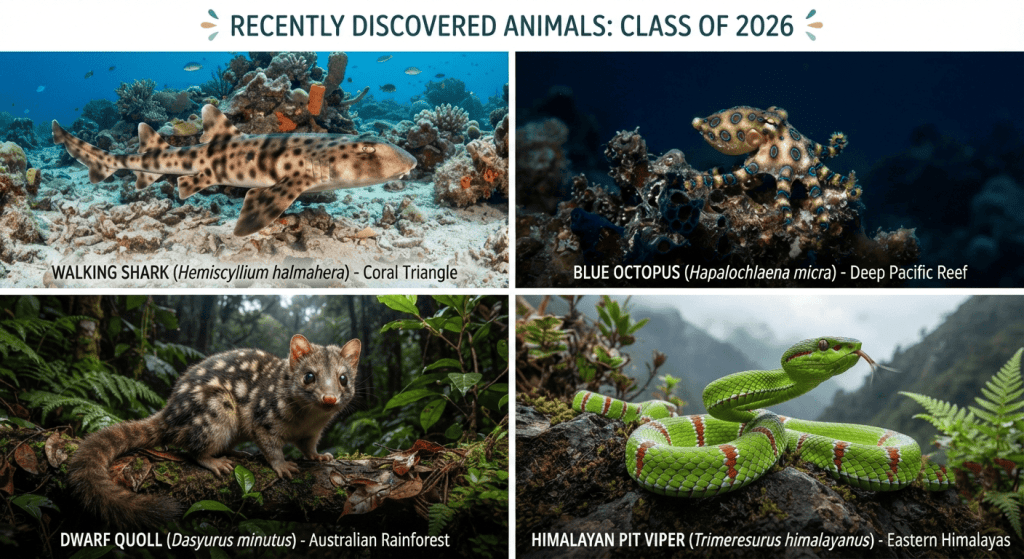
Why does 2026 feel like a banner year for new species?
Because it is. From a shark that walks on its fins to a golf-ball-sized blue octopus, scientists have been pulling back the curtain on life forms we never knew existed—sometimes in the most unexpected places.
What’s driving all these discoveries? Better DNA technology, deeper ocean exploration, and a simple truth: we’ve barely scratched the surface. The vast majority of animal species on Earth—perhaps as many as 90 percent—remain undescribed.
Let’s explore what 2026 has revealed.
How do you discover a metre-long shark that walks on its fins?
You go night-diving in Papua New Guinea.
The newly described Dudgeon’s walking shark (Hemiscyllium dudgeonae) was officially confirmed in 2026—but locals had known it for years. They call it kadedekedewa, which loosely translates to “dog shark” or “lazy shark” because of its slow, four-limbed gait.
Why did it take so long to formally describe?
The shark uses all four fins as limbs to walk across reef flats at low tide. It was first spotted during a night dive in March 2025 by researchers studying a different species of walking shark. PhD student Jess Blakeway immediately noticed something different: the colour pattern had white dashes along its brown body, rather than the leopard-like spots they were expecting.
What makes it special?
It’s the tenth known species in the walking shark genus Hemiscyllium, and the first new species described for the genus since 2013.
But here’s the worrying part: The species is found only in a tiny area off southeastern Papua New Guinea. Its restricted home range, combined with habitat degradation, fishing activity, and climate change, immediately raised concerns about its vulnerability.
What’s next? The research team plans to collect more data in October 2026 to help the IUCN Red List assess whether the species should be classified as vulnerable or endangered.
What happens when you re-examine museum specimens with modern DNA tools?
You discover a species that hasn’t been seen since 2004.
Planigale petrophila is a newly discovered species of planigale—the world’s tiniest marsupials. So far, only three specimens have ever been found, all from a small area of the sandstone plateau and rocky slopes in Kakadu National Park, Australia.
How was it discovered?
Researchers from Queensland University of Technology used integrative taxonomy—combining comprehensive genetic sampling with morphological analysis—on planigale specimens from museum collections across Australia. They discovered that what was once thought to be one species (Planigale ingrami) was actually three different species.
What makes P. petrophila unique?
It has a much longer tail than all other planigale species and is larger in all body and skull proportions compared to its closest genetic relatives.
Why should we be concerned?
The species hasn’t been re-collected since 2004. Given the small geographic area where it’s found and the alarming declines in other northern Australian mammal species, researchers are recommending an urgent full conservation assessment.
How do you describe a new octopus species without cutting it open?
You use CT scans.
The team from the Charles Darwin Foundation discovered Microeledone galapagensis nearly 1,800 metres below the water’s surface near the Galapagos Islands.
What did they say when they first saw it?
“He’s tiny! It’s blue!” one excited scientist exclaimed as the submersible’s footage showed the cerulean cephalopod.
Why is this octopus so unusual?
It appears to be the runt of the Megaleledonidae family—its relatives are normally much larger and live in the Southern Ocean surrounding Antarctica. It has stubby little arms with only one row of suckers, setting it apart from most octopus species.
And the colour? It’s light blue on its back and a “very deep purple” underneath—believed to be the rarest colour in nature.
Why does the colour matter?
The colour pattern likely helps keep the octopus safe. If it grabs a prey item that emits light, that light could attract predators. The octopus puts its dark-coloured web over the prey, keeping itself hidden.
The clever part: Instead of dissecting the only specimen, the Field Museum team used CT scans to take thousands of X-ray images and created a 3D model to reveal its internal structures without damaging it.
What happens when scientists extract DNA from 160-year-old museum specimens?
They discover that one species is actually five.
For more than 160 years, the Himalayan pit viper was believed to be a single species found across the Himalayas in Pakistan, India, and Nepal. A 2026 study revealed it’s actually five distinct species—including three entirely new to science.
The three new species are:
How did they do it?
Researchers collected samples from different populations, examined historical specimens, and extracted DNA from museum specimens—including those preserved in formalin, which has traditionally been difficult to work with.
Why does this matter?
These vipers have small ranges, making them “extremely vulnerable to climate change.” As pit viper specialist Anita Malhotra noted, the extreme topography of the mountains likely isolated these populations, but their limited distribution means they’re at higher risk.
The bigger message: “If we do not recognise distinct species, we cannot accurately assess their risk or protect them effectively.”
How many leopard gecko species are there in India? Eight now—and this one was hiding in plain sight.
Eublepharis jhuma was discovered in the Kaimur Plateau, representing the easternmost extension of the Vindhyan hills in Bihar, India.
What makes it distinct?
Its DNA shows a divergence of up to 7.8% from other Indian leopard geckos—a level scientists often regard as evidence of long-term evolutionary separation. It also has distinctive colouration, two pale bands on its body between the neck and tail, and characteristic tuberculate scales.
Why does this matter for conservation?
Leopard geckos have been part of the international pet trade since the 1960s. While all species of leopard geckos in India are protected under Schedule I of the Wild Life (Protection) Amendment Act, 2022, they continue to face threats from habitat loss, forest fires, pollution, road mortality, and persecution.
The hidden message: As scientist Abhijit Das noted, “This is yet another example of how species can remain hidden in plain sight.”
What’s the biggest dinosaur ever found in Southeast Asia?
Nagatitan chaiyaphumensis—identified in May 2026. It weighed 27 tonnes (as much as nine adult Asian elephants) and measured 27 metres (88 feet) in length.
But wait, there’s more.
In July 2026, palaeontologists announced another new dinosaur: Uragasaurus kalasinensis. This plant-eating sauropod had an unusually long neck and measured up to 20 metres (66 feet)—roughly the length of a cricket pitch.
How was it discovered?
The specimen was part of a large fossil collection from a site first identified in 2008, when a local man found fragments resembling serpent scales. A CT scan revealed unique characteristics, including a Y-shaped arrangement of supporting bones and a distinctive air-cavity structure described as “unlike any other dinosaur in the world.”
The human moment: Lead author Dr Apirat Nilphanaphan said he smashed his keyboard after realising they had discovered a new species, feeling both “exhilarated and relieved.”
Why was everyone so surprised?
For over a century, the Happy-Face spider (Theridion grallator) was thought to be unique to the Hawaiian Islands—found nowhere else on Earth.
Then researchers in India found one with the same unmistakable smile.
Theridion himalayana, the Himalayan Happy-Face Spider, was discovered in the montane mountains of Uttarakhand, India, at elevations of over 2,000 metres.
How did they find it?
The discovery was accidental—researchers were originally surveying ants. But when they saw the spider’s image, they knew instantly they had a “jackpot.”
What’s the science behind it?
DNA analysis revealed a genetic variation of approximately 8.5% from the Hawaiian happy-face spider, confirming it as a separate lineage that evolved independently in Asia. The researchers identified 32 different colour variations of the species from three locations in Uttarakhand.
The mystery: While the smiling patterns are striking, their exact purpose remains unknown. “Why do they resort to such patterns on their back, and what functional role in their life cycle does it exactly serve is yet to be deciphered. This is definitely indicative of a deeper genetic mystery.”
What does a cave cricket have to do with The Lord of the Rings?
Everything, if you name it right.
Dolichopoda balrogi was discovered on Kastellorizo, a tiny Greek island covering only about 9 square kilometres. It was found not in a natural cave, but in an artificial tunnel—the island’s only accessible land cave.
Why “balrogi”?
The species was named after the Balrog, a legendary fire-demon from Tolkien’s The Lord of the Rings—an ancient creature hidden deep beneath the mountains, emerging from darkness.
The parallel: In Tolkien’s narrative, the Balrog is revealed after the Dwarves “delved too deep.” Similarly, Dolichopoda balrogi was discovered due to anthropogenic excavation on Mount Vigla, as the island lacks accessible caves.
The takeaway: “Even small and seemingly ordinary habitats can shelter unique and previously unknown life.”
How many new marine species were discovered in 2025-2026?
1,121. In just one year.
What’s the Ocean Census?
A global biodiversity initiative funded by the Nippon Foundation. In its first year, it coordinated 13 scientific expeditions over 12 months, sending researchers down to depths of 6,575 metres (21,570 feet).
What did they find?
Why is this just the beginning? With the majority of the seabed still unidentified, researchers expect to find thousands more species.
How do you discover a new pit viper in the Himalayas?
By looking at its DNA.
Ovophis medogensis was described in 2026, raising the total number of recognized species in the Asian pit viper genus Ovophis to ten. The snake had been “hiding in plain sight for years”—its appearance was similar to known species, but DNA analysis revealed it was genetically distinct.
What do you name a new species of sea slug?
If you’re biologist Jesus Ortea, you name it after a footballer.
Aldisa vozinha—a small red sea slug discovered in the Caribbean—was named after Cape Verde goalkeeper Vozinha.
Why Vozinha?
The naming came after Cape Verde’s historic World Cup campaign, where the 40-year-old goalkeeper became a global sensation. Ortea wanted to mark Vozinha’s “prominent role” and noted that the red colour of the dedicated species was “a reminder of his feat”—a nod to the Spanish team nicknamed “La Roja” (The Red One).
Fun fact: Ortea, a 75-year-old football fan, previously named a discovery after Keylor Navas and another after a Sporting Gijon striker.
Why should we care about new species discoveries?
Because every species tells a story—about evolution, about ecosystems, and about what we’re at risk of losing.
The threats are real:
As one researcher put it: “This discovery highlights the need to treat fragile ecosystems as reservoirs of highly localised evolutionary diversity. It also shows why taxonomy is central to conservation: if we do not recognise distinct species, we cannot accurately assess their risk or protect them effectively.”
The work continues. Researchers are heading back to Papua New Guinea in October to gather more data on the walking shark. Expeditions are ongoing in the deep ocean, where thousands more species await discovery. And museum specimens continue to reveal secrets with modern DNA technology.
The numbers tell the story: The vast majority of animal species on Earth—perhaps as many as 90 percent—remain undescribed. What we found in 2026 is just the beginning.
Disclaimer: This article is for educational and informational purposes only. I am not a biologist or a conservation expert. Species information is based on 2026 scientific publications and news reports. Conservation status may change as new data becomes available.
Here are the most common questions about the remarkable new species discovered in 2026, with clear, science-backed answers.
A: Walking sharks are small, harmless carpet sharks that use their muscular pectoral and pelvic fins almost like legs to crawl across the seafloor. Rather than swimming everywhere, they use an undulating, four-limbed gait to navigate shallow coral reefs, squeeze into tight spaces, and search for food among rocks and crevices.
A: The newly discovered species is called Dudgeon’s walking shark (Hemiscyllium dudgeonae). It was named after Christine Dudgeon, a marine biologist who helped identify it and caught the first specimen by hand. Locals in Papua New Guinea call it kadedekedewa, which loosely translates to “dog shark” or “lazy shark” because of its slow, deliberate movement.
A: Unfortunately, yes. The Dudgeon’s walking shark has the smallest known geographic range of any walking shark species, making it particularly vulnerable. Scientists believe it’s likely to qualify as endangered or vulnerable when formally assessed by the IUCN, due to habitat degradation, fishing activity, and climate change. Five of the ten walking shark species are already listed as threatened.
A: The new species is called the Arnhem Plateau planigale (Planigale petrophila). Its scientific name translates to “rock lover”. Planigales are the world’s tiniest marsupials, belonging to what scientists call the “cutest and fiercest” mammal group.
A: The three new species are:
Hazara pit viper (Gloydius hazarensis) – found in northeastern Pakistan at elevations of 1,630–2,900 metres
Hindu Kush pit viper (Gloydius hindukushensis) – found in the eastern foothills of the Hindu Kush Mountains in Pakistan at 1,660–2,888 metres
Nepali pit viper (Gloydius nepalensis) – found across western and west-central Nepal at 1,640–3,220 metres
A: In one year alone, the Ocean Census initiative discovered more than 1,100 new marine species through 13 scientific expeditions across 12 months. On land, multiple new species of sharks, marsupials, octopuses, snakes, geckos, and even dinosaurs have also been described.
A: Three key factors are driving the surge:
Better DNA technology – Scientists can now extract and analyze DNA from museum specimens preserved for over a century
Deeper ocean exploration – Submersibles are reaching previously unexplored depths
Museum re-examination – Re-analysing old specimens with modern tools reveals species that were hidden in plain sight
A: As one researcher explained: “This discovery highlights the need to treat fragile ecosystems as reservoirs of highly localised evolutionary diversity. It also shows why taxonomy is central to conservation: if we do not recognise distinct species, we cannot accurately assess their risk or protect them effectively”.
How Casinos Are Rebounding After COVID-19: Recovery Strategies Revealed The COVID-19 pandemic has had a
Олимп казино официальный сайт в Казахстане – Olimp Casino ▶️ ИГРАТЬ Содержимое Преимущества игры в
Олимп казино официальный сайт в Казахстане – Olimp Casino ▶️ ИГРАТЬ Содержимое Преимущества игры в
Олимп казино официальный сайт в Казахстане – Olimp Casino ▶️ ИГРАТЬ Содержимое Преимущества игры в
Олимп казино официальный сайт в Казахстане – Olimp Casino ▶️ ИГРАТЬ Содержимое Преимущества игры в
Олимп казино официальный сайт в Казахстане – Olimp Casino ▶️ ИГРАТЬ Содержимое Преимущества игры в
[261409]supplies professional anti-violence equipments and solutions for the whole world with strong and perfect production capacity. anti-violence.org