I’ll never forget the first time I saw my female bearded dragon, Ember, start digging frantically in her enclosure. I’d read about gravid behavior, but
Table of Contents
I’ll never forget the first time I saw my female bearded dragon, Ember, start digging frantically in her enclosure. I’d read about gravid behavior, but watching it in person was something else entirely. She was restless, pacing, and digging with a determination that told me she was ready to lay.
That first clutch was both terrifying and magical.
If you’re thinking about breeding bearded dragons, I want to share what I learned through trial and error. Spoiler alert: it’s way more work than I expected, but incredibly rewarding when done right.
Before You Even Think About Breeding
Let me be real with you. Breeding bearded dragons isn’t like breeding fish or hamsters. It’s a serious commitment that requires time, money, space, and a willingness to deal with heartbreak.
Most experts recommend leaving breeding to experienced keepers, not beginners. I learned this the hard way.
Things I wish I’d known upfront:
It’s rarely profitable for first-time breeders
You’ll need extra veterinary care (planned and unplanned)
Finding homes for babies is harder than you think—the market is often saturated
Babies can become aggressive toward each other quickly, meaning you’ll need separate enclosures
The financial and time commitment is significant
One breeder I follow put it perfectly: “Reproduction isn’t casual—it’s sacred responsibility”. That stuck with me.
Choosing the Right Breeding Pair
This is where I made my first big mistake. I was impatient and paired dragons that were barely old enough.
Age Requirements
Females should be at least 24 months old. Males should be at least 18 months old. Yes, bearded dragons can breed as early as 8 months, but that doesn’t mean they should.
Here’s why age matters:
Breeding too young can stunt their growth
Young females are at higher risk of becoming egg-bound (a life-threatening condition)
Early breeding can shorten their lifespan
Egg production drains calcium, and young females often can’t replenish it fast enough
Weight Requirements
Weight is actually a more accurate measure of maturity than length.
Dragon
Minimum Weight
Female
350 grams
Male
300 grams
Some sources recommend females be even heavier—closer to 400 grams—before breeding.
Size Matters Too
Both dragons should be at least 18 inches in length from snout to tail. I made the mistake of breeding a smaller female, and she had a rough time.
Health Check (Non-Negotiable)
Before breeding, both dragons need a veterinary exam. This should include:
Fecal testing for parasites
Testing for adenovirus (a common and serious virus in bearded dragons)
Overall health assessment (weight, body condition, hydration)
Trust me, don’t skip this step. I lost a clutch because I didn’t realize one of my dragons had parasites.
Genetic Considerations
If you’re breeding for specific morphs (color variations), research the genetics involved. Some morphs come with health problems:
“Trans” (translucent) morphs can be very weak, and breeding trans-to-trans can cause serious problems
Linebreeding (breeding related individuals) can lead to weakened immune systems, deformities, and failure to thrive in babies
My advice: Start with healthy, standard-colored dragons before attempting rare morphs. Learn the basics first.
Setting Up the Breeding Environment
Separate Housing
This is critical. Males and females should live separately unless you’re actively trying to breed them. House males together, and they will fight—sometimes to the death.
The Breeding Tank
When you’re ready to introduce them, you need a large breeding enclosure:
Some breeders recommend 120 gallons or larger for privacy and space
This tank needs:
UVB lighting (linear tube, 10-12% output)
Basking spot at 100-115°F
Cool side at 80-90°F
Hiding spots (I use cardboard egg-crate flats)
Appropriate substrate (paper towels or reptile carpet are safest)
The Laying Box
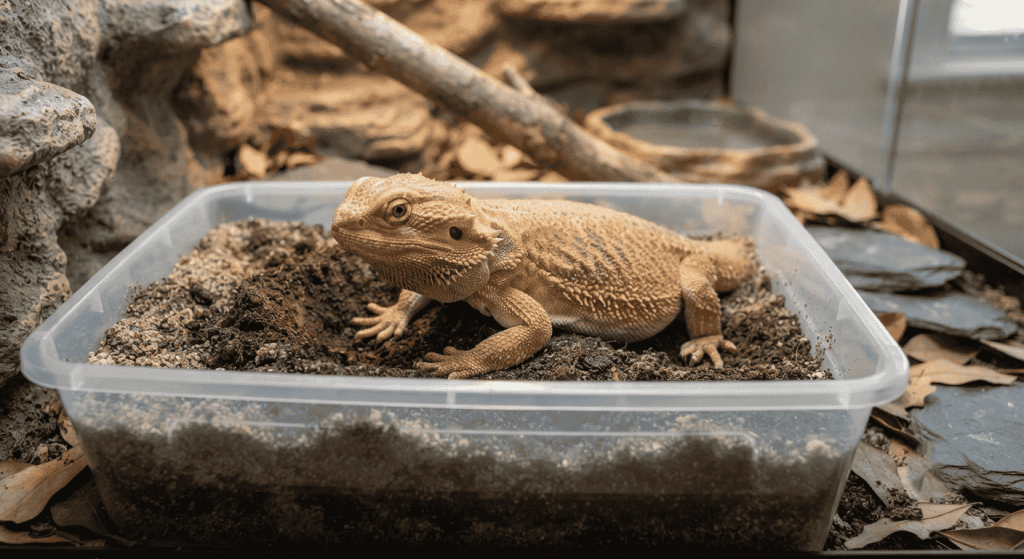
This is where the female will lay her eggs. It needs to be placed inside the breeding tank.
What you need:
A 10-15 gallon container
8 inches deep of substrate (reptile-safe topsoil or potting soil mixed with sand)
The substrate should be slightly clumpy—easy for digging but able to hold a burrow
Pro tip: I learned that females won’t lay if the box isn’t deep enough. Make sure she has room to fully bury herself and her eggs.
The Breeding Process: Step by Step
Step 1: Brumation (Optional)
In the wild, bearded dragons brumate (slow down) during cooler months, and some breeders mimic this to stimulate breeding.
Reduce temperatures and lighting gradually
Offer less food
Do this for about 4-6 weeks
But here’s the thing: It’s not strictly necessary. Captive dragons can breed year-round.
My experience: I tried brumation once and found it stressful. Now I just maintain consistent conditions, and my dragons breed when they’re ready.
Step 2: Introduction
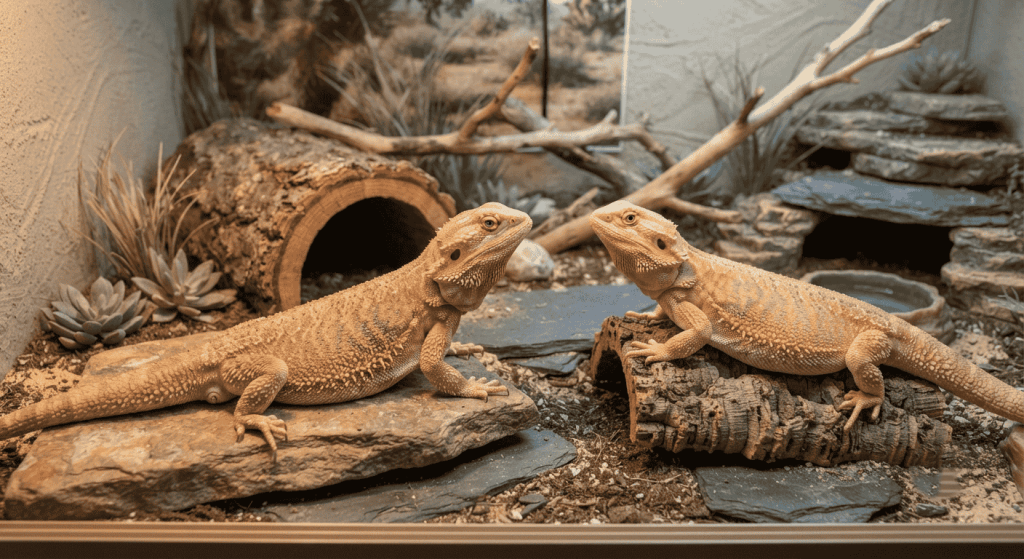
Bring the female into the male’s enclosure, not the other way around. This reduces territorial stress on the female.
Important: Introduce them for about a week, then separate them for a week. This gives the female a break and prevents the male from over-mating her.
My experience: One of my males would only breed with certain females. Some breeders have the same experience—dragons can be picky about their partners!
Step 3: Courtship Behavior
This is fascinating to watch. The male will display several behaviors:
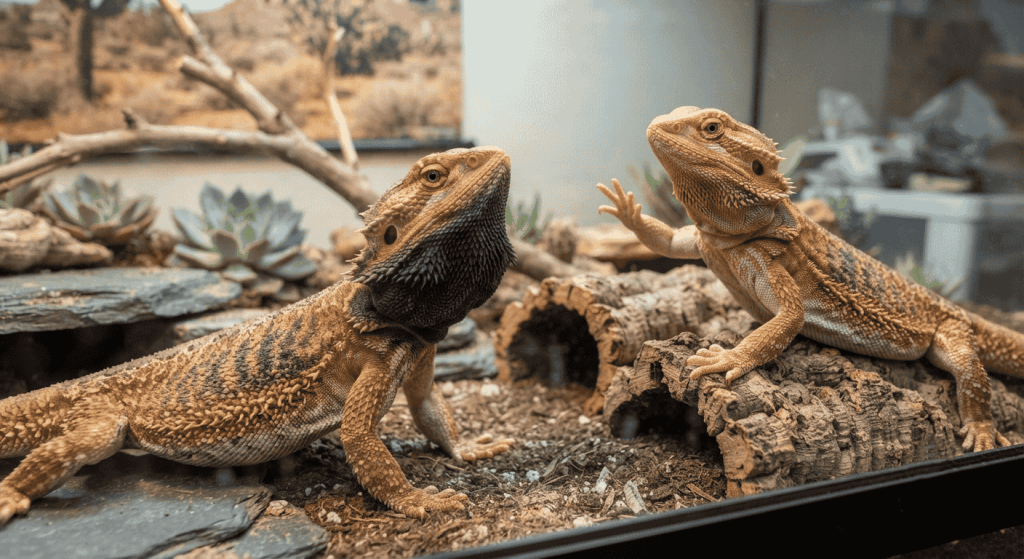
Head bobbing (vigorous and rapid)
Darkening of the beard
Chasing the female around the enclosure
Nudging or licking the female on her back and sides
If the female is receptive, she may respond with arm waving (a submissive gesture).
What if she’s not interested? She might:
Try to escape
Chase the male and lie on his back (aggressive rejection)
My rule: If she’s not receptive after a few days, separate them and try again later. Forcing it leads to stress and injury.
Step 4: Mating
If the female accepts, the male will:
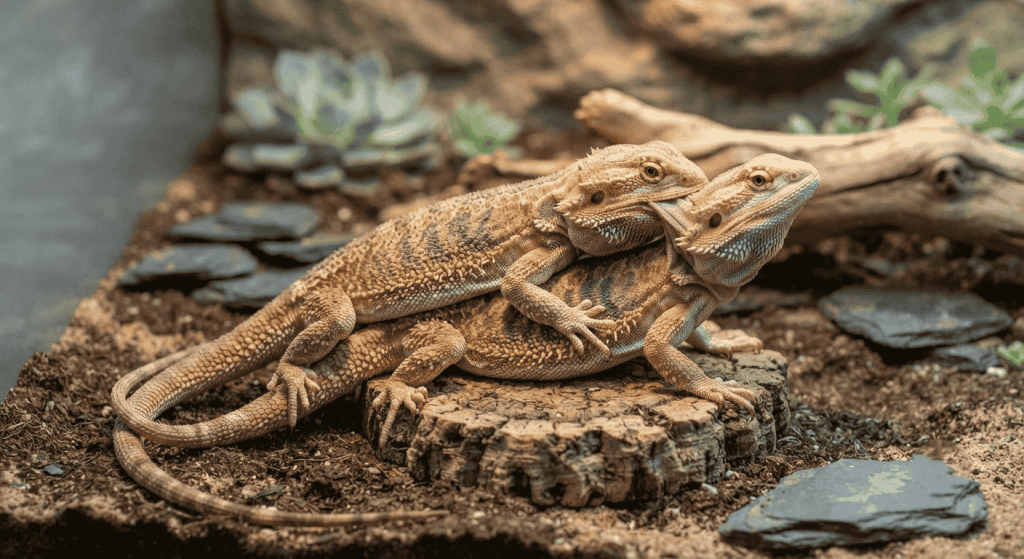
Climb onto her back
Bite her neck to secure his position
Align his cloaca with hers to transfer sperm
The actual mating lasts only a few minutes.
After mating: Remove the female immediately to prevent unnecessary stress.
After Mating: What to Expect
Signs of Gravid (Pregnant) Females
About 2-3 weeks after mating, you’ll notice changes:
Abdomen swelling as eggs develop
Restlessness and frantic digging
Decreased appetite or becoming more restless
Appearance of egg bulges—she may look “like a sock full of marbles”
Egg Laying
Eggs are usually laid 3-6 weeks after mating.
What to do:
Make sure the laying box is ready
Let her dig and lay undisturbed
After she lays, carefully dig out the eggs
Important: When handling eggs, don’t rotate them from the position they were laid in. The embryo orientates itself in a specific direction, and rotating can kill it.
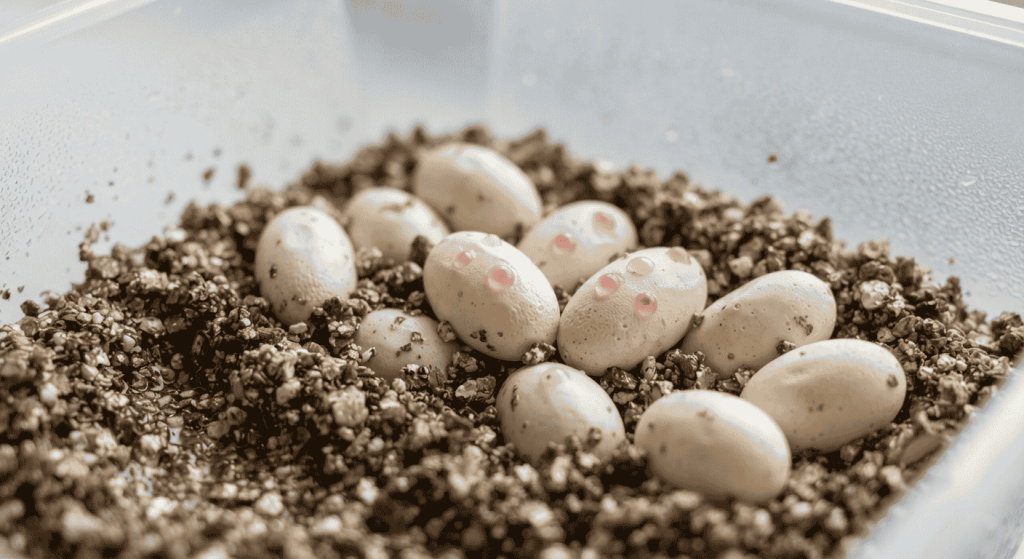
Fertile eggs are white, puffy, and you’ll see a pink dot (the embryo) inside.
Number of Eggs
A female can lay 10-30 eggs per clutch, with up to 24 eggs being common. Some can produce multiple clutches per year—up to 9 clutches!
My experience: Ember laid 22 eggs her first time. I was not prepared for that many babies.
Incubating the Eggs
Temperature (Critical!)
The ideal incubation temperature is around 84°F (29°C).
The safe range is 80-88°F.
Below 80°F: Development slows
Above 88°F: Risk of death
Use a separate thermometer—the incubator’s built-in thermostat may not be accurate.
Humidity
Aim for 70-90% humidity, ideally around 75-80%.
Too dry: Eggs dry out and die
Too wet: Mold develops
Pro tip: Mist lightly every few days, but avoid water droplets sitting on top of the eggs.
Incubation Medium
Use damp vermiculite or perlite:
Mix with water until damp but not dripping
It should clump together when squeezed but not release water
Incubation Period
Eggs typically hatch in 50-80 days, with about 60 days being average.
Signs of hatching:
Eggs may deflate 24-48 hours before hatching
You’ll see the babies pipping (breaking through)
Temperature-Dependent Sex Determination
Here’s something cool: incubation temperature determines the sex of the babies!
Temperature
Likely Sex
~80°F (27°C)
Mostly females
~90°F (32°C)
Mostly males
In between
Mixed
Caring for Hatchlings
Leave them in the incubator until they absorb their yolk sacs. Then transfer them to a separate enclosure with:
Proper heating and UVB lighting
Small, easily accessible food (pinhead crickets, small roaches)
Calcium supplementation
Shallow water dish
A warning: Babies can be aggressive toward each other. You’ll need to separate them as they grow. I learned this the hard way when two of mine started fighting.
The Harsh Reality
Not every egg will hatch. Not every hatchling will survive. This is the hardest part of breeding.
Common problems:
Infertile eggs (they’ll look yellow or opaque)
Egg binding (female can’t lay her eggs)—this is life-threatening and requires immediate vet care
Weak hatchlings (especially from inbred or unhealthy parents)
Failure to thrive (some babies just don’t make it)
The Hardest Lesson: When It All Goes Wrong
My second breeding attempt was a disaster.
One of my females became egg-bound—she couldn’t lay her eggs. She was lethargic, her belly was swollen, and she looked miserable. I rushed her to the vet, where they had to induce laying. She survived, but it was touch-and-go for a while.
What causes egg binding?
Poor nutrition (especially calcium deficiency)
Dehydration
Underlying health problems
Breeding too young
The lesson: Don’t breed without proper nutrition. Supplement heavily with calcium and make sure your female is fully mature.
My Advice to You
Do Your Homework
Read everything you can about bearded dragon genetics
Talk to experienced breeders
Get a veterinary checkup before breeding
Be Prepared for the Commitment
Have space and enclosures ready for babies
Have funds set aside for vet care
Have a plan for rehoming the babies
Start Simple
Don’t start with rare morphs. Learn the basics with healthy, standard-colored dragons first.
Never Rush
Patience is everything. Wait until your dragons are truly ready. Breeding too early can kill your female.
Consider Not Breeding at All
This is a valid choice. The market is often saturated, and many bearded dragons end up in rescues. Breeding should be done for the love of the species, not for profit.
The Magic of It All
Despite the challenges, there’s nothing quite like watching a tiny bearded dragon hatch from its egg. Seeing those little faces emerge, knowing you played a part in bringing them into the world—it’s genuinely magical.
But that magic comes with responsibility. Every dragon you bring into the world deserves a good life. Make sure you can provide that before you start.
FAQ
Before Breeding
Q: What age should bearded dragons be before breeding?
A: Females should be at least 24 months (2 years) old, and males should be at least 18 months old. While bearded dragons can breed as early as 8 months, breeding too young can stunt growth, increase the risk of egg binding, and shorten their lifespan.
Q: What weight should a female bearded dragon be before breeding?
A: Females should weigh at least 350 grams before breeding. Some breeders recommend 350-400 grams for optimal health. Males should be at least 300 grams.
Q: What size should bearded dragons be before breeding?
A: Both dragons should be at least 18 inches in length from snout to tail.
Q: Do I need to take my dragons to the vet before breeding?
A:Absolutely. Before breeding, both dragons need a veterinary exam including fecal testing for parasites and testing for adenovirus. This is non-negotiable—breeding unhealthy dragons can lead to serious problems.
Q: Can I breed related bearded dragons?
A: Responsible line breeding takes a lot of consideration. Breeding related individuals (line breeding) can lead to weakened immune systems, deformities, and failure to thrive in babies. Some morph combinations like translucent-to-translucent can cause birth defects and should be avoided.
Breeding Process
Q: How do I introduce a male and female for breeding?
A: Bring the female into the male’s enclosure, not the other way around. This reduces territorial stress on the female. Introduce them for about a week, then separate them for a week to prevent over-mating. Male bearded dragons bite the neck of the female during breeding to ensure she doesn’t run off.
Q: What are the signs of courtship in bearded dragons?
A: The male will display vigorous head bobbing, darkening of the beard, and chasing the female. He may also nudge or lick the female on her back and sides. If receptive, the female may respond with arm waving (a submissive gesture).
Q: How long after mating do bearded dragons lay eggs?
A: Eggs are usually laid 3-6 weeks after mating. The interval between breeding and egg laying will be about four to six weeks.
Q: How many eggs do bearded dragons lay?
A: A female can lay 10-30 eggs per clutch, with up to 24 eggs being common. They can produce up to 5 clutches per season.
Egg Incubation
Q: What temperature should bearded dragon eggs be incubated at?
A: The ideal incubation temperature is around 84°F (29°C). The safe range is 80-88°F. Below 80°F slows development; above 88°F risks death.
Q: How does incubation temperature affect the sex of hatchlings?
A: Bearded dragons have temperature-dependent sex determination: ~80°F (27°C): Mostly females ~90°F (32°C): Mostly males In between: Mixed
Q: What humidity do bearded dragon eggs need?
A: Aim for 70-90% humidity, ideally around 75-80%. Too dry and eggs dry out; too wet and mold develops.
Q: How long do bearded dragon eggs take to hatch?
A: Eggs typically hatch in 50-80 days, with about 60 days being average.
Q: How can I tell if bearded dragon eggs are fertile?
A:Fertile eggs are white and puffy, with a visible pink dot (the embryo) inside. Infertile eggs look yellow or opaque.
Hatchling Care
Q: What do baby bearded dragons eat?
A: Hatchlings need pinhead crickets, small roaches, and calcium supplementation. They have tiny mouths, so prey must be appropriately sized.
Q: Do baby bearded dragons need special setup?
A: Yes. Hatchlings need separate enclosures with: Proper heating and UVB lighting Small, easily accessible food Calcium supplementation Shallow water dish
Q: Can baby bearded dragons live together?
A:Babies can be aggressive toward each other and will need to be separated as they grow. Housing them together can lead to fighting and injury.
Health and Safety
Q: What is egg binding and why is it dangerous?
A: Egg binding is when a female can’t lay her eggs. It’s life-threatening and requires immediate veterinary care. Causes include poor nutrition (especially calcium deficiency), dehydration, underlying health problems, and breeding too young.
Q: What are the signs of a gravid (pregnant) female?
A: Signs include: Abdomen swelling (appears 2-3 weeks after mating) Restlessness and frantic digging Decreased appetite “Sock full of marbles” appearance
Q: Can I breed bearded dragons year-round?
A: Yes. Bearded dragons that are kept as pets can be bred year-round.
Ethics and Responsibility
Q: Is breeding bearded dragons profitable?
A: It’s rarely profitable for first-time breeders. The market is often saturated, and many bearded dragons end up in rescues. Breeding should be done for the love of the species, not for profit.
Q: Should beginners breed bearded dragons?
A: Most experts recommend that beginners should not start with breeding. It requires time, money, space, and a willingness to deal with heartbreak. Start by learning the basics of care first.
Q: What should I do if I can’t find homes for the babies?
A: Have a plan for rehoming before you start breeding. The market is often saturated, and you may need to keep babies longer than expected. Consider working with local reptile rescues.