
How Do Leopard Geckos Mate? A Complete Step-by-Step Guide with Pictures
If you’re thinking about breeding leopard geckos, or you’re just curious about how these fascinating little lizards reproduce, you’ve come to the right place. Leopard
If you’re thinking about breeding leopard geckos, or you’re just curious about how these fascinating little lizards reproduce, you’ve come to the right place. Leopard
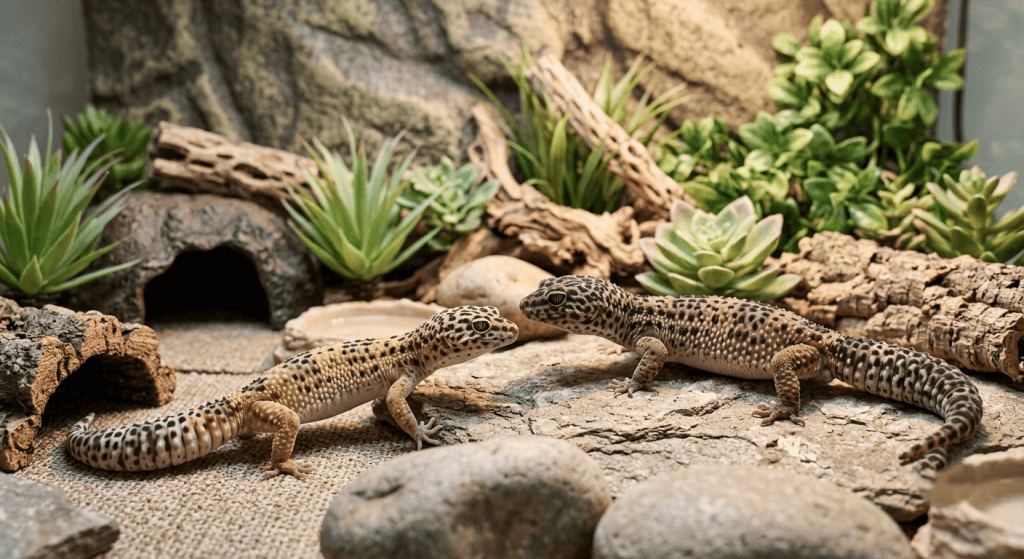
If you’re thinking about breeding leopard geckos, or you’re just curious about how these fascinating little lizards reproduce, you’ve come to the right place.
Leopard geckos are one of the most popular pet reptiles in the world—and for good reason. They’re docile, easy to care for, and relatively straightforward to breed. But understanding exactly how the mating process works is essential if you want to do it successfully and safely.
Let me walk you through everything, step by step, from courtship to egg-laying.
Before you even think about putting a male and female together, you need to make sure they’re actually ready.
Age matters:
Weight matters even more:
Health check:
Both geckos should be free of parasites and illness. If you’re unsure, take them to an exotic vet for a checkup before breeding.
Leopard geckos have a natural breeding season. In the Northern Hemisphere, this typically runs from January through September. Some sources say it starts around March and continues through summer.
The key takeaway: Spring and summer are your best windows for breeding. Trying to breed outside this season can be difficult because their natural reproductive cycle is tied to temperature and daylight changes.
Some breeders simulate winter conditions (cooler temperatures and shorter days) for 1-2 months before gradually warming things up to trigger breeding behavior. This is called “cycling”.
So you’ve got a healthy male and a healthy female. Now what?
The setup:
Place the male into the female’s enclosure, not the other way around. This reduces territorial stress because the female is already comfortable in her space.
What happens next:
The male will locate the female and begin following her around the enclosure. This is the beginning of the courtship process.
This is where things get interesting. Male leopard geckos put on quite a show to impress females.
Tail vibration:
The male will vibrate or rattle the tip of his tail rapidly. This is a clear signal to the female that he’s interested and ready to mate. You can actually hear the vibration if you’re close enough—it makes a faint buzzing sound.
Head bobbing:
He’ll bob his head up and down while approaching her.
Tail waving:
He may wave his tail from side to side as part of the display.
Clicking sounds:
Some males make clicking noises with their mouths during courtship.
Scent checking:
The male will approach the female and lick her body to pick up chemical cues (pheromones) that tell him she’s ready to mate. Male leopard geckos use skin-derived chemicals to determine the sex of other geckos. They also use secretions from their femoral pores to sense whether they’re dealing with a potential mate or a rival.
Now it’s up to the female. She has two choices.
If this happens, separate them immediately and try again another day. Forced mating can lead to serious injuries.
Courtship can take anywhere from several minutes to several hours, depending on how interested the female is. If she’s receptive, the actual mating can begin.
Once the female accepts, here’s what happens:
1. The male bites the female’s neck:
The male will grasp the female’s neck skin in his mouth. This may look aggressive—and sometimes it is—but it’s a normal part of leopard gecko mating.
The male may start by gently biting the base of her tail and work his way up to her neck. Mating can be a rough affair, and it’s not uncommon for females to get small bite wounds on their necks or lips.
2. The male positions himself:
He’ll align his body with hers and bring his hind leg over the base of her tail.
3. Tail locking and insertion:
If the female is receptive, she’ll gape her cloaca (the all-purpose opening for reproduction and waste), allowing the male to insert one of his hemipenes. Hemipenes are the paired reproductive organs that male lizards possess. Males typically use only one at a time during mating.
4. The actual mating:
The process is usually brief—lasting only 2 to 5 minutes. During this time, the male transfers sperm to fertilize the female’s eggs.
What does it look like?
The geckos will lock tails and remain relatively motionless for several seconds while mating occurs. Then the male will wiggle free and move away from the female.
Separate them:
It’s crucial to remove the female from the male’s enclosure shortly after mating to prevent stress or potential aggression. Males may try to mate repeatedly, which can exhaust the female.
Sperm storage:
Here’s something amazing: female leopard geckos can store sperm in their reproductive tracts for up to 15 months. This means a single mating can fertilize multiple clutches of eggs throughout the breeding season.
How long until eggs appear?
Females typically lay eggs about 21 to 28 days after mating. Some sources say the gestation period is 16 to 22 days, while others mention around 6 weeks. The exact timing can vary slightly between individuals.
The eggs:
Female leopard geckos usually lay two eggs per clutch. Occasionally, they may lay just one egg, but that’s less common.
The egg-laying box:
Provide a lay box filled with a moist substrate like vermiculite or coconut fiber. The female will dig a hole and bury her eggs in this substrate.
How often?
A female can lay a clutch every 15 to 22 days over a period of 4 to 5 months. Over the course of a breeding season, a successful pair can produce anywhere from 8 to 10 eggs. Some females can lay up to 5 clutches in a season.
Removing the eggs:
Once the eggs are laid, carefully remove them from the enclosure and place them in an incubator to ensure proper development.
Temperature matters—a lot.
The incubation temperature determines the sex of the hatchlings—a phenomenon called Temperature-Dependent Sex Determination (TSD).
| Temperature | Likely Sex |
|---|---|
| ~80°F (27°C) | Mostly females |
| ~90°F (32°C) | Mostly males |
| In between | A mix of both sexes |
Incubation period:
Eggs typically hatch after about 55 days, though the incubation period can range from 6 to 15 weeks depending on temperature.
Pro tip: If you notice the substrate where the eggs are buried looks slanted, that’s a sign the female has laid eggs there.
| Step | What Happens | How Long |
|---|---|---|
| 1. Introduction | Male placed in female’s enclosure | Immediate |
| 2. Courtship | Male tail vibrates, head bobs, licks female, makes clicking sounds | Minutes to hours |
| 3. Female Response | Accepts (lifts tail) or rejects (bites, tail whips) | Seconds |
| 4. Mating | Male bites neck, inserts hemipene, sperm transfer | 2-5 minutes |
| 5. Post-Mating | Separate geckos; sperm stored for multiple clutches | N/A |
| 6. Egg Laying | Female lays 2 eggs in moist lay box | 21-28 days after mating |
| 7. Incubation | Eggs incubated at 80-90°F for 55+ days | 55+ days |
1. Never house two adult males together. They will fight—and it can be bloody.
2. Watch for aggression. If the female bites the male or if the mating gets too violent, separate them immediately.
3. Monitor the female’s health. Egg-laying is physically demanding. Provide extra calcium and vitamin supplements to support her.
4. Don’t over-breed. Laying eggs is stressful and can shorten a female’s lifespan if done too often. Limit breeding to once or twice per year.
5. Have a plan for the babies. Before you breed, think about what you’ll do with the hatchlings. Some females can lay 16 eggs in their first year. Do you have buyers or rehoming options lined up?
How do I know if my leopard geckos are mating?
The most obvious sign is observing the behavior itself—the male grasping the female’s neck, tail locking, and the brief physical coupling.
Can female leopard geckos have babies without a male?
No. They can lay unfertilized eggs (called “slugs”), but these won’t hatch.
How do I tell if I have a male or female?
Males have a pronounced hemipenile bulge under their tail. Females don’t. Both sexes have a V-shape of pores at the base of their tail, but males have much deeper pores and often a waxy substance visible in them.
How many times can leopard geckos breed in a season?
A female can lay a clutch every 2-3 weeks for 4-5 months. However, responsible breeders limit this to prevent health problems.
Breeding leopard geckos can be an incredibly rewarding experience. Watching the courtship ritual, seeing the eggs develop, and eventually holding a tiny hatchling in your hand—it’s amazing.
But it’s also a responsibility. These are living creatures, not just a science experiment. Make sure you’re prepared for the time, effort, and expense involved before you start. And always prioritize the health and wellbeing of your geckos over the excitement of producing babies.
If you have any doubts, consult a reptile veterinarian or an experienced breeder. They can give you personalized advice based on your specific geckos and setup.
Good luck, and happy breeding!
Disclaimer
This article is for educational and informational purposes only.
Hi, I’m [Huma Sham]. I’ve been fascinated by exotic pets for years and love helping people understand these incredible creatures. When I’m not writing, I’m usually reading about wildlife or spending time with my own leopard gecko. Thanks for reading!
How Casinos Are Rebounding After COVID-19: Recovery Strategies Revealed The COVID-19 pandemic has had a
Олимп казино официальный сайт в Казахстане – Olimp Casino ▶️ ИГРАТЬ Содержимое Преимущества игры в
Олимп казино официальный сайт в Казахстане – Olimp Casino ▶️ ИГРАТЬ Содержимое Преимущества игры в
Олимп казино официальный сайт в Казахстане – Olimp Casino ▶️ ИГРАТЬ Содержимое Преимущества игры в
Олимп казино официальный сайт в Казахстане – Olimp Casino ▶️ ИГРАТЬ Содержимое Преимущества игры в
Олимп казино официальный сайт в Казахстане – Olimp Casino ▶️ ИГРАТЬ Содержимое Преимущества игры в